HOA Karen Shut Off My Grill—Then the HOA President Asked Why She Ruined His Barbecue
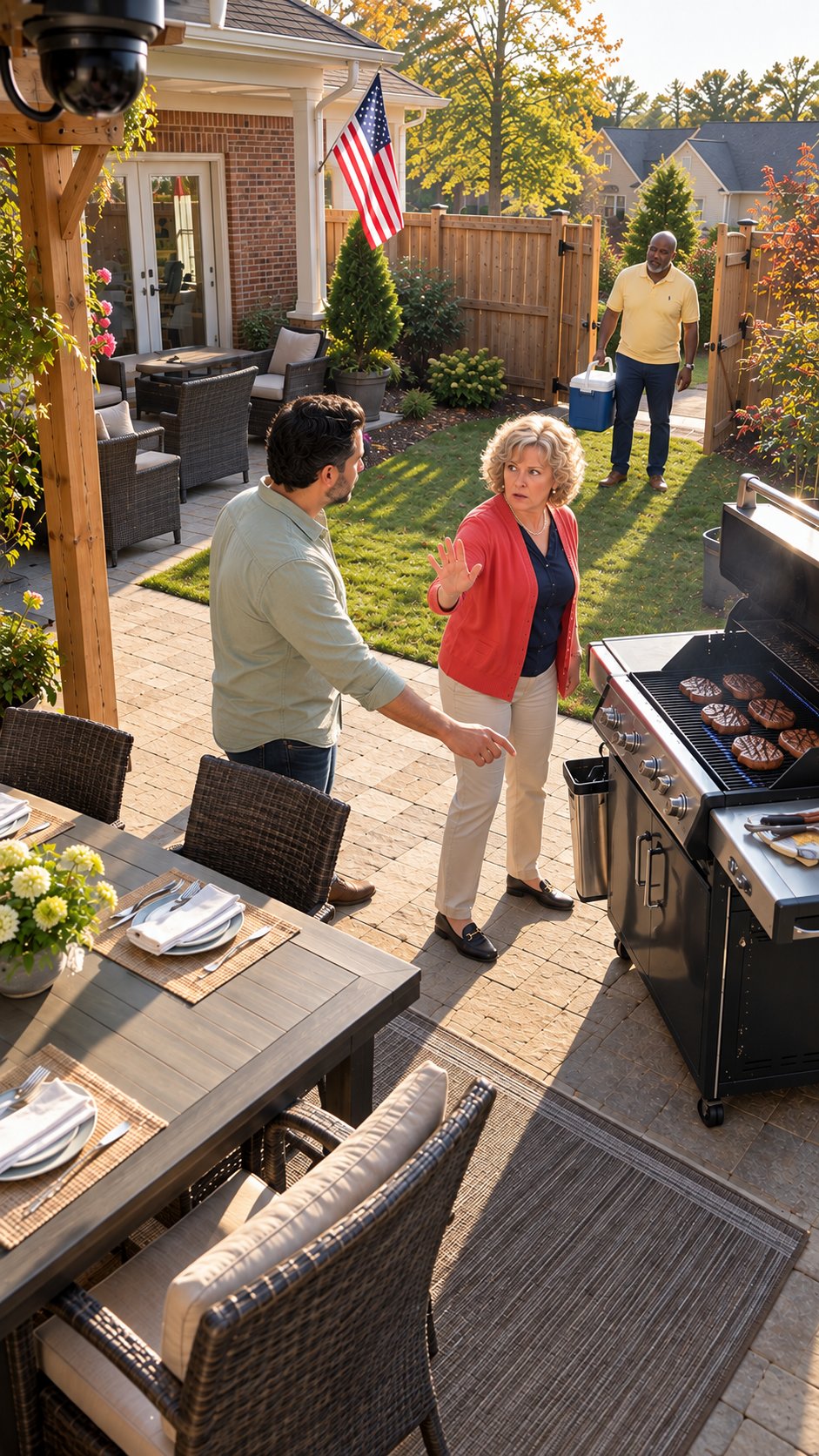
Karen was already touching my grill when I walked outside.
Not standing beside it.
Not looking at it.
Touching it.
Her right hand was wrapped around one of the control knobs of my stainless-steel propane grill, and the burner she'd just shut down gave one final blue flicker before going dark.
Four ribeye steaks were sitting over the grates.
A tray of corn waited on the side table.
Smoke curled into the warm Virginia evening.
I stopped in the doorway.
“STEP AWAY FROM IT.”
Karen Whitmore spun around.
She was fifty-eight, wore white slacks, a navy blouse, and the expression of someone who believed being confronted on somebody else's patio was somehow an inconvenience to her.
She pointed at the steaks.
“THAT FILTH IS BANNED!”
I stared at her.
“You entered my yard to shut down my dinner?”
Karen stepped toward me.
“I'LL SHUT DOWN EVERY DAMN GRILL IN THIS NEIGHBORHOOD!”
For about three seconds, neither of us moved.
Then I walked straight toward the grill.
Karen lifted one hand.
“Don't.”
I reached past her.
Turned the burner back on.
CLICK.
WHOOSH.
Blue flame returned beneath the steaks.
Karen's face went red.
“DON'T YOU DARE!”
“My grill.”
“You are violating community fire regulations!”
“My backyard.”
“That doesn't exempt you!”
I looked toward the wooden gate.
It was hanging open.
I always kept it latched because of my dog.
Which meant Karen hadn't accidentally wandered in.
She'd opened it.
Entered.
Walked across my patio.
Then shut off my grill.
I pointed toward the gate.
“Leave.”
Karen folded her arms.
“Not until that grill is off.”
“Then we're going to have a problem.”
“You already have one.”
She reached toward the controls again.
I stepped between her and the grill.
“Don't touch it.”
She stopped.
Then smiled.
“You think because you bought this house three months ago, you can ignore the rules?”
“I've read the rules.”
“Obviously not.”
“Show me the rule.”
Karen opened her mouth.
Before she could answer—
the backyard gate swung wider behind her.
A man stepped through carrying a large blue cooler.
He was sixty-two, broad-shouldered, gray-haired, wearing khaki shorts and a faded University of Virginia T-shirt.
Karen turned.
I recognized him immediately.
Thomas Reed.
President of the Cedar Ridge Homeowners Association.
He looked at Karen.
Then at me.
Then at the steaks.
Then at the cooler in his hand.
Finally, he looked back at Karen.
“Why are you ruining my barbecue?”
Silence.
Karen blinked.
“Your what?”
Thomas lifted the cooler.
“My barbecue.”
I folded my arms.
Karen looked from him to me.
Then back again.
“You're eating here?”
Thomas frowned.
“Yes.”
“But he's using a propane grill.”
“I noticed.”
“Tom, those are prohibited.”
“No, they're not.”
Karen froze.
Thomas set the cooler on my patio table.
Inside were beer, soda, sparkling water, and enough potato salad to feed twelve people.
He straightened.
“Where did you get that idea?”
Karen pointed toward the grill.
“Section nine.”
Thomas stared at her.
“Section nine of what?”
“The fire-safety amendment.”
“There is no fire-safety amendment banning backyard grills.”
“Yes, there is.”
“No.”
“I've been enforcing it for two weeks.”
Thomas's expression changed.
That sentence mattered.
He spoke more slowly.
“You've been doing what?”
Karen realized too late that she'd said the wrong thing.
I looked at Thomas.
He looked at me.
Then at the open gate.
“How did she get back here?”
I answered:
“She opened my gate.”
Thomas turned to Karen.
“You entered Jason's fenced backyard?”
Karen lifted her chin.
“I was conducting a compliance inspection.”
Thomas stared at her.
“No, you weren't.”
“I am chair of the Community Standards Committee.”
“That doesn't give you permission to enter fenced private areas.”
Karen's voice sharpened.
“I could see smoke.”
Thomas looked at my grill.
Then at the thin stream of smoke rising from four steaks.
“It's a barbecue, Karen.”
“It's a fire hazard.”
Thomas pointed toward the cooler.
“I brought bratwurst.”
For the first time since I'd walked outside, I almost laughed.
Karen did not.
She pointed at him.
“You're the HOA president. You should be enforcing the rules.”
“I am.”
“Then make him shut it down.”
Thomas looked at me.
“Jason?”
“Yeah?”
“How do you like your steak?”
“Medium rare.”
He nodded.
“Don't let Karen make you burn it.”
Then he turned toward her.
“Please leave his property.”
That should have ended it.
It didn't.
Because Karen Whitmore hadn't come into my backyard because of four steaks.
The grill was just the latest thing she had decided she could control.
And by the end of that summer, we would discover that mine wasn't the only backyard she'd entered.
My name is Jason Cole.
I was thirty-nine when I bought the house on Hawthorne Lane in Cedar Ridge.
I worked as a project manager for a commercial construction company in Richmond.
I wasn't married.
No kids.
One dog named Murphy.
Murphy was an eight-year-old black Labrador whose two major interests were food and pretending he hadn't recently been fed.
I moved into Cedar Ridge because I wanted less house than I'd owned before and more backyard than my apartment had offered after my divorce.
The neighborhood was about twenty-five years old.
Mature trees.
Sidewalks.
Brick-front houses.
A community pool.
Small clubhouse.
Two tennis courts.
Nothing luxurious.
Nothing terrible.
The HOA dues were reasonable.
The covenants were boring.
That was exactly what I wanted.
I had spent eleven years in a marriage that ended with more conflict than either of us was proud of.
My ex-wife and I eventually reached a decent place.
But after the divorce, I developed a deep appreciation for quiet.
I wanted a house.
A grill.
A dog.
A lawn I could mow badly without someone conducting an investigation.
Cedar Ridge seemed perfect.
Then I met Karen.
She introduced herself twelve hours after my moving truck arrived.
I was carrying a box into the garage.
“New owner?”
I turned.
A woman stood at the end of my driveway holding a clipboard.
“Yes.”
“Karen Whitmore.”
She didn't offer a hand.
“Community Standards Committee.”
I set down the box.
“Jason Cole.”
“I know.”
That should've warned me.
She looked at the moving truck.
“How long will that remain?”
“The truck?”
“Yes.”
“Until we're done unloading.”
“When?”
I looked at the two movers carrying my sofa.
“Hopefully before they retire.”
She didn't smile.
“Commercial vehicles can't remain overnight.”
“Good thing it won't.”
She looked at Murphy.
“Dogs must be leashed.”
“He's inside.”
“I saw him earlier.”
“In my house?”
“In the doorway.”
I waited.
Karen checked something on her clipboard.
“Trash collection is Tuesday. Containers can't be visible from the street except during the approved period.”
“Got it.”
“Grass maximum is four inches.”
“Okay.”
“No exterior modifications without approval.”
“Understood.”
“No recreational vehicles.”
“Don't own one.”
“No poultry.”
“Murphy will be devastated.”
She stared.
“Your dog?”
“Yes.”
“Why?”
“He was hoping for chickens.”
Still nothing.
Karen turned and walked away.
One mover came out behind me.
“Friend of yours?”
“Apparently.”
Thomas Reed introduced himself that evening.
Completely different experience.
He knocked.
Handed me a folder.
“Welcome to Cedar Ridge.”
“Thanks.”
“I'm Tom. HOA president.”
I looked down the street.
“Then who was the woman with the clipboard?”
Thomas sighed.
“Karen.”
“You know her?”
“Unfortunately, yes.”
That was the first time I laughed in Cedar Ridge.
Thomas explained the basics.
The HOA had five board members.
Karen wasn't on the board.
She chaired a volunteer Community Standards Committee that helped flag possible covenant issues for management review.
Thomas emphasized flag.
Not decide.
Not punish.
Not enter property.
Flag.
The management company handled formal notices.
The board handled disputes and hearings.
Thomas said:
“Most people here are normal.”
“Comforting.”
“I mean it.”
“That's exactly what someone says before telling me they're all insane.”
He laughed.
“You'll be fine.”
He was right.
Mostly.
My immediate neighbors were great.
On one side lived Ben and Alicia Morales with their two kids.
On the other lived a retired teacher named Carol Brennan.
Across the street was a young couple, Marcus and Hannah Lee.
People waved.
People borrowed tools.
Children left bicycles in driveways.
Someone's lawn was always slightly too long.
Nobody died.
For my first month, Karen was mostly background noise.
Then I bought the grill.
It was a six-burner stainless-steel propane grill.
Too large for one man.
I knew that.
The salesman knew that.
Murphy definitely knew that.
But I liked cooking outside.
My old grill had stayed with my ex-wife because technically her brother had given it to us.
So I bought a new one.
I assembled it on a Saturday.
Thomas walked past while I was fighting with the side burner.
“You feeding the whole neighborhood?”
“Eventually.”
“Good answer.”
Two days later, I received an email from Karen.
Not from the HOA.
From Karen.
SUBJECT: UNAPPROVED OUTDOOR COOKING APPLIANCE
I stared at it.
According to Karen, my grill constituted an “external heat-producing installation” and required committee review.
I opened the covenants.
Searched.
Nothing.
I emailed Thomas.
Does my grill need HOA approval?
His reply arrived nine minutes later.
No.
Then:
Please don't ask Karen that question directly unless you have several free hours.
I laughed.
And ignored her email.
Three days later, a printed notice appeared under my windshield wiper.
It carried no HOA logo.
No management company information.
Just:
NOTICE OF COMMUNITY SAFETY CONCERN
Below that:
PROPANE COOKING DEVICE OBSERVED WITHIN RESIDENTIAL LOT.
I photographed it.
Sent it to Thomas.
He called me.
“Did Karen put this there?”
“I assume.”
“That's not an official notice.”
“I assumed that too.”
“Throw it away.”
“I was thinking of framing it.”
“Don't encourage her.”
I threw it away.
That should've been the end.
Instead, Karen escalated.
She began walking through the neighborhood around dinner time.
Not every night.
Often enough that people noticed.
If someone was grilling, she stopped.
Asked questions.
How far was the grill from siding?
Was the propane tank certified?
Was the grill “permanently stored” outdoors?
One resident told her to get off his driveway.
Another laughed.
A third actually moved his grill because Karen told him he'd receive a $250 fine.
That was when the problem became more serious.
The HOA had not authorized any grill fine.
Thomas found out when the homeowner called management asking how to pay it.
There was no fine.
No violation.
No case.
Thomas told Karen to stop giving residents unofficial enforcement instructions.
She agreed.
At least, that's what she told him.
Then she created the “fire-safety amendment.”
It wasn't entirely invented.
That was what made the situation confusing.
Six years earlier, Cedar Ridge had adopted rules limiting open flames in certain common areas.
No charcoal grills at the pool.
No personal grills on clubhouse grounds.
No fire pits in common green spaces.
Reasonable rules.
The association's insurance carrier had recommended them.
Karen took language from that rule and began describing it as a community-wide prohibition.
She left out the words COMMON AREA.
Most people never read the full rule.
They heard:
HOA.
Fire.
Insurance.
Ban.
And assumed she knew what she was talking about.
I didn't know any of that the afternoon of my barbecue.
All I knew was Thomas was coming over.
So were Ben and Alicia.
Carol.
Marcus and Hannah.
A few other neighbors.
Nothing formal.
I'd told people:
“I'm cooking Saturday. Bring something or don't.”
Thomas volunteered bratwurst.
I bought steaks.
Alicia was bringing salad.
Carol promised dessert.
At 4:45, I put the steaks on.
At 4:49, Murphy started barking inside.
I went into the kitchen to check on him.
At 4:51, Karen entered my backyard.
I know the exact time because my security camera recorded it.
I'd installed cameras after a package theft at my previous apartment.
Front door.
Driveway.
Back patio.
Nothing sophisticated.
The backyard camera covered the patio, gate, grill area, and part of the lawn.
It recorded Karen approaching the closed gate.
She stopped.
Looked toward my house.
Tried the latch.
Opened it.
Walked in.
She didn't call my name.
Didn't knock.
Didn't announce herself.
She went directly to the grill.
Looked at the steaks.
Reached for the controls.
That's when I came outside.
Everything afterward was recorded too.
Including:
“THAT FILTH IS BANNED!”
And:
“I'LL SHUT DOWN EVERY DAMN GRILL IN THIS NEIGHBORHOOD!”
And Thomas arriving with his cooler.
And the expression on his face when she said:
“I've been enforcing it for two weeks.”
After Thomas told her to leave, Karen didn't move.
“This association has a duty to protect residents.”
Thomas said:
“Not by entering fenced yards.”
“Someone has to enforce safety.”
“Management enforces violations after proper review.”
“They aren't doing anything.”
“Because backyard grills aren't prohibited.”
“They should be.”
“That is a different argument.”
Karen pointed toward my house.
“What happens when his siding catches fire?”
I answered:
“My grill is on a stone patio more than ten feet from the house.”
She turned toward me.
“Don't interrupt.”
I stared at her.
Thomas said:
“Karen.”
She ignored him.
“You people treat everything like a joke until someone's home burns down.”
Something in her voice changed.
The anger was still there.
But beneath it was something else.
Fear.
Thomas noticed too.
His expression softened slightly.
“Karen, we're not discussing fire policy in Jason's backyard.”
“Why not?”
“Because he told you to leave.”
She looked around.
By then Ben and Alicia had arrived at the open gate.
They'd heard shouting.
Alicia was holding a bowl of salad.
Ben looked at me.
“You good?”
“Yeah.”
Karen pointed at them.
“Tell him propane grills are dangerous.”
Ben looked at my grill.
Then at Karen.
“I was planning to eat.”
That did not help.
Thomas repeated:
“Karen, leave.”
This time she did.
She walked through the gate.
Then turned.
“When something happens, don't say I didn't warn you.”
She left.
Ben watched her go.
Then looked at Thomas.
“Is she always like that?”
Thomas sighed.
“Not always.”
Alicia asked:
“Are we still eating?”
I checked the steaks.
Two were overcooked.
“One of us isn't.”
Thomas opened his cooler.
“That's why I brought bratwurst.”
The barbecue went ahead.
Karen became the main topic for about fifteen minutes.
Then people moved on.
Kids ran through my yard.
Murphy stole half a hot dog.
Carol brought peach cobbler.
Thomas burned one bratwurst while criticizing my grill technique.
By sunset, the incident almost felt funny.
Almost.
Then Carol said:
“She came into my yard too.”
Conversation stopped.
I looked at her.
“When?”
“Thursday.”
Thomas put down his drink.
“What?”
Carol nodded.
“I was upstairs. I saw her from the window.”
“Why didn't you tell me?”
“I thought she was just being Karen.”
“What did she do?”
“Put something on my patio table.”
“What?”
“A notice about my fire pit.”
Thomas stared.
“You have a gas fire table.”
“Yes.”
“Did she enter through your gate?”
“Yes.”
“Was it closed?”
“Yes.”
Thomas rubbed his forehead.
Alicia said:
“She did that to the Fergusons.”
Thomas looked up.
“What?”
“They told me she went behind their house because of a smoker.”
I asked:
“How many houses has she been entering?”
Nobody knew.
Thomas's barbecue was suddenly less relaxing.
The next morning, Thomas emailed the entire board.
He didn't accuse Karen of crimes.
He didn't declare her guilty of anything.
He asked a simpler question.
Had anyone authorized Community Standards volunteers to enter fenced private areas?
Every answer was no.
Management confirmed it.
The HOA's attorney confirmed it.
Committee volunteers could observe conditions visible from streets and common areas.
They could report complaints.
They could communicate when authorized.
They could not treat private residential yards as inspection zones simply because the properties were inside the HOA.
That distinction should have been obvious.
Apparently it wasn't.
Thomas called me Sunday afternoon.
“Do you still have the video?”
“Yes.”
“Save the original.”
“Already did.”
“Would you provide a copy to management?”
“Yes.”
He paused.
“Jason, I'm sorry.”
“You didn't send her.”
“I know.”
“You told her to leave.”
“I know.”
“Then why are you apologizing?”
“Because she was using an HOA role when she entered your yard.”
Fair.
I appreciated that.
Then I asked:
“What's going on with her?”
Thomas was quiet.
“What do you mean?”
“That wasn't normal rule-enforcement enthusiasm.”
“No.”
“She looked genuinely terrified of the grill.”
Thomas sighed.
“There's history.”
“What history?”
“Not mine to tell.”
I respected that.
For about forty-eight hours.
Then Karen told me herself.
She came back Monday.
This time she knocked on the front door.
Progress.
I opened it but didn't invite her inside.
She held a folder.
“I want to explain.”
I looked at the folder.
“Does the explanation require entering my backyard?”
“No.”
“Good start.”
She didn't appreciate the joke.
“I was wrong to open your gate.”
“Yes.”
“I shouldn't have touched your grill.”
“Yes.”
“But I am not wrong about the danger.”
There it was.
I leaned against the doorframe.
“Karen, you can believe propane grills are dangerous.”
“They are.”
“So are cars.”
“That's ridiculous.”
“Cars can cause fires.”
“That's not the same.”
“No. It's an example.”
She opened the folder.
Inside were photographs.
One showed a burned house.
Not Cedar Ridge.
I looked at her.
“What is this?”
“My sister's house.”
The tone changed instantly.
I stopped joking.
The photograph showed severe damage along the rear of a two-story home.
Charred siding.
Blackened windows.
Part of a deck destroyed.
Karen said:
“Fourteen years ago.”
I waited.
“My brother-in-law left a grill too close to the deck railing.”
I looked at the picture again.
“What happened?”
“The fire spread into the house.”
“Was anyone hurt?”
“My sister was burned.”
I looked at Karen.
“I'm sorry.”
“She spent seventeen days in the hospital.”
That explained the fear.
It didn't justify entering my yard.
Both things could be true.
Karen said:
“People don't understand how quickly it happens.”
“I understand why this matters to you.”
“No, you don't.”
“Probably not.”
She looked surprised by the answer.
I continued:
“But you still can't come into my yard and shut off my grill.”
Her face hardened again.
“That's exactly the problem.”
“What is?”
“Everyone waits until after.”
“After what?”
“After the accident.”
I nodded toward the folder.
“So propose an actual safety rule.”
“I did.”
“To whom?”
“The board.”
“What happened?”
“They watered it down.”
That was new information.
Thomas later explained.
Karen had proposed a complete ban on outdoor grills, smokers, and fire pits anywhere in Cedar Ridge.
The board asked the association's attorney and insurance broker to review the proposal.
The response was not:
Grills are perfectly safe.
It was:
A blanket ban wasn't necessary based on the information available.
The board instead considered safety guidance.
Clearances.
Equipment condition.
Common-area restrictions.
Reminders about manufacturer instructions.
Local fire requirements.
Karen considered that cowardice.
She wanted prohibition.
When the board declined, she apparently decided an old common-area rule gave her enough language to enforce one herself.
It didn't.
I told Karen:
“You don't get to rewrite the rule because the board rejected your version.”
“Then what do you suggest?”
“Start with not touching other people's property.”
She closed the folder.
“You think this is funny.”
“No.”
“You were laughing Saturday.”
“At Thomas bringing bratwurst into an argument about banned grills.”
Her mouth tightened.
“That was irresponsible.”
“Karen.”
“What?”
“I believe you about your sister.”
She stopped.
“I believe that fire scared you.”
Her eyes shifted.
“But fear doesn't give you authority you don't have.”
For several seconds, she said nothing.
Then:
“When someone's house burns, remember you said that.”
She walked away.
No apology.
Not yet.
The board suspended the Community Standards Committee's inspection activity while it reviewed procedures.
That sentence caused a neighborhood explosion.
Not a real explosion.
A Facebook explosion.
Some residents thought the HOA was finally stopping “Karen patrol.”
Others thought the board was abandoning standards.
One person claimed the HOA was now allowing “open bonfires.”
Nobody had proposed open bonfires.
Another claimed insurance would cancel every homeowner policy.
Also false.
Thomas posted a painfully boring clarification.
It was exactly what the neighborhood needed.
The HOA had not banned backyard grills.
Existing common-area flame restrictions remained.
Residents were expected to comply with applicable laws, manufacturer requirements, and any valid HOA provisions.
Committee members were not authorized to enter fenced private areas without permission.
That was it.
Then the stories started.
Carol.
The Fergusons.
A man named David Kim.
The Morales family.
Even Marcus Lee across the street.
Karen had entered or attempted to enter several yards over the previous month.
Sometimes the gate was open.
Sometimes closed.
At two houses, she merely left notices.
At one, she photographed a grill from inside the yard.
At another, she allegedly moved a portable fire pit several feet away from a fence.
Nobody reported physical confrontation.
Nobody claimed she stole anything.
But the pattern was obvious.
She believed her committee role allowed physical inspection.
It didn't.
The strangest case involved David Kim.
He had an electric grill.
Karen still cited it.
I asked him:
“For fire?”
He nodded.
“Apparently.”
“Did you tell her it's electric?”
“Three times.”
“What did she say?”
“That electricity causes fires.”
I couldn't argue with the literal statement.
David smiled.
“She has achieved a level of technical correctness that is almost useless.”
That became my favorite description of Karen.
Management sent Karen a formal instruction.
She was not to conduct independent inspections.
She was not to represent unofficial notices as HOA enforcement.
She was not to enter private fenced areas without permission.
Her committee role was suspended pending board review.
Karen responded with a twelve-page email.
Thomas showed me only the first paragraph.
I told him:
“I don't need the rest.”
“Coward.”
“Yes.”
My own incident still needed resolution.
I didn't want money.
Nothing was damaged.
The steaks didn't count.
I wanted written confirmation that Karen had no authority to enter my backyard.
Management provided it.
I also wanted the board to clarify procedures for everyone.
They did.
I considered the matter closed.
Karen didn't.
Two weeks later, I received a certified letter.
Not from the HOA.
From Karen personally.
It alleged my grill created an “imminent hazard” to adjacent properties.
She demanded I relocate it.
I measured the location.
Then I checked the manufacturer's guidance.
Then applicable local requirements.
Then I called the county fire prevention office with a general question about safe placement.
I moved the grill.
By eighteen inches.
Not because Karen ordered me to.
Because during my review, I realized moving it slightly farther from a wooden privacy screen was sensible.
That annoyed me.
I told Thomas.
“Don't tell Karen.”
He laughed.
“Why?”
“She'll think she won.”
“Jason.”
“What?”
“You're allowed to learn something from a person you dislike.”
“I reject that concept.”
“Very mature.”
That became an important part of the whole mess.
Karen was wrong about her authority.
She was wrong about the HOA rule.
She was wrong to enter yards.
She was wrong to touch my grill.
But outdoor cooking actually did involve fire risk.
Pretending otherwise just because Karen was obnoxious would have been stupid.
So Thomas contacted the local fire department.
Not to ask them to ban grills.
To ask whether someone could speak at a voluntary community safety event.
A fire prevention officer agreed.
Karen hated the idea.
Which surprised me.
“You'd think she'd love it,” I told Thomas.
“She doesn't want education.”
“What does she want?”
“Control.”
That was the difference.
The safety event happened at the clubhouse.
I attended mostly because Thomas promised food.
Ironically, the food was cooked outside.
On grills.
Karen sat in the back.
The fire prevention officer talked about equipment condition, safe placement, grease buildup, supervision, propane handling, extinguishers, children, decks, and following manufacturer guidance.
He did not say:
ALL GRILLS ARE FILTH AND MUST BE DESTROYED.
Karen asked:
“Wouldn't the safest policy be to prohibit grills completely?”
The officer considered.
“The safest way to avoid any cooking fire is not to cook.”
Several people laughed.
Karen didn't.
He continued:
“But safety policy is usually about managing risk appropriately, not pretending all risk can be eliminated.”
I looked at Thomas.
Thomas looked at me.
Neither smiled.
We were trying to behave.
The officer added:
“Associations can have their own rules, but that's a legal and governance question. I'm here to talk about fire prevention.”
Perfect answer.
Karen had nowhere to go with it.
Afterward, she approached him privately.
I didn't hear the conversation.
Thomas did.
He later told me Karen showed him the photograph of her sister's burned house.
The officer treated her seriously.
He didn't dismiss her fear.
He also didn't validate her blanket ban.
He explained that traumatic incidents often shape how people perceive risk.
He suggested she channel that concern into education.
Thomas said Karen cried.
That changed how I saw her.
Not enough to excuse anything.
Enough to make her human again.
For several weeks, she disappeared from neighborhood enforcement.
No clipboard.
No evening grill patrol.
No notices.
People joked that Cedar Ridge had entered a golden age.
Then something unexpected happened.
Karen knocked on my door again.
No folder.
No clipboard.
“Do you have a minute?”
“Yes.”
She looked toward the side gate.
“I won't go back there.”
I smiled slightly.
“Appreciated.”
She didn't smile.
“I owe you an apology.”
I waited.
“I entered your property without permission.”
“Yes.”
“I touched your grill.”
“Yes.”
“I misrepresented the common-area rule.”
That one surprised me.
“Yes.”
“I shouldn't have done any of those things.”
I nodded.
“Thank you.”
She looked uncomfortable.
Then:
“I still hate grills.”
I laughed.
She almost did.
“I figured.”
“I probably always will.”
“That's allowed.”
She looked at me.
“You really believe that?”
“Yes.”
“I can think you're wrong?”
“Every day.”
“But I can't shut it off.”
“Now you're getting it.”
This time she did smile.
Barely.
Then she said something I didn't expect.
“Tom told me you moved it.”
I glared toward Thomas's house even though it wasn't visible.
“Traitor.”
Karen actually laughed.
“Eighteen inches?”
“Approximately.”
“Why?”
“Because I reviewed the setup.”
“And?”
“And more clearance was sensible.”
Her expression changed.
Not triumph.
Relief.
“You listened.”
“No.”
Her face tightened.
“I reviewed.”
“That's listening.”
“No, that's research.”
“You're impossible.”
“So I've been told.”
For the first time, we ended a conversation without one of us angry.
The board dissolved the old Community Standards Committee structure.
Not because standards disappeared.
Because the process had become too personality-driven.
The management company took a larger role in initial compliance review.
Resident volunteers could report concerns.
They could not issue unofficial notices.
They could not announce fines.
They could not enter fenced yards.
They could not physically alter conditions.
Formal violations required proper documentation and established procedures.
Thomas called the new policy “boring.”
I said:
“Boring is beautiful.”
He raised his beer.
“To boring.”
Karen remained in Cedar Ridge.
That surprised people.
Some expected her to move after losing the committee role.
She didn't.
She still attended meetings.
Still asked too many questions.
Still complained about landscaping.
Still believed half the neighborhood parked incorrectly.
But something changed.
She began asking:
“Is that an official rule?”
Sometimes before declaring one.
Progress.
The following summer, I hosted another barbecue.
Same patio.
Same grill.
Murphy was older and slower.
Thomas arrived carrying the same blue cooler.
I pointed at it.
“You keep that thing just for dramatic entrances?”
“Yes.”
Ben brought ribs.
Alicia brought salad.
Carol brought peach cobbler again.
David Kim brought something he insisted had been cooked on his “dangerous electric grill.”
At six-thirty, someone knocked on the gate.
Not opened it.
Knocked.
I looked through.
Karen.
She was holding a bowl.
I opened the gate.
“What?”
She lifted the bowl.
“Potato salad.”
I stared.
“Are you lost?”
“No.”
“You understand there's a grill operating approximately fifteen feet from you?”
“I can see it.”
“You want me to shut it off?”
“No.”
Thomas shouted from the patio:
“Karen! You coming in or conducting an inspection?”
She called back:
“Shut up, Tom.”
Everyone laughed.
I stepped aside.
“Come in.”
She did.
With permission.
That mattered.
She stayed about an hour.
Didn't eat steak.
Didn't eat ribs.
Ate salad.
Sat farthest from the grill.
Nobody teased her about her sister.
Nobody should have.
Fear isn't funny simply because it becomes inconvenient.
At one point, Murphy wandered toward her.
Karen scratched his head.
I said:
“He's not HOA approved.”
She looked at me.
“Four-inch grass maximum.”
“What?”
“He told me your lawn is five.”
I laughed.
She smiled.
For a moment, she was just another neighbor.
Then Ben made a mistake.
He asked:
“So what actually happened with your sister?”
The patio went quiet.
Ben immediately looked sorry.
Karen could have refused.
Instead she answered.
“My brother-in-law finished cooking.”
She looked toward my grill but not directly at it.
“He thought everything was off.”
Nobody interrupted.
“There was grease buildup. The grill was near the deck. Something ignited. By the time they noticed, the siding had caught.”
She swallowed.
“My sister went back inside for their dog.”
Alicia whispered:
“Oh.”
“She got burned on her arm and shoulder.”
“Did she get the dog?”
Karen nodded.
“Yes.”
Thomas said quietly:
“I'm sorry.”
Karen looked down.
“She recovered.”
Then:
“But after that, every time I smell a grill, I remember the hospital.”
There it was.
Not regulation.
Memory.
Ben said:
“I didn't know.”
“Most people didn't.”
I asked:
“Why didn't you just tell people?”
Karen gave me a tired smile.
“Because then I would have to admit I was afraid.”
Nobody had a clever answer.
That conversation changed Cedar Ridge more than the board meeting did.
Not because everyone agreed with Karen.
They didn't.
But residents understood her behavior without accepting it.
That distinction mattered.
Empathy didn't require surrendering boundaries.
Karen's sister's fire explained why she panicked around grills.
It did not create permission to open my gate.
My right to use a lawful grill did not require mocking her fear.
Both could be true.
Adults should be able to survive two truths at once.
A few months later, Thomas decided not to run again for HOA president.
He had served four years.
“Why?” I asked.
“Because I want to enjoy my retirement.”
“You're not retired.”
“From this.”
“Coward.”
“Absolutely.”
Residents immediately began asking me to run.
I refused.
Repeatedly.
Then Carol said:
“You complain about everything.”
“I complain about Karen.”
“Leadership experience.”
“No.”
Thomas said:
“You read documents.”
“No.”
David said:
“You're reasonable.”
“Clearly you don't know me.”
Alicia said:
“You have free evenings.”
“I hate all of you.”
I eventually ran.
I blame peer pressure.
I became HOA president the following January.
The first email I received after the election was from Karen.
SUBJECT: CONGRATULATIONS / IMMEDIATE CONCERNS
I didn't open it for six hours.
When I finally did, there were eleven bullet points.
Number four concerned decorative mailbox paint.
Number seven concerned basketball hoops.
Number eleven:
Need annual fire-safety reminder before grilling season.
I stared at that one.
Not ban.
Reminder.
I replied:
Agreed on #11. Management can coordinate with fire prevention again.
Karen responded:
Thank you.
No argument.
I nearly checked whether someone had hacked her account.
Being HOA president taught me something uncomfortable.
It was easy to make fun of associations when you weren't responsible for one.
Then the calls started.
A drainage dispute.
Unpaid assessments.
A homeowner whose tree fell onto common property.
Pool contractor problems.
Insurance renewals.
Reserve studies.
A resident furious about a neighbor's fence.
Another furious that the HOA had rules about fences.
People wanted enforcement when they were complaining.
Freedom when they were being complained about.
Often in the same week.
I began to understand why Thomas always looked tired.
I also understood how someone like Karen could slide from volunteer to self-appointed sheriff.
Residents sometimes rewarded certainty.
If you spoke confidently enough, people assumed you knew the rules.
That was dangerous.
So whenever someone asked:
“Can the HOA do that?”
I stopped answering from memory.
I checked.
Documents first.
Opinions second.
It annoyed everyone.
Good.
Karen became useful in a completely different way.
She was excellent at reading budgets.
Actually excellent.
When our landscaping contract came up for renewal, she found a duplicated seasonal charge nobody else noticed.
It saved the association several thousand dollars.
I told her:
“See? This is a superpower.”
“What?”
“Reading paperwork.”
“I've always read paperwork.”
“Then why did you invent a grill ban?”
She glared.
I smiled.
Too soon.
Even two years later.
Maybe always too soon.
She eventually joined the Finance Committee.
Not Community Standards.
Finance.
Perfect fit.
She asked aggressive questions.
Requested documentation.
Annoyed vendors.
Stayed off private patios.
Everybody won.
Murphy died when I was forty-four.
Cancer.
Fast.
One month he was slowing down.
Two months later, I was holding him at the veterinary clinic while he went to sleep.
I came home to an empty house.
For the first time since buying it, Cedar Ridge felt too quiet.
Neighbors found out.
Food appeared.
Carol brought soup.
Alicia brought enchiladas.
Thomas brought beer.
Karen left something on my porch.
A small framed photograph.
Murphy at the second barbecue.
Sitting beside her chair.
I didn't know she'd taken it.
There was a note.
He was a good dog. Even if his lawn inspections were terrible. — Karen
I sat on my front steps and cried.
Grief does strange things to old conflicts.
It doesn't erase them.
It changes their size.
Karen's husband, Paul, died three years later.
Heart attack.
Sudden.
She was sixty-five.
I attended the funeral.
Afterward, she stood beside me in the church parking lot.
“I don't know what to do with the house.”
“You don't have to decide today.”
“He handled everything outside.”
“Then don't touch anything for a while.”
“The grass will violate the rules.”
I looked at her.
She looked at me.
Then we both laughed.
It was the first time I'd seen her laugh since Paul died.
Ben and I mowed her lawn for most of that summer.
She hated needing help.
We ignored her.
One evening, I brought her mail up from the curb.
She was sitting on the porch.
“Jason?”
“Yeah?”
“Do you remember your first barbecue?”
I laughed.
“Unfortunately.”
“I was awful.”
“Yes.”
“You could soften that.”
“You asked.”
She smiled.
Then:
“I really believed I was protecting people.”
“I know.”
“That almost makes it worse.”
“Why?”
“Because I thought good intentions meant I didn't have to ask permission.”
I sat in the other chair.
“That was the problem.”
She nodded.
“Paul told me that.”
“When?”
“The night after.”
“What did he say?”
Karen smiled faintly.
“He said, ‘You can't trespass for safety, Karen.’”
I laughed.
“Smart man.”
“He usually was.”
We sat quietly.
Then she said:
“I hated you for turning the grill back on.”
“I know.”
“I thought you were trying to humiliate me.”
“I was trying to save the steaks.”
She laughed.
“That makes it worse.”
I served two terms as HOA president.
Then stopped.
Absolutely refused a third.
Thomas sent me a message:
Coward.
I replied:
Absolutely.
By then, Cedar Ridge had changed.
New families.
Older families moving away.
Children becoming teenagers.
Teenagers leaving.
Trees taller.
Roofs replaced.
Kitchens remodeled.
The clubhouse repainted twice.
The pool renovated.
The rules changed too.
Some tightened.
Some disappeared.
The grill ban Karen invented never existed.
But the annual fire-safety reminder remained.
Short.
Practical.
No hysteria.
No threats.
Just useful information.
Karen helped draft it.
Years later, I replaced the original grill.
It finally rusted beyond what I was willing to repair.
When the delivery truck arrived, Karen happened to be walking past.
She was seventy now.
Slower.
Still sharp.
She looked at the giant box.
“Another one?”
“Yes.”
“Couldn't you buy a normal-sized grill?”
“No.”
“How many burners?”
“Seven.”
She looked horrified.
“Seven?”
“Technological progress.”
“That's not progress.”
I smiled.
“Want to inspect it?”
She pointed at my gate.
“I'm not falling for that.”
“Permission granted.”
“No.”
“Come on.”
“Absolutely not.”
I laughed.
She walked away.
Then called over her shoulder:
“Keep it away from the siding!”
“I KNOW.”
That was Cedar Ridge now.
When I eventually sold the house, the buyers were a young couple with a toddler.
During the final walkthrough, the husband noticed the patio.
“Did you grill out here?”
“All the time.”
“Any HOA restrictions?”
I laughed before I could stop myself.
The realtor looked confused.
I said:
“No blanket grill ban. Read the current documents for yourself, obviously.”
“Okay.”
Then I pointed.
“Keep reasonable clearance. Maintain the equipment. Follow the actual safety guidance.”
The husband nodded.
“Got it.”
I almost told him the whole story.
Karen.
The steaks.
The gate.
Thomas arriving with the cooler.
I didn't.
Every neighborhood has ghosts nobody else can see.
Karen moved away six months before I did.
She went to North Carolina to live closer to her daughter and grandchildren.
On her last day, I helped load boxes.
Thomas came too.
He was seventy-eight and complained the entire time.
At noon, we sat on Karen's empty patio eating sandwiches.
No grill.
Obviously.
Thomas looked at Karen.
“You know Jason still tells people you tried to ban dinner.”
Karen pointed at him.
“You encouraged him.”
“I brought bratwurst.”
“You undermined my authority.”
“You had no authority.”
“I know that now.”
I said:
“Historic breakthrough.”
She threw a napkin at me.
Then she became quiet.
“I was scared.”
We knew.
She continued:
“And I made everybody else responsible for making me feel safe.”
That was probably the clearest explanation she'd ever given.
I said:
“People do that.”
She looked at me.
“That's generous.”
“I'm older.”
“You're still annoying.”
“Also true.”
Before leaving, she handed me a small envelope.
Inside was the original photograph of her sister's burned house.
I looked up.
“I can't take this.”
“Yes, you can.”
“Why?”
“Because I don't need it anymore.”
I understood what she meant.
Not that she'd forgotten.
Not that fire had stopped being dangerous.
Not that the memory had disappeared.
She no longer needed to carry the photograph around as proof that her fear was justified.
She knew it was justified.
What wasn't justified was making fear the neighborhood's law.
I handed it back.
“Keep the picture.”
She frowned.
“Why?”
“It's part of your sister's story.”
I paused.
“You don't need to use it as evidence anymore.”
Karen looked at me for a long time.
Then nodded.
She put it back in the envelope.
The last thing she said before getting into her daughter's car was:
“Don't burn your next house down.”
I answered:
“Don't inspect anybody's backyard.”
She smiled.
“Deal.”
Then she left.
I moved three months later.
Smaller place.
Different neighborhood.
No HOA.
That wasn't intentional.
Mostly.
I bought another grill.
Five burners this time.
Personal growth.
Thomas visited the first summer.
He arrived carrying the same blue cooler.
I couldn't believe it.
“You still own that?”
“It still works.”
“So did my old grill.”
“No, it didn't.”
We sat outside.
Cooked steaks.
Talked about Cedar Ridge.
Thomas asked:
“You ever hear from Karen?”
“Christmas card.”
“Any violations?”
“Apparently my handwriting is unacceptable.”
“Fair.”
We laughed.
Then he looked at the grill.
“You know, the funniest part of that entire story wasn't me walking in.”
“What was?”
“You turning the grill back on.”
“Why?”
“Because you had absolutely no idea who she was.”
“I knew she was in my backyard.”
“Exactly.”
He was right.
People who heard the story later always loved his entrance.
The HOA president walking through the gate with a cooler.
Karen demanding that the HOA shut down my grill.
Thomas looking at her.
Then at the steaks.
Then asking:
“Why are you ruining my barbecue?”
Perfect reversal.
But that wasn't the part I remembered most.
I remembered opening the kitchen door and seeing someone standing beside my grill.
Someone who believed a title connected to a homeowners association gave her permission to cross a boundary she hadn't been invited across.
That was the real conflict.
Not grills.
Not steaks.
Not even HOA rules.
Boundaries.
Karen's fear had crossed hers.
I also remembered something uncomfortable.
She wasn't wrong that fire deserved respect.
I moved my grill.
I cleaned it more regularly.
I bought a better extinguisher.
I paid more attention to clearances.
Not because Karen had authority.
Because information could be useful even when the person delivering it badly was wrong about everything else.
That was harder to admit than defeating a fake grill ban.
But it mattered more.
If I'd turned the entire conflict into:
Karen bad, grill good
I would've learned nothing.
Karen would've learned nothing.
The neighborhood would've just found another argument.
Instead, she eventually learned that safety doesn't create unlimited authority.
I learned that resisting someone doesn't require rejecting every concern they raise.
Thomas learned never to bring potato salad because everyone preferred Carol's.
We all grew.
Mostly.
Years later, I found the old backyard camera clip on a hard drive.
I almost deleted it.
Then I watched it.
There was Karen.
Fifty-eight.
Marching through my gate.
Checking the patio.
Approaching the grill.
Reaching for the knob.
CLICK.
Burner off.
Then me walking outside.
Younger.
Angrier.
“STEP AWAY FROM IT.”
Karen spinning.
“THAT FILTH IS BANNED!”
“You entered my yard to shut down my dinner?”
“I'LL SHUT DOWN EVERY DAMN GRILL IN THIS NEIGHBORHOOD!”
Then me reaching past her.
CLICK.
WHOOSH.
“DON'T YOU DARE!”
And finally—
the gate opening.
Thomas entering with that ridiculous blue cooler.
Karen turning.
Thomas stopping.
Looking at her.
Looking at me.
Looking at the grill.
Then delivering the line that would follow us for years:
“Why are you ruining my barbecue?”
I laughed watching it.
Then the video continued.
That was the part short clips never show.
Karen arguing.
Thomas correcting her.
Me ordering her out.
Neighbors arriving.
The tension.
The confusion.
The beginning of a much longer story.
I watched until Karen left.
Then I closed the file.
I didn't delete it.
But I didn't need to watch it again.
The video captured Karen at her worst.
It did not capture her apologizing.
It did not capture her sitting at my second barbecue with potato salad.
It did not capture her talking about her sister.
It did not capture her helping save the HOA money.
It did not capture the photograph she left after Murphy died.
It did not capture me mowing her lawn after Paul died.
It did not capture her learning to knock on gates.
A camera records what happens in front of it.
That's valuable.
But a person can become more than the worst fifteen seconds a camera ever caught.
Karen did.
So did I.
If you asked her today whether grills were dangerous, she'd probably say yes.
If you asked me, I'd say yes too.
Anything involving heat, fuel, grease, and fire deserves attention.
If you asked Karen whether she should enter your backyard and shut yours off—
I know exactly what she'd say.
No.
Not because grills became harmless.
Because she finally learned the difference between being concerned and being in charge.
That difference saved Cedar Ridge from years of unnecessary war.
And whenever Thomas tells the story, he still exaggerates.
According to him, he arrived just as Karen was preparing to physically dismantle my grill.
False.
According to him, I looked terrified.
Also false.
According to him, his cooler contained “emergency barbecue supplies.”
It contained beer and potato salad.
He also claims his line was:
“Karen, why in God's name are you ruining my barbecue?”
It wasn't.
The camera proves it.
His exact words were:
“Why are you ruining my barbecue?”
I remind him every time.
He says:
“Mine is better.”
Maybe.
But truth doesn't need rewriting just because a better line exists.
Karen taught me that too.
Accidentally.
The strangest part is that when I think about Cedar Ridge now, I don't think first about the argument.
I think about summer evenings.
Murphy sleeping under the patio table.
Carol's peach cobbler.
Ben burning ribs and pretending he meant to.
Alicia laughing.
David defending his electric grill.
Thomas carrying that blue cooler.
And Karen, eventually, sitting in a chair far from the flame with a bowl of potato salad in her lap.
A neighborhood isn't defined by whether people fight.
People will fight.
Put enough humans close together and eventually someone will become emotionally invested in a fence, a tree, a parking space, a trash can, a grill, or the exact shade of beige permitted on a mailbox.
What matters is whether disagreement becomes permission to stop seeing one another as neighbors.
For a while, Karen stopped.
So did some of us.
Then we found our way back.
I still grill steaks.
Medium rare.
I still keep the grill farther from anything combustible than I did before Cedar Ridge.
I still check the propane connection.
Still clean grease buildup.
Still keep an extinguisher nearby.
And every once in a while, when I turn the burner on—
CLICK.
WHOOSH.
—I remember that first Saturday.
Karen standing beside my grill.
Her hand on the control.
Four steaks cooling over dead burners.
Her shouting:
“THAT FILTH IS BANNED!”
Me asking:
“You entered my yard to shut down my dinner?”
Her stepping closer.
“I'LL SHUT DOWN EVERY DAMN GRILL IN THIS NEIGHBORHOOD!”
Me reaching past her.
Turning mine back on.
Karen exploding:
“DON'T YOU DARE!”
Then—
the wooden gate swinging open.
Thomas Reed walking into my backyard carrying a cooler.
Stopping.
Looking at Karen.
Looking at my grill.
And asking the simplest question of the entire afternoon:
“Why are you ruining my barbecue?”
Karen thought the HOA president had arrived to enforce her rule.
He hadn't.
There was no rule.
There was no authorized inspection.
There was no neighborhood grill ban.
There was only an angry woman carrying an old fear into somebody else's backyard and mistaking that fear for authority.
It took months for her to understand that.
It took me longer to understand something else.
The best ending wasn't Karen losing.
It wasn't me winning.
It wasn't even Thomas humiliating her with a cooler full of bratwurst.
The best ending came the following summer.
Same backyard.
Same grill.
Same gate.
Except this time—
Karen stopped outside.
Knocked.
Waited.
And when I opened it, she lifted a bowl of potato salad and asked:
“Can I come in?”
That question was more important than every rule we'd argued about.
Because finally, she understood where her authority ended.
At the gate.
And where being a neighbor could begin.
With permission.