My Wife Came Home From a “Run” With Marks on Her Neck
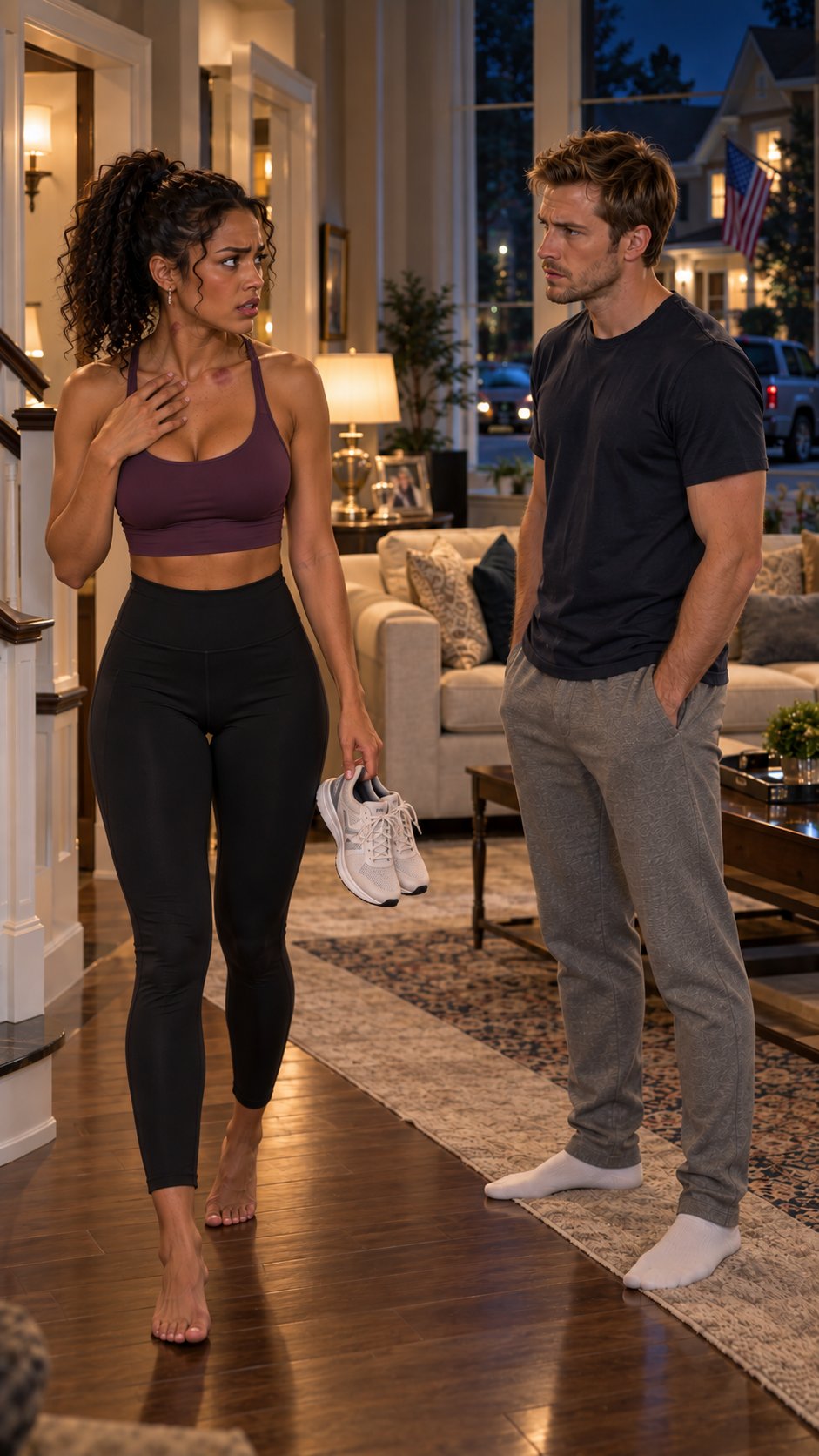
My wife came through the front door at 10:38 on a Wednesday night wearing black running tights, a gray quarter-zip, and shoes that were almost completely clean.
I noticed the shoes later.
First, I noticed her neck.
Several faint reddish-purple marks sat just above the collar of her shirt, near her left collarbone.
“Good run?”
“YES. WHY?”
I looked at the marks.
“Running did that?”
Her hand flew up.
“IT'S NOTHING.”
“Then why'd you hide it?”
“STOP ACCUSING ME.”
I stared at her.
“I haven't accused you yet.”
She went silent.
That silence was the first honest thing that happened all evening.
My name is Eric Dalton.
I was forty-six.
My wife, Julia, was forty-three.
We had been married nineteen years and lived outside Denver with our sixteen-year-old son, Owen, and fourteen-year-old daughter, Paige.
Julia had started running seriously about a year earlier.
At first, I loved it.
She had spent years putting everyone else first—children, work, her mother, our house—and running gave her something that belonged only to her.
Three miles became five.
Five became eight.
Saturday races appeared on the calendar.
Then a local running group appeared.
Then Wednesday nights became “tempo night.”
I knew several people in the group.
Megan, a nurse.
Luis, an accountant.
Beth, a teacher.
And one name Julia mentioned more often than the others.
Ryan Hale.
Forty-one.
Divorced.
Physical therapist.
Fast runner.
I had met him twice.
He was friendly.
Maybe too friendly, but that may be hindsight talking.
The marks changed the context.
“Julia,” I said. “What are they?”
“Skin irritation.”
“From?”
“My vest.”
“You aren't wearing a vest.”
“I wore one earlier.”
I looked at her clean shoes.
“Where did you run?”
“Cherry Creek.”
“It rained there.”
She froze.
I knew because I'd driven through that part of town an hour earlier.
Roads soaked.
Trails muddy.
Her shoes looked as though they'd come out of the closet.
“Did you change shoes?”
“No.”
“Then where's the mud?”
She looked down.
That was when fear replaced anger.
“Eric…”
“Were you running tonight?”
“Yes.”
“Where?”
Silence.
I nodded.
“Okay.”
She hated that.
“Don't do that.”
“Do what?”
“Say okay like you've already decided.”
“I haven't decided anything. I'm waiting for you to tell me what happened.”
She sat on the edge of the couch.
Then said:
“I stopped somewhere.”
“Where?”
“Ryan's.”
There it was.
The name I had hoped not to hear.
I sat across from her.
“Why?”
“He hurt his calf Saturday. I dropped something off.”
“At ten at night?”
“It wasn't supposed to take long.”
“What did you drop off?”
“A recovery sleeve.”
“Why did you have it?”
“He asked if I could bring one from the running store near my office.”
Reasonable.
Almost.
“How long were you there?”
“Twenty minutes.”
I looked at the marks.
“Did Ryan do that?”
“No.”
Immediate.
“Then what did?”
She touched them again.
“I told you. My vest.”
“Julia, please don't make me prove obvious things before you'll tell me the truth.”
Her eyes filled.
Nothing frightens you quite like watching the person you trust calculate which version of the truth to give you.
“I went inside,” she said.
“I assumed that.”
“He'd made tea.”
“At ten at night.”
“Yes.”
“You drank tea.”
“Yes.”
“Then?”
“We talked.”
“About?”
“Running. Work. His divorce.”
“And us?”
She looked down.
That answered me.
“What did you tell him about us?”
“That we've been distant.”
“Are we?”
“Yes.”
The answer hurt because it was partly true.
Our marriage had become efficient.
We coordinated school pickups, groceries, mortgage payments, orthodontist appointments, and family calendars with impressive competence.
We had stopped dating each other with equal competence.
That was a marriage problem.
It was not yet an explanation for her neck.
“Then what?”
“He hugged me.”
“How?”
She looked annoyed.
“You know what a hug is.”
“I know what a normal hug usually doesn't leave on somebody's collarbone.”
Her face collapsed.
“He kissed me.”
The room became quiet.
“On the neck?”
“Yes.”
“Once?”
She hesitated.
“More than once.”
“Did you stop him?”
“Eventually.”
Eventually.
A word can change nineteen years.
“Did you kiss him?”
“Not on the mouth.”
I actually laughed.
“That's the answer you're giving me?”
“I didn't kiss him on the mouth.”
“Did you participate?”
Tears rolled down her face.
“Yes.”
I looked away.
Outside, sprinklers clicked somewhere in the neighborhood.
A refrigerator compressor hummed.
Ordinary sounds continued while my marriage became unfamiliar.
“How long has this been happening?”
“Tonight was the first physical thing.”
“Physical. What happened before?”
She didn't answer.
“Julia.”
“We've been talking.”
“How long?”
“Four months.”
“Messages?”
“Yes.”
“Calls?”
“Yes.”
“Did you hide them?”
“Some.”
“Delete them?”
She nodded.
I stood.
Not because I wanted to intimidate her.
Because I couldn't sit still.
“You accused me of accusing you before I accused you because you already knew what this was.”
She covered her face.
“Yes.”
That was the real beginning.
The marks weren't the betrayal.
They were the receipt.
The purchase had started months earlier.
Julia and Ryan began talking after a half marathon in May.
Group messages became direct messages.
Direct messages became conversations about training, aging, children, disappointment, and marriage.
Ryan's divorce was ugly.
Julia listened.
Then he listened to her.
She told him I worked too much.
True.
She told him we rarely went anywhere alone.
True.
She told him she sometimes felt invisible.
Painfully true.
She did not tell me any of those things with the same urgency.
That mattered.
“You gave him the complaints before you gave me the chance to hear them,” I said.
She nodded.
“I know.”
“No. Don't use ‘I know’ as a shortcut.”
She cried.
“I was afraid you'd fix it instead of hear me.”
That sounded like something a therapist would eventually tell us.
It also sounded plausible.
I did fix things.
Broken faucet?
Fix.
School problem?
Solve.
Budget problem?
Spreadsheet.
Emotional pain?
I often treated it like a task with a deadline.
That was mine to own.
But Ryan wasn't assigned the right to become her secret emotional partner because I was bad at listening.
Both facts could exist.
I asked to see the messages.
Julia handed me her phone.
There were gaps.
Deleted conversations.
But enough remained.
Ryan:
You looked strong tonight.
Julia:
Strong is not how I feel.
Ryan:
That's because you don't see yourself the way other people do.
Another week:
Julia:
Eric didn't even notice I cut my hair.
Ryan:
I noticed before warm-up.
That one hurt embarrassingly much.
I remembered the haircut.
I had noticed two days later.
Another:
Ryan:
Ever wonder what life would've looked like if we'd met ten years ago?
Julia:
Dangerous question.
Ryan:
Doesn't mean you can't answer.
Julia:
Yes.
One word.
Yes.
I stared at it.
Julia whispered:
“I'm sorry.”
I kept reading.
There were boundaries too.
Times she stopped him.
Ryan:
Come over.
Julia:
No.
Ryan:
Why not?
Julia:
Because I'm married and you're lonely and this is already getting stupid.
For a moment, relief.
Then two days later she messaged him first.
Running tonight?
The door reopened.
That was the pattern.
Resistance.
Return.
Boundary.
Invitation.
She wasn't helplessly swept away.
She was conflicted and repeatedly chose proximity to the conflict.
I put the phone down.
“Were you planning to sleep with him?”
“No.”
“Did you want to?”
She didn't answer.
“That's different.”
“I know.”
“Answer.”
“Part of me wondered.”
That hurt more than a cleaner lie would have.
I slept in the guest room.
Or tried to.
At 2:15 a.m., I heard Julia walking down the hallway.
She stopped outside the door.
Didn't knock.
Then walked away.
I stared at the ceiling until sunrise.
At 6:30, Owen came downstairs for cereal.
He saw me already sitting in the kitchen.
“You're up early.”
“Couldn't sleep.”
He poured cereal.
Then looked at the guest room.
“Mom snoring?”
Normally I would've laughed.
Instead:
“Something like that.”
Kids notice tone.
He looked at me for another second.
Then thankfully let it go.
The next morning, Julia told the children we were having a difficult week and needed space.
No details.
They were teenagers, not marriage counselors.
Then she said she needed to call Ryan.
She asked whether I wanted to listen.
“No.”
“Why?”
“Because I don't want to supervise your integrity.”
She stared at me.
“If you're ending it because I'm standing beside you, we have a different problem.”
She went outside.
Twenty minutes later she returned.
“It's over.”
I felt almost nothing.
Ending an affair does not repair the marriage it damaged.
That afternoon, something unexpected happened.
Ryan texted me.
I didn't know he had my number.
Julia had given it to him months earlier when our car battery died after a race and he helped jump it.
His message:
I owe you an apology. You don't owe me a response. I crossed lines I knew were there.
I didn't respond.
Then another message arrived.
For what it's worth, last night should not have happened. She stopped it before it went further.
I stared at that sentence.
Before it went further.
How far had it gone?
I showed Julia.
Her face changed.
“What?”
“He makes it sound like there's more.”
“There isn't.”
“Then tell me every second.”
She did.
Or what she said was every second.
She arrived at Ryan's at 9:41.
That timestamp came from her phone connecting automatically to his Wi-Fi.
That detail bothered me too.
“You'd been there before?”
Julia froze.
“Once.”
I closed my eyes.
“You told me you stopped there to drop something off.”
“I did.”
“But your phone already knew his Wi-Fi.”
“Yes.”
“When were you there before?”
“After a group run.”
“Alone?”
“Eventually.”
There it was.
Another piece.
Again.
“How many times have you been inside his house?”
“Three.”
“You said tonight was—”
“I said tonight was the first physical thing.”
I stared at her.
The precision of that answer made me furious.
“You're answering like an attorney.”
“I'm trying to be accurate.”
“No. You're trying to say the narrowest technically true thing possible.”
She cried.
And I realized something important.
A person can stop telling outright lies and still manipulate reality through omission.
That isn't full honesty.
It's controlled disclosure.
The first time, several runners had gathered after a long run.
Everybody eventually left.
Julia remained another fifteen minutes.
Nothing physical.
Second time, she stopped for coffee after work.
Alone.
That was the first time Ryan told her directly:
“I think about you when you're not here.”
Julia said:
“You shouldn't.”
Then stayed another forty minutes.
That detail mattered.
Words establish boundaries.
Behavior either supports them or erases them.
Wednesday night was the third visit.
Ryan opened wine.
That detail was new too.
“You said tea.”
“I had tea after.”
“You omitted wine.”
“One glass.”
“Why?”
“Because I knew it sounded worse.”
Every concealed detail damaged the next truthful one.
They sat on the couch.
Talked.
Ryan said he hated watching her leave after runs.
Julia said they needed distance.
Ryan asked whether she was saying that because she wanted distance or because she was scared she didn't.
Julia didn't answer.
He moved closer.
Touched her face.
She let him.
He kissed her temple.
Then cheek.
Then neck.
Julia put her hands on his chest.
Not to stop him initially.
He kissed near her collarbone.
She said his name.
He interpreted it as encouragement.
Maybe it was for a few seconds.
Then he reached toward the zipper of her running top.
Julia stepped back.
Said:
“No.”
Ryan stopped.
Immediately, according to both of them.
No force.
No ignored refusal.
No sex.
No mouth kiss.
But a line had been crossed deliberately enough.
Julia went to the bathroom.
Saw the marks.
Panicked.
She pulled her collar higher and drove home.
That explained why she covered them the moment I noticed.
She wasn't discovering evidence.
She had already inspected it.
“Why tell me vest irritation?”
“Because I was scared.”
“You had the whole drive home.”
“I know.”
“You could've walked in and told me.”
“I know.”
“You chose a cover story.”
“Yes.”
That sober choice hurt almost as much as Ryan's couch.
She had approximately twenty-five minutes in the car.
Twenty-five minutes to choose honesty.
Instead, she practiced concealment.
She later admitted she checked the marks twice at red lights.
Pulled the zipper higher.
Adjusted her hair.
By the time she walked through our door, she wasn't confused about what had happened.
She was confused about whether she could hide it.
That distinction stayed with me.
Three days later, Julia moved temporarily into her sister's condo.
Not because I threw her out.
Because every room in our house had become tense.
She wanted the kids to stay home.
I agreed.
We alternated dinners with them.
Julia came Monday, Wednesday, Friday.
I handled Tuesday and Thursday.
Weekends became awkward negotiations.
For the first time in nineteen years, our family calendar included the question:
Which parent is eating here tonight?
I consulted a divorce attorney.
Not as a threat.
Information gave me something solid when everything emotional felt liquid.
Nineteen years meant assets, retirement accounts, the house, my business interest, custody questions for Paige, college expenses.
The attorney explained options.
Then said:
“You don't have to decide today.”
That sentence was surprisingly useful.
Everyone else seemed to want a verdict.
My brother asked:
“You staying?”
My mother asked:
“Can you forgive her?”
A friend asked:
“Did she actually cheat?”
Even I kept trying to force myself toward yes or no.
Stay or leave.
Marriage or divorce.
But I wasn't ready.
So I did nothing with the legal information.
Not yet.
Julia started individual therapy.
I did too.
Six weeks later, we entered marriage counseling.
Our therapist, Dr. Simone Carter, asked a question during the first session.
“Eric, what do you need in order to decide whether you want this marriage?”
I expected myself to say fidelity.
Instead:
“A complete story.”
Julia looked at me.
I continued.
“I can survive an ugly truth better than changing versions.”
That became our first condition.
No more trickle truth.
Julia wrote a timeline.
Not because our therapist demanded forensic detail.
Because Julia's first explanations had changed.
The timeline began four months before the marks.
First private message.
First complaint about our marriage.
First time Ryan said he was attracted to her.
First time she didn't shut it down.
First deleted message.
First private coffee.
That was new.
I stopped reading.
“Coffee?”
Julia closed her eyes.
“Twice.”
“You told me his house was the first time you'd been alone outside running.”
“I was wrong.”
“No.”
I put the pages down.
“You remembered.”
She started crying.
I stood to leave the counseling room.
Dr. Carter didn't stop me.
I walked outside.
Ten minutes later, I returned.
Julia was still there.
I said:
“This is exactly what I meant.”
She nodded.
Then she gave me the rest.
Two coffees.
One lunch.
Three times at his house including the group gathering.
No physical contact before Wednesday.
Plenty of emotional intimacy.
At lunch, Ryan asked whether she would ever leave me.
Julia said:
“I don't know.”
That sentence nearly ended our marriage.
Not because she'd considered divorce.
People in unhappy moments think things.
Because she'd discussed the possible end of our marriage with the man waiting for it to end before discussing it with me.
I asked:
“When was the last time you asked me whether I was happy?”
She couldn't remember.
Then Dr. Carter asked me the same question.
“When was the last time you asked Julia?”
I couldn't remember either.
That was humbling.
We had both assumed the marriage's continuation proved its health.
It didn't.
But again—
neglect did not equal permission.
Distance did not equal permission.
Boredom did not equal permission.
Julia had alternatives.
Talk to me.
Ask for counseling.
Demand change.
Separate.
Even leave.
Instead, she created a private emotional corridor connecting our marriage to another man.
That choice belonged to her.
I moved from the guest room to my brother's house for a month.
Our son Owen became angry.
Not at Julia specifically; he didn't know details.
At both of us.
“You guys tell us communication matters and then won't tell us anything.”
He was right and wrong.
Children deserve stability and age-appropriate truth.
They don't deserve every adult detail.
We told him and Paige that Julia had broken an important boundary in the marriage, and we were deciding whether trust could be rebuilt.
Paige asked:
“Did Mom cheat?”
Julia answered.
“Yes. Emotionally, and I crossed a physical line once.”
I respected her for not hiding behind technical definitions.
Paige cried.
Owen walked outside.
That night was worse than discovering the marks.
Watching your choices become pain in your children's faces strips away every romantic fantasy.
Ryan had been exciting in secret.
There was nothing exciting about a fourteen-year-old asking whether Christmas would happen in one house or two.
Julia never blamed the kids.
Never blamed me.
That mattered.
She said:
“What I did is between your dad and me. Whatever happens, neither of you caused it and neither of you has to fix it.”
Owen asked:
“Are you leaving Dad?”
Julia answered:
“I don't know what Dad will decide.”
I appreciated that.
She didn't make me the executioner.
Didn't say:
“Your father doesn't know if he can forgive me.”
She simply owned uncertainty.
Months passed.
Ryan left the running group.
Julia left too.
I told her she didn't have to.
She said:
“I don't trust my reasons for wanting to stay right now.”
That answer showed more self-awareness than anything she'd said during the affair.
She stopped running at night for a while.
Then one morning I realized I hated that.
Running had been hers before Ryan.
I didn't want betrayal to steal it permanently.
“You should run again.”
She stared.
“Are you sure?”
“No.”
I smiled sadly.
“But yes.”
She joined a different club across town.
Daytime weekend runs.
Not as a punishment.
A reset.
Trust returned strangely.
Not linearly.
One Tuesday she was twenty minutes late and my chest tightened.
Traffic.
Nothing more.
Another time I saw a notification from a man's name and went cold.
Her cousin.
Nothing more.
Julia never mocked those reactions.
Never said:
“Are we still doing this?”
She understood that a nervous system heals slower than an apology.
Once she came home after a run with her phone dead.
She saw my expression.
Immediately said:
“My battery died at mile seven. Beth drove me.”
Then stopped herself.
“I don't want to live like I'm giving an alibi every time something normal happens.”
Neither did I.
We had to find the line between transparency and surveillance.
That took months.
Dr. Carter said:
“Trust isn't rebuilt by making Julia permanently trackable.”
I knew that.
Still, part of me wanted it.
Location sharing.
Passwords.
Receipts.
Proof.
Then Dr. Carter asked:
“If you can only trust her while monitoring her, do you actually trust her?”
No.
So we used transparency as scaffolding.
Not architecture.
Julia volunteered her schedule for a while.
Kept her phone open.
Told me when Ryan attempted one final contact through email.
But the goal was eventually to stop needing evidence.
At eight months, she moved home.
Separate room.
At eleven months, we went on our first date.
A tiny Mexican restaurant we'd loved when we were newly married.
Julia said:
“I forgot this place.”
“I didn't.”
“You never suggested it.”
“You never did either.”
There it was.
Our old pattern.
Both waiting for the other to make the marriage feel alive.
We talked for three hours.
Not about Ryan until the end.
Then Julia said something important.
“I used to think Ryan made me feel alive.”
I waited.
“He didn't.”
“What did?”
“Doing something secret.”
That was uncomfortable.
She continued.
“The secrecy made everything intense. Messages mattered because they were hidden. Coffee mattered because it was forbidden. A normal compliment felt enormous because I wasn't supposed to want it.”
That insight helped me.
Affairs often get credited with qualities produced partly by secrecy itself.
Urgency can masquerade as depth.
Risk can masquerade as chemistry.
Limited access can masquerade as longing.
That didn't mean Julia and Ryan felt nothing.
It meant they had never tested those feelings against ordinary life.
Bills.
Children.
Laundry.
Illness.
Boredom.
Responsibility.
I had.
Nineteen years of it.
Comparison wasn't fair in either direction.
A year after discovery, I asked the question I'd avoided.
“If I hadn't seen the marks, would you have told me?”
Julia cried before answering.
“I don't know.”
I appreciated the honesty.
“Do you think it would've continued?”
“Probably.”
That hurt.
But it also removed the fantasy that she had already been on her way home to confess.
She wasn't.
The marks exposed something she had not yet chosen to end.
That fact became part of my decision.
Could I stay knowing chance—not conscience—had revealed it?
For a while, I thought no.
Then therapy forced a better question.
Not:
“Did she deserve another chance?”
Marriage isn't a prize awarded by a judge.
The question was:
“Given who she is behaving like now, do I want to attempt a future with her?”
Different question.
I eventually answered yes.
Attempt.
Not guarantee.
Julia understood.
There was another question I needed answered.
“Why Ryan?”
Julia thought for a long time.
“He noticed me.”
“That's it?”
“No.”
She looked ashamed.
“He didn't need anything from me.”
I almost laughed.
“He absolutely needed something from you.”
“I know that now.”
But I understood what she meant.
At home, everybody needed Julia.
Paige needed rides.
Owen needed money for school activities.
Her mother needed help.
Her employer needed results.
I needed partnership.
Ryan seemed to offer attention without responsibility.
Except he wasn't.
He wanted intimacy.
Possibility.
Maybe eventually a relationship.
The “nothing required” feeling was another illusion.
“Why didn't you ask me to notice you?”
“I did.”
“When?”
She gave examples.
A dinner she'd suggested that I postponed.
A weekend she wanted us to take that I said was too busy.
A night she wore a new dress and I barely looked up from a work email.
I remembered some.
Not all.
That hurt differently.
She had reached.
I had missed it.
But then she admitted:
“I stopped reaching long before Ryan.”
That mattered too.
We had both retreated.
Only one of us created a secret relationship.
Again, two truths.
Two years after the late run, we renewed nothing.
No vows.
No ceremony.
No dramatic beach.
We simply reached a point where I moved fully back into our bedroom.
One night she noticed my clothes in the closet.
She touched the sleeve of a jacket.
“Does this mean what I think?”
“It means I'm tired of the guest room.”
She laughed through tears.
“Very romantic.”
“Best you're getting.”
She hugged me.
I hugged her back.
That felt more meaningful than a second wedding would've.
We weren't starting over.
Starting over is impossible.
We were continuing with knowledge.
Years passed.
Owen went to college.
Paige followed.
Our marriage became quieter again, but not careless.
We learned the difference.
Quiet is not neglect.
Routine is not automatically disconnection.
You can live an ordinary life and still actively know the person beside you.
Julia still ran.
So did I eventually, though “ran” may be generous.
She called my pace “aggressive walking.”
I called hers “abandoning your husband.”
Saturday mornings became ours.
She'd run six miles.
I'd do four slowly.
We met for coffee.
No phones for the first twenty minutes.
Simple.
Not magical.
Sustainable.
Five years after the affair, we saw Ryan unexpectedly.
A charity 10K.
He was standing near registration with a woman and a little boy.
Julia saw him first.
Her body stiffened.
I noticed.
“You okay?”
“Yes.”
“Want to leave?”
“No.”
Ryan noticed us.
He approached alone.
I didn't want him to.
But he did.
“Eric.”
“Ryan.”
He looked at Julia.
“Hi.”
“Hi.”
Awkward silence.
Then Ryan said:
“I owe both of you—”
I stopped him.
“You apologized years ago.”
He nodded.
“I know.”
“Then leave it there.”
He did.
That was it.
No fight.
No speech.
No revenge.
He returned to his family.
Julia and I ran.
Well, she ran.
I survived.
Afterward she asked:
“How did that feel?”
“Less dramatic than I expected.”
“Same.”
That mattered.
Ryan had once occupied enormous psychological space in our marriage.
Now he was a man near a registration tent.
Healing sometimes looks like somebody becoming ordinary again.
At our twenty-fifth anniversary, Owen gave a toast.
He knew more by then.
Not every detail.
Enough.
He said:
“My parents taught me that marriage isn't about never disappointing each other.”
I became nervous.
Julia whispered:
“Where is he going?”
Owen continued.
“It's about whether you can tell the truth when disappointment would be easier to hide.”
I looked at Julia.
She was crying.
Paige said:
“Mom, you're ruining your makeup.”
Everyone laughed.
Later, I asked Owen where he'd gotten that line.
He shrugged.
“Watching you guys.”
Children see more than we think.
Years later, Paige called me after a boyfriend lied to her.
Not cheating.
Money.
She asked:
“How do you know whether someone deserves another chance?”
I said:
“Don't start with deserves.”
“What?”
“Ask whether their behavior makes another chance wise for you.”
She was quiet.
“That's annoyingly reasonable.”
“I'm old.”
I didn't tell her to stay.
Didn't tell her to leave.
My reconciliation with Julia was not a universal prescription.
Some betrayals end marriages.
Some should.
Some couples rebuild.
The injured person gets to decide what they can live with.
Paige eventually ended that relationship.
I supported her.
Julia did too.
That was important.
We never turned our survival into ideology.
At sixty-one, Julia injured her knee.
Running stopped for six months.
She became miserable.
One evening she stood in the living room wearing running clothes anyway.
“Where are you going?”
“Walking.”
“Doctor said twenty minutes.”
“I know.”
I looked at her.
“Good run?”
She froze.
Then understood.
“Oh, no.”
I smiled.
“Why?”
She pointed at me.
“Don't.”
“Running did that?”
“Eric.”
I laughed.
She threw a cushion at me.
Humor had returned to the memory.
Not because the betrayal became funny.
Because it no longer had the power to destroy the room.
Julia walked over.
Pulled down the collar of her shirt dramatically.
“See? No suspicious marks.”
“Please never do that again.”
She laughed.
Then kissed me.
On the mouth.
“Back in twenty.”
She returned in nineteen.
“Show-off,” I said.
At sixty-eight, we moved from the old house.
Packing the living room, Julia stopped near the doorway.
“What?”
I asked.
“This is where you were standing.”
“When?”
She gave me a look.
I knew.
10:38.
Wednesday.
Running clothes.
Marks.
“It was over there.”
“No. Here.”
“You were closer to the couch.”
She laughed.
“You remember the furniture arrangement?”
“Trauma is detailed.”
Her smile disappeared.
“I'm sorry.”
Even after all those years.
“I know.”
We stood there.
Empty room.
Boxes.
No teenagers upstairs.
No muddy-trail questions.
No Ryan.
Just two older people in a house they'd survived.
Julia said:
“I still hate who I was that night.”
I shook my head.
“Don't simplify yourself.”
“What?”
“You did something wrong. You weren't a different species.”
She looked at me.
“If you turn that version of yourself into a monster, you don't learn anything useful.”
She thought about it.
“What did I learn?”
“You tell me.”
She looked around the empty room.
“That loneliness isn't permission.”
“Good.”
“That attraction isn't destiny.”
“Good.”
“That secrecy makes stupid things feel important.”
“Very good.”
“That clean running shoes are apparently forensic evidence.”
I laughed.
“Critical lesson.”
Then she became serious.
“And that if I have a problem with my marriage, the first person who deserves to hear it is the person I'm married to.”
That one mattered most.
We left the house.
Our new place was smaller, closer to trails.
Julia continued running into her seventies.
Slowly.
I continued aggressive walking.
One summer morning, she came home with a bruise near her collarbone.
I noticed immediately.
She noticed me noticing.
Neither of us spoke.
Then she said:
“Tree branch.”
I raised an eyebrow.
She pulled out her phone.
Her running friend had taken a photograph of Julia standing beside the offending branch, looking furious.
I laughed.
“You documented it?”
“My husband has trust issues.”
She smiled when she said it.
Then her expression softened.
“Formerly justified trust issues.”
“Better.”
She kissed my cheek.
No panic.
No hiding.
That was trust decades later.
Not blindness.
Context without fear.
Julia is seventy-five now.
I'm seventy-eight.
We have grandchildren.
She no longer runs six miles.
Two is a good morning.
Sometimes we walk together.
A few months ago, one of our granddaughters asked how Grandma became a runner.
Julia told her:
“I needed something that made me feel like myself.”
True.
The girl asked:
“Did Grandpa run too?”
Julia laughed so hard she had to stop walking.
“Eventually.”
I said:
“I was elite.”
“At what?”
“Hydration.”
Our granddaughter rolled her eyes.
We kept walking.
I thought about how something genuinely healthy had once become entangled with something destructive.
Running wasn't the problem.
Ryan wasn't the entire problem.
Our marriage problems weren't the entire problem.
Julia's choices mattered.
My emotional absence mattered.
Her secrecy mattered more.
Repair required us to stop collapsing all those truths into one easy explanation.
People want one cause.
One villain.
One moment.
Real marriages rarely offer that convenience.
If you ask me what saved ours, I can't give you one thing.
It wasn't love alone.
We already loved each other while she was messaging Ryan.
It wasn't children.
Children are not glue.
It wasn't forgiveness.
Forgiveness without changed behavior would've been useless.
It was hundreds of ordinary decisions after the truth.
Julia telling me things that made her look bad before I discovered them.
Me listening without immediately trying to solve every emotion.
Both of us naming distance before it became resentment.
Boundaries.
Counseling.
Time.
Consistency.
And the willingness to accept that rebuilding trust doesn't mean demanding the injured person stop remembering.
I remembered.
I still do.
The memory simply changed weight.
For years, if Julia came home late in running clothes, my body noticed before my mind.
Then eventually it didn't.
That's when I knew something had healed.
Not because I trusted running clothes.
Because I trusted Julia again.
One night near our fiftieth anniversary, we were sitting on the porch.
Julia asked:
“What's the first thing you remember from that night?”
I thought.
“Your shoes.”
She frowned.
“My shoes?”
“They were clean.”
She laughed.
“You didn't mention those first.”
“I noticed after.”
“What did you notice first?”
“Your neck.”
She nodded.
Silence.
Then:
“What hurt most?”
Not the question I expected.
“The sentence.”
“Which one?”
“Stop accusing me.”
She looked surprised.
“Not the marks?”
“No.”
“Not Ryan?”
“Those hurt.”
“Then why that sentence?”
I looked at her.
“Because I hadn't accused you.”
She became quiet.
“You were already defending yourself against the truth before I'd even named it.”
Julia nodded slowly.
“I remember.”
“You knew.”
“Yes.”
“That was the moment I knew you knew.”
She stared toward the yard.
Then said:
“I think I was arguing with myself.”
“How?”
“I'd spent months saying it wasn't an affair because we hadn't done anything physical.”
I listened.
“Then he kissed me. And on the drive home, that excuse was gone.”
That made sense.
“So when you asked about the marks…”
“I heard the accusation I'd been making against myself for forty minutes.”
There it was.
A truth I hadn't understood even in counseling.
Her defensiveness hadn't started in our living room.
It had started in Ryan's driveway.
Maybe earlier.
I took her hand.
She squeezed mine.
“I wish I'd walked in and told you.”
“So do I.”
“Would it have changed everything?”
“Yes.”
She looked at me.
“Would you still have been hurt?”
“Of course.”
“But?”
“I would've known honesty won before fear did.”
She nodded.
That distinction still mattered after thirty years.
Then Julia told me something she'd never admitted before.
“There was one more moment.”
My stomach tightened automatically.
Even decades later.
“What?”
“Before I came inside.”
I waited.
“I sat in the driveway for almost six minutes.”
I hadn't known.
“Doing what?”
“Trying to decide whether to tell you.”
I looked at her.
“And?”
“I opened my phone.”
“For what?”
“To text you.”
“What were you going to say?”
She remembered the words.
I need to tell you something before I come inside.
“Did you type it?”
“Yes.”
“Why didn't you send it?”
“I looked at the house.”
She swallowed.
“Your office light was on. Paige's bedroom light was on. Owen's bike was by the garage. Everything looked normal.”
“And you wanted normal.”
“Yes.”
“So you deleted it.”
“Yes.”
That revelation hurt in a strange, old way.
Not fresh betrayal.
Fresh understanding.
She had come closer to honesty than I'd known.
And still chosen concealment.
“I wish you'd sent it.”
“I know.”
“You would've still hurt me.”
“I know.”
“But the entire story afterward would've been different.”
“Yes.”
Then she said:
“I think that's why I've never forgotten your sentence.”
“What sentence?”
“I haven't accused you yet.”
She looked at me.
“Because I knew you were giving me a chance to say it myself.”
I hadn't consciously meant it that way.
But maybe I was.
We sat quietly.
Then Julia smiled.
“Good run?”
I laughed.
“Terrible.”
“Why?”
“Old knees.”
She leaned against me.
No more needed saying.
When I think about that Wednesday now, I don't begin with Ryan.
I begin with the front door.
10:38 p.m.
Julia walking in.
Black running tights.
Gray top.
Clean shoes.
Marks near her collarbone.
Me asking casually:
“Good run?”
Her answer too sharp:
“YES. WHY?”
My eyes moving toward her neck.
“Running did that?”
Her hand immediately covering the marks.
“IT'S NOTHING.”
“Then why'd you hide it?”
Then the line that changed the temperature of the entire room:
“STOP ACCUSING ME.”
I remember looking at my wife and realizing I hadn't accused her of anything.
Not cheating.
Not lying.
Not seeing another man.
Nothing.
So I said the only true thing available.
“I haven't accused you yet.”
And she went silent.
For years, I thought that silence was where our marriage broke.
I was wrong.
It had been cracking quietly for months.
The silence was simply the first moment I could hear it.
What happened afterward mattered more.
The ugly truth.
The changing story.
The complete story.
The separation.
The counseling.
The anger.
The children.
The slow return.
The hundreds of choices nobody sees because healthy marriages are usually repaired in moments too boring for dramatic titles.
The marks near Julia's collarbone faded before the week ended.
The consequences didn't.
Neither did the lessons.
Attraction can happen inside a marriage.
Loneliness can happen inside a marriage.
Distance can happen.
None of those things make betrayal inevitable.
There is always a decision between feeling something and secretly building a life around that feeling.
Julia crossed that line.
Then crossed another.
Then, eventually, stopped.
I had a decision too.
I could leave.
I seriously considered it.
There would have been nothing shameful about that.
Instead, after watching what she did with the truth once it was fully exposed, I chose to see whether trust could be rebuilt.
It could.
Slowly.
Not perfectly.
But genuinely.
And decades later, when my wife walks through the door after a morning on the trail, I still sometimes ask:
“Good run?”
She usually says:
“Yes.”
No sharpness.
No fear.
No hidden meaning.
Just yes.
That's the strange thing about surviving a moment that once seemed capable of ending everything.
Eventually, ordinary words become ordinary again.
And after what happened in our living room that Wednesday night—
ordinary became one of the things I valued most.