My Wife Said She Hated Coming Home to Me—Then I Asked Who She Was Going To
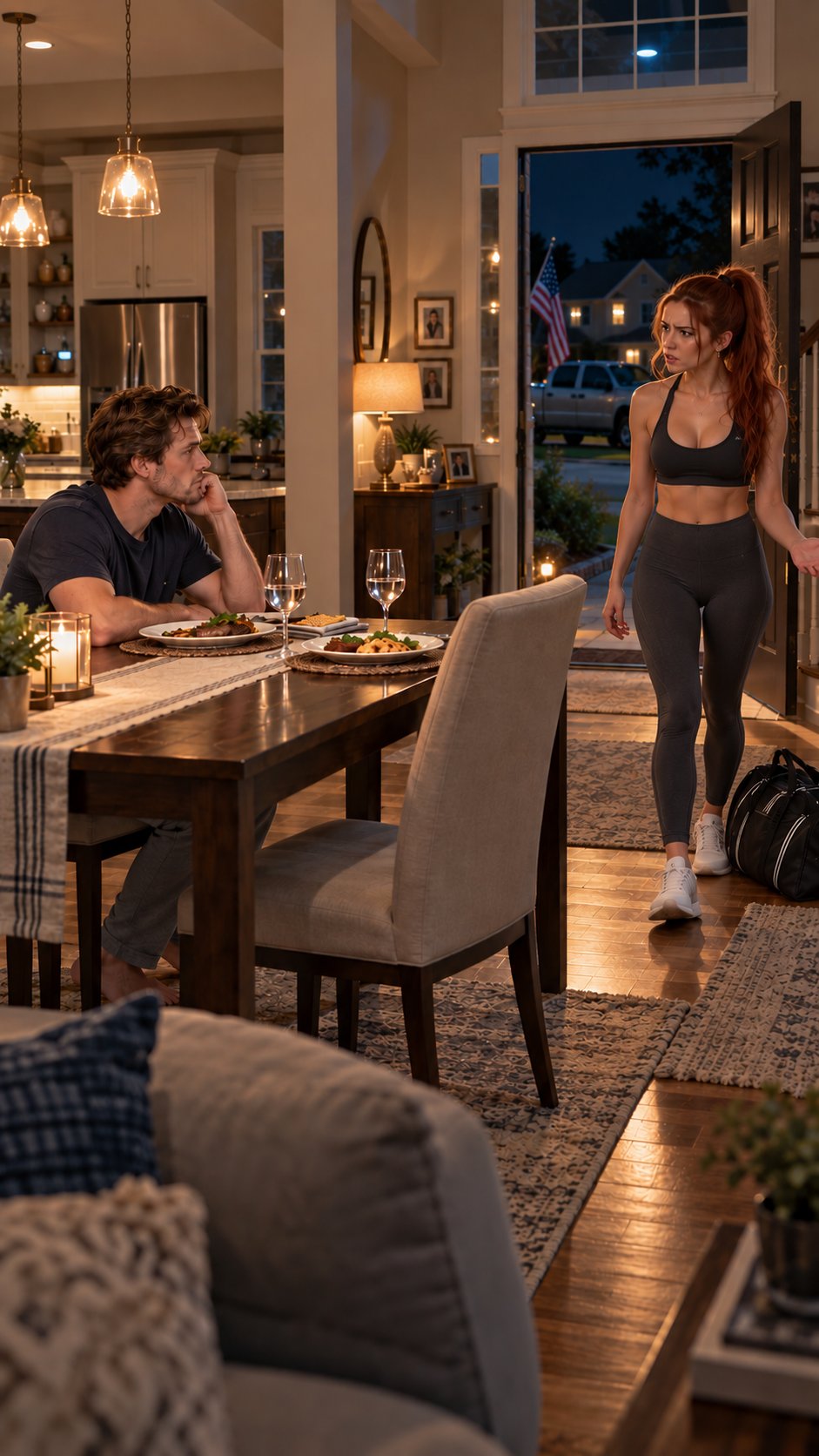
The second plate had been cold for almost three hours when my wife finally walked through the door.
11:47 p.m.
I know because I was staring at the microwave clock when I heard her key turn.
The house was completely quiet.
Our twelve-year-old daughter, Lucy, was asleep upstairs.
The dishwasher had finished its cycle.
The candles I'd lit at seven had burned down into little pools of wax.
And on the dining-room table sat two plates of chicken marsala, roasted potatoes, and green beans that had stopped looking appetizing sometime around nine.
I was still sitting beside them.
My wife stepped inside wearing black leggings, a gray athletic jacket, and white sneakers.
A large gym bag hung from her shoulder.
Her name was Rachel.
We'd been married fourteen years.
She saw me.
Stopped.
And immediately frowned.
Not surprised.
Not apologetic.
Annoyed.
“DON'T GIVE ME THAT LOOK.”
I stared at her.
“What look?”
She dropped her gym bag beside the entry table.
THUD.
“Like I owe you an explanation.”
I looked at the empty chair across from me.
Then back at her.
“I thought a wife coming home was a pretty normal expectation.”
Rachel's jaw tightened.
“You knew I was going to the gym.”
“At six-thirty.”
“So?”
“It's almost midnight.”
“I lost track of time.”
“For five hours?”
She exhaled sharply.
“Here we go.”
I didn't raise my voice.
That almost seemed to irritate her more.
“Rachel, I cooked dinner.”
“I didn't ask you to.”
“I texted you.”
“I was working out.”
“For five hours?”
“I talked to people afterward.”
“Who?”
She stared at me.
Then something changed.
Maybe she was tired.
Maybe she'd spent too long preparing for an accusation I hadn't actually made.
Maybe some part of her wanted the fight.
Whatever the reason, she said the sentence that changed the entire night.
“MAYBE I DON'T LIKE COMING HOME TO YOU.”
I went completely quiet.
Rachel's expression shifted instantly.
She looked toward the stairs.
Then the kitchen.
Anywhere except at me.
The refrigerator hummed behind us.
I could hear the wall clock.
Tick.
Tick.
Tick.
I looked at the woman I'd married fourteen years earlier.
Then I asked:
“So who do you like going to?”
Her eyes snapped back to mine.
For the first time that night—
Rachel looked afraid.
Not guilty.
Not yet.
Afraid.
And that distinction would matter.
Because what happened next wasn't the moment I discovered my wife was having an affair.
It was the moment I realized I no longer knew whether she was.
And once that question entered our marriage, almost everything I'd ignored for the previous four months began rearranging itself.
My name is Daniel Mercer.
I was forty-one that night.
Rachel was thirty-nine.
We lived outside Raleigh, North Carolina, in the kind of neighborhood where the houses were large enough to make everyone look financially comfortable even when half the people inside them were quietly worrying about money.
I worked in commercial insurance.
Rachel was a physical therapist.
We had one daughter.
Lucy.
Twelve.
Smart.
Funny.
Obsessed with astronomy.
Capable of explaining Saturn's rings for forty-five minutes without noticing everyone else had stopped participating.
From the outside, our life looked painfully ordinary.
Two careers.
Mortgage.
School pickups.
Soccer practices until Lucy quit soccer and discovered science club.
Family vacations.
Christmas with Rachel's parents.
Thanksgiving with mine.
Saturday grocery runs.
Arguments about laundry.
Arguments about thermostat settings.
Arguments about whether decorative pillows served any purpose beyond creating additional objects that had to be removed before sleeping.
We weren't perfect.
But until that year, I would've called us happy.
Not honeymoon happy.
Real happy.
The kind built from knowing exactly how the other person takes coffee.
Rachel and I met when I was twenty-five.
A mutual friend invited both of us to a barbecue.
I spilled mustard on my shirt ten minutes after arriving.
Rachel handed me a napkin and said:
“Strong opening.”
I said:
“You should see what I do with ketchup.”
She laughed.
That was it.
No lightning.
No movie music.
Just a conversation that lasted until everyone else started stacking chairs.
We dated three years.
Married at twenty-eight and twenty-six.
Lucy came three years later.
Rachel was the more spontaneous one.
I was the planner.
She booked trips.
I researched hotels.
She bought concert tickets.
I checked parking.
She could decide at 4:00 p.m. that we should drive two hours for dinner.
I wanted reservations.
Somehow it worked.
For years.
The first change was so small I didn't register it as a change.
Rachel joined a gym.
That wasn't unusual.
She'd always exercised.
We had a treadmill at home, but she hated it.
“Running while staring at a laundry basket isn't exercise. It's punishment.”
The new gym was about fifteen minutes away.
Large.
Modern.
Weights.
Classes.
Pool.
Sauna.
She started going three evenings a week.
Then four.
I was happy for her.
She seemed energized.
She bought new workout clothes.
Started tracking strength goals.
Talked about a trainer named Nicole who was “absolutely brutal.”
Nothing about it worried me.
Why would it?
Then the sessions got longer.
An hour became ninety minutes.
Ninety minutes became two hours.
Sometimes she stopped for smoothies with people afterward.
Again—
normal.
Adults are allowed friends.
Marriage isn't a tracking device.
I didn't want to become the husband asking where his wife was every minute.
So I didn't.
The second change was her phone.
Rachel had never been secretive with it.
Neither of us routinely searched the other's messages.
We knew each other's passcodes because married people occasionally need to answer phones, change music, read directions, or find a photo.
Then one afternoon Lucy grabbed Rachel's phone to look something up.
Rachel crossed the kitchen faster than I'd seen her move in months.
“Use your own.”
Lucy laughed.
“Mine's upstairs.”
“I said use yours.”
The sharpness surprised both of us.
Lucy handed it back.
“Okay.”
Rachel immediately softened.
“Sorry, sweetheart. Work stuff.”
Lucy shrugged.
I didn't.
Not internally.
But I didn't say anything.
Two weeks later, Rachel changed her passcode.
I noticed only because she asked me to change the music while we were driving.
“What's the code?”
She hesitated.
Then took the phone herself.
“I've got it.”
That was unusual.
Still not evidence.
People change passwords.
People have work messages.
People deserve privacy.
I reminded myself of all of that.
Then came the late nights.
Tuesday.
Thursday.
Sometimes Saturday.
“The class ran over.”
“Nicole wanted to show us something.”
“We grabbed coffee.”
“I sat in the sauna.”
“I stopped at Target.”
Each explanation worked individually.
Stacked together, they began to feel different.
I didn't accuse her.
Instead, I did what people often do when they're afraid of an answer.
I tried harder.
I cooked more.
Planned a weekend in Asheville.
Bought tickets to a concert she'd mentioned.
Asked whether she wanted to go hiking.
She accepted some things.
Rejected others.
The concert was the strangest.
Rachel had loved the artist for years.
When I showed her the tickets, I expected excitement.
She smiled.
But it looked delayed.
“That's sweet.”
Sweet.
Not:
Oh my God.
Not:
How did you get these?
Sweet.
Then she asked:
“What night?”
“October eighteenth.”
Her expression changed.
“What?”
“Nothing.”
“You have something?”
“I might.”
“On a Friday night six weeks from now?”
“Gym group sometimes does things.”
I laughed because I thought she was joking.
She wasn't.
We went to the concert.
She enjoyed it.
At least I think she did.
But she checked her phone constantly.
During one song, the screen lit up.
I saw only a name.
M.
Rachel turned the phone facedown.
I didn't ask.
That single letter would bother me for weeks.
The night of the cold dinner was our anniversary.
Not the major one.
Fourteen years.
Still.
We'd always celebrated.
Sometimes restaurants.
Sometimes trips.
One year Lucy got sick and we ate takeout Thai food beside her bed while she watched cartoons.
That remains one of my favorite anniversaries.
That year, Rachel told me she had a late patient and then wanted to work out.
I said:
“On our anniversary?”
She paused.
“Oh.”
That hurt more than I expected.
She'd forgotten.
Then she smiled.
“I'm sorry.”
“It's fine.”
“No, it's not.”
She kissed me.
“Dinner at home?”
“Sure.”
“I'll be back by eight.”
I bought groceries.
Cooked.
Opened wine.
Lucy helped set the table before going upstairs.
At 7:42, I texted:
Dinner almost ready.
No answer.
8:11:
Everything okay?
No answer.
8:46:
Rachel?
At 9:03:
Sorry. Still here. Don't wait.
I replied:
It's our anniversary.
Three dots appeared.
Disappeared.
Then:
I know. I'm sorry.
She came home at 11:47.
And told me maybe she didn't like coming home to me.
“So who do you like going to?”
Rachel stared at me.
“What is that supposed to mean?”
“You know exactly what it means.”
“No, Daniel. Say it.”
I stood.
“Are you seeing someone?”
Her face hardened.
“You're unbelievable.”
“That isn't an answer.”
“You think because I don't rush home every night I'm sleeping with somebody?”
“I didn't say sleeping.”
“Oh, please.”
She grabbed her bag.
I said:
“Who is M?”
She stopped.
That was the first real mistake she made.
Not the lateness.
Not the defensiveness.
The stop.
Half a second.
Maybe less.
But I saw it.
“Who?”
“M.”
“I don't know what you're talking about.”
“The person messaging you at the concert.”
She stared at me.
“You read my messages?”
“No.”
“Then how do you know?”
“Your screen lit up.”
“So you were watching my phone.”
“I was sitting beside you.”
She laughed bitterly.
“Wow.”
“What?”
“You're becoming paranoid.”
I looked at her.
“Tell me who M is.”
She picked up her bag.
“I'm going to bed.”
“Rachel.”
“I'm not doing this.”
“Who is M?”
She turned.
“Maybe if you weren't interrogating me every time I walked through the door, I'd actually want to come home.”
I almost laughed.
“Every time?”
“Yes.”
“This is the first time I've asked.”
She opened her mouth.
Nothing came out.
Because we both knew I was right.
She went upstairs.
I stayed at the table.
Two cold plates.
One unopened bottle of wine.
Fourteen years of marriage.
I wish I could say I made some decisive choice that night.
I didn't.
I put the food in containers.
Loaded the dishwasher.
Blew out the candles.
Checked the doors.
Then slept in the guest room.
At 6:20 the next morning, Lucy knocked.
“Dad?”
I opened my eyes.
She stood in the doorway wearing pajamas.
“Why are you in here?”
“Mom was snoring.”
Rachel didn't snore.
Lucy knew that.
She looked at me for several seconds.
Then nodded.
“Okay.”
Children often recognize lies adults think they're protecting them with.
Rachel left early.
No conversation.
At 8:14 she texted:
We need to talk tonight.
I replied:
Yes.
At 8:17:
Not in front of Lucy.
Obviously.
Then nothing.
I spent the entire workday unable to concentrate.
I didn't investigate her.
Didn't follow her.
Didn't call the gym.
Didn't install anything.
I considered checking our shared credit-card account.
Then felt ashamed for considering it.
Then angry that I felt ashamed.
That was the emotional trap.
If I looked, I was suspicious.
If I didn't, I remained ignorant.
That evening, after Lucy went to a friend's house for a sleepover, Rachel sat across from me in the living room.
No gym clothes.
No bag.
No escape waiting by the door.
She began:
“I shouldn't have said what I said.”
“Which part?”
“You know which part.”
“Maybe I don't.”
She sighed.
“That I don't like coming home to you.”
“Was it true?”
“I was angry.”
“That isn't what I asked.”
She looked at her hands.
“Sometimes.”
That hurt.
I nodded.
“Okay.”
“Daniel—”
“I'm listening.”
She took a breath.
“I feel suffocated here.”
I looked around our living room.
“What does that mean?”
“It means everything is routine.”
“That's marriage sometimes.”
“I know.”
“Work. Lucy. House. Bills. Dinner.”
“I know.”
“So what's suffocating?”
She became frustrated.
“You always need everything defined.”
“Yes. Especially when my wife says she doesn't like coming home.”
Rachel stood.
Walked to the window.
Then said:
“I don't know who I am anymore.”
That sentence I understood.
Or thought I did.
She'd become a mother at twenty-nine.
Career.
Family.
Responsibilities.
Approaching forty.
People question themselves.
I softened.
“Okay.”
She turned.
“At the gym, nobody needs anything from me.”
I nodded.
“I can understand that.”
“I can just be Rachel.”
“Okay.”
“Not Mom. Not somebody's wife. Not the person who remembers appointments.”
“Okay.”
She looked relieved.
Then I asked:
“Who's M?”
Relief gone.
Immediately.
“Seriously?”
“Yes.”
“We're finally talking and you go back to that?”
“Because you're avoiding it.”
“Mark.”
The name landed quietly.
“Mark who?”
“Mark Ellison.”
I knew the name.
One of the physical therapists who occasionally worked with Rachel's clinic on sports rehabilitation referrals.
I'd met him once.
Maybe twice.
Mid-forties.
Divorced.
Very fit.
Friendly.
Too friendly?
I didn't know.
Memory becomes unreliable when jealousy enters it.
Suddenly every handshake looks suspicious.
“What does Mark have to do with the gym?”
“He works out there.”
“How often?”
“I don't know.”
“Rachel.”
“A few times a week.”
“With you?”
“Sometimes.”
“Does Nicole exist?”
She looked offended.
“Yes.”
“I'm asking.”
“Yes, Daniel. Nicole exists.”
“Does Mark work out with you?”
“Sometimes we're there together.”
“Do you leave together?”
“Sometimes people get coffee.”
“People?”
She looked away.
There it was again.
That tiny movement.
I asked:
“Have you been alone with him?”
“Yes.”
“Where?”
“Coffee.”
“Anywhere else?”
She stared at me.
“No.”
Too fast.
I knew it.
She knew I knew it.
I said:
“Try again.”
Her face changed.
“What?”
“You answered before I finished thinking about the question.”
“I answered.”
“Have you been anywhere alone with Mark besides coffee?”
Silence.
Then:
“His car.”
My stomach tightened.
“Why?”
“Talking.”
“Where?”
“Parking lot.”
“After the gym?”
“Yes.”
“How long?”
“I don't know.”
“Ten minutes?”
“Sometimes.”
“An hour?”
She didn't answer.
“Rachel.”
“Sometimes.”
I stood.
She immediately said:
“Nothing happened.”
I walked toward the kitchen.
“Daniel.”
I stopped.
“Nothing happened.”
I turned.
“Then why have you been lying?”
“I haven't.”
“You told me you were at the gym.”
“I was.”
“You were sitting in another man's car.”
“After the gym.”
“Until almost midnight?”
She looked away.
That was answer enough.
I didn't yell.
I wish I could claim that was maturity.
It wasn't.
I was too stunned.
There is a strange stage in betrayal before anger fully arrives.
Your brain becomes administrative.
Dates.
Times.
Details.
You start organizing pain.
“When did this start?”
“Nothing started.”
“When did you start sitting in his car?”
“A couple months ago.”
“How many?”
“I don't know.”
“Two?”
“Maybe three.”
“Before our Asheville trip?”
She hesitated.
“Yes.”
“Before the concert?”
“Yes.”
“Before you changed your phone code?”
Her eyes flashed.
“My phone code is not your business.”
I laughed.
That was the first time.
Not because anything was funny.
“You're right.”
She looked surprised.
“You're absolutely right. Your phone code isn't my business.”
I pointed between us.
“But whether my wife is developing a relationship with another man while lying to me about where she is? That's my business.”
She sat down.
“It's not a relationship.”
“What is it?”
“Friendship.”
“Do you hide your other friendships?”
“No.”
“Do you sit in Nicole's car until midnight?”
“No.”
“Do you forget our anniversary because of Nicole?”
Her eyes filled.
“I said I was sorry.”
“You said you were sorry you forgot.”
“Yes.”
“You didn't say you were with Mark.”
She wiped at her face.
“I knew how you'd react.”
That sentence made something inside me go cold.
I said:
“Rachel, hiding something because you know it would hurt your spouse doesn't make the hiding reasonable.”
She looked down.
I asked the question I didn't want answered.
“Have you kissed him?”
“No.”
“Has he kissed you?”
“No.”
“Have you touched each other?”
“What does that even mean?”
“You know.”
“No.”
“Has he told you he has feelings for you?”
Silence.
There.
I closed my eyes.
“Rachel.”
“He said he cares about me.”
“How?”
“What?”
“What exactly did he say?”
“I don't remember.”
“Yes, you do.”
She cried quietly.
“He said he thinks about me.”
I felt physically sick.
“And what did you say?”
“I told him this was complicated.”
Not:
I'm married.
Not:
Stop.
Not:
I don't feel that way.
This is complicated.
I sat down.
Across from my wife.
Same chair as the previous night.
Only now the plates were gone.
“Do you think about him?”
She didn't answer.
I nodded.
“Okay.”
“Daniel—”
“Do you?”
“Yes.”
One word.
Quiet.
Honest.
Finally.
It hurt more than all the lies.
I slept in the guest room again.
Rachel cried in our bedroom.
At 1:00 a.m., I was still awake.
At 2:00.
At 3:00.
Around 3:30, I understood something important.
Whether Rachel had physically cheated was no longer the only question.
She had built an emotional space with another man and protected it from me.
She looked forward to seeing him.
Stayed away from home to remain near him.
Changed how she guarded her phone.
Forgot our anniversary.
And when I asked why she didn't want to come home, the first person her behavior pointed toward was Mark.
Physical boundaries mattered.
But they weren't the entire definition of betrayal.
The next morning, we told Lucy nothing beyond:
“Mom and Dad are having a difficult week.”
She stared at us.
“Are you getting divorced?”
Rachel started crying.
I said:
“We don't know what's happening yet.”
Lucy looked terrified.
I hated that.
But I wasn't going to promise something I couldn't guarantee.
She asked:
“Did somebody do something?”
Rachel looked at me.
I said:
“This is between the adults.”
Lucy nodded.
Then went upstairs.
Five minutes later, I heard her bedroom door close.
Rachel whispered:
“She knows.”
“She knows something is wrong.”
“I don't want her scared.”
“Neither do I.”
“What do we do?”
For the first time in months, Rachel sounded like my wife again.
Not defensive.
Not irritated.
Scared.
I answered:
“We stop lying.”
That afternoon, Rachel told me more.
Not everything at once.
Truth came in layers.
That's common when someone has spent months protecting a secret.
Mark had started talking to her after workouts in May.
His divorce had been finalized the previous year.
He was lonely.
Rachel was unhappy.
They talked about work.
Then marriages.
Then his marriage.
Then ours.
That bothered me.
“You discussed me?”
“Yes.”
“What did you say?”
“That we felt distant.”
“Did you tell me we felt distant?”
She looked down.
“No.”
That hurt in a different way.
She had given another man access to a problem I didn't know existed in my own marriage.
Mark told her she deserved to feel “seen.”
I hated that word for months.
Seen.
Such an innocent word.
People can hide enormous emotional trespasses behind therapeutic vocabulary.
Rachel told him she felt invisible at home.
I asked:
“Did I make you feel invisible?”
“Sometimes.”
“How?”
“You stopped asking what I wanted.”
“Give me an example.”
She struggled.
That didn't mean her feeling was false.
Feelings aren't courtroom exhibits.
But if we were going to understand our marriage, I needed specifics.
Eventually she said:
“Everything became logistics.”
She was right about that.
Our conversations often sounded like operations meetings.
Lucy pickup.
Groceries.
Insurance.
Vacation dates.
Roof repair.
Dentist.
I had participated in that.
So had she.
But then Rachel said:
“Mark listened.”
I answered:
“I would've listened.”
“You would've tried to fix it.”
“Maybe.”
“You always fix.”
I sat with that.
She wasn't entirely wrong.
When Rachel complained, I often offered solutions.
Bad day?
Here's what you should do.
Conflict at work?
Here's how to handle it.
Overwhelmed?
Let's create a schedule.
Sometimes she didn't need a solution.
She needed me to sit in the discomfort.
I could own that.
But owning my failures didn't make her choices mine.
Both truths could exist.
I said:
“I can accept that I wasn't always the husband you needed.”
She cried.
I continued:
“But you don't get to use that as permission for secrecy.”
“I know.”
“Do you?”
“Yes.”
“Because every time we talk about Mark, you tell me what was wrong with us first.”
She became quiet.
I said:
“Our problems explain why attention from him felt good. They don't explain why you lied.”
She nodded.
That was the first conversation where I thought our marriage might survive.
Then she told me they'd held hands.
It happened in his car.
Three weeks before our anniversary.
Rachel had been crying about an argument we'd had.
I barely remembered the argument.
Something about visiting her parents.
Mark reached over.
Held her hand.
She didn't pull away.
“How long?”
“I don't know.”
“Seconds?”
“Longer.”
“Did you want him to?”
“Yes.”
I looked away.
That answer hurt.
But at least it was clean.
“Anything else?”
“No.”
I looked at her.
She added:
“He hugged me.”
“When?”
“Different night.”
“How?”
She became angry.
“What do you mean how?”
“You know what I'm asking.”
“It was a hug.”
“Rachel.”
“Long.”
I nodded.
“Anything else?”
“No.”
I waited.
She said:
“No.”
I believed she was still withholding something.
I couldn't prove it.
That became the next problem.
Trust doesn't return merely because someone finally says:
That's everything.
Rachel offered to show me her phone.
I surprised both of us by saying no.
“Why?”
“Because I don't want to become your investigator.”
“But you don't believe me.”
“No.”
She flinched.
I continued:
“If we're going to stay married, I need you to become honest without me discovering things.”
“I am.”
“You've said that four times.”
She cried again.
The following day, she showed me the messages anyway.
Not every conversation remained.
Some had been deleted.
That alone created questions.
But enough existed.
There was no explicit sexual content.
No photographs.
No plans for hotels.
No direct statement that they'd kissed.
There was emotional intimacy.
A lot of it.
Thinking about you.
Wish tonight could've lasted longer.
I hate watching you drive away.
You deserve someone who makes you feel wanted.
And from Rachel:
I don't know what I'm doing.
I shouldn't look forward to this as much as I do.
I wish everything were simpler.
Then one that nearly ended us.
Mark:
If you weren't married, would you give us a chance?
Rachel:
You know the answer.
I put the phone down.
She whispered:
“Daniel.”
I stood.
“You told him yes.”
“I didn't say yes.”
I looked at her.
“Don't insult me.”
She covered her face.
I left the house.
Not dramatically.
No suitcase.
I drove.
For two hours.
No destination.
At one point I parked outside a hardware store and sat there staring at shopping carts.
A man loaded lumber into a pickup.
A woman returned a garden hose.
Ordinary life continued while mine felt unrecognizable.
That's one of the strangest parts of heartbreak.
Traffic lights still change.
People still buy screws.
The world refuses to acknowledge your emergency.
I called my brother, Steven.
He lived in Tennessee.
I hadn't told anyone.
He answered:
“What's up?”
I couldn't speak.
Immediately:
“Daniel?”
“Rachel's involved with somebody.”
Silence.
Then:
“Are you safe?”
That question surprised me.
“Yes.”
“Is she?”
“Yes.”
“Lucy?”
“Yes.”
“Okay.”
No insults.
No:
I always hated her.
No revenge fantasies.
Just:
“What do you need?”
I started crying in a hardware-store parking lot.
At forty-one.
Hands over my face.
My brother stayed on the phone.
He asked whether I wanted to come stay with him.
I said no.
Then yes.
Then no again.
Eventually he said:
“You don't have to decide your marriage tonight.”
That sentence saved me from making several bad decisions.
Pain demands immediate certainty.
Leave.
Stay.
Forgive.
Divorce.
Confront him.
Tell everyone.
Destroy something.
Do something.
But sometimes the healthiest immediate action is simply refusing to decide while you're bleeding emotionally.
I went home.
Rachel was sitting on the stairs.
She stood when I entered.
“I ended it.”
I looked at her.
“With Mark.”
“When?”
“Tonight.”
“How?”
“I called him.”
“What did you say?”
“That I couldn't see him anymore outside professional circumstances and I'd request changes at work if necessary.”
“And?”
“He said he understood.”
I nodded.
Then asked:
“Did you want to end it?”
She started crying.
That answer was worse than words.
I said:
“If you're only ending it because I found out, we have a problem.”
“I know.”
“Do you?”
“Yes.”
“Because I can't compete with an imaginary version of a relationship where he gets your best conversations and none of the bills, parenting, exhaustion, or ordinary life.”
Rachel looked at me.
I continued:
“He gets to be the man in a parked car telling you you're special. I get to be the husband asking whether Lucy finished homework and whether the water heater sounds weird.”
She whispered:
“That's not fair.”
“No.”
I nodded.
“It isn't.”
We started marriage counseling.
Not because counseling guarantees marriage.
It doesn't.
Our therapist, Dr. Evelyn Brooks, made that clear immediately.
“My job isn't to keep you married at any cost.”
Rachel looked nervous.
Dr. Brooks continued:
“My job is to help you understand what happened, determine whether trust can be rebuilt, and make decisions deliberately.”
I liked her immediately.
Rachel took longer.
The first sessions were brutal.
Rachel wanted to discuss our emotional distance.
I wanted to discuss Mark.
Dr. Brooks said both mattered.
But sequence mattered too.
She told Rachel:
“Daniel cannot productively examine the preexisting marriage while he still feels the betrayal itself is being minimized.”
Rachel cried.
Then Dr. Brooks turned to me.
“And Daniel cannot use Rachel's betrayal to establish that every problem before it was imaginary.”
That irritated me.
Which probably meant I needed to hear it.
We separated the questions.
What had been wrong in our marriage?
What choices had Rachel made independently of those problems?
What did accountability require?
What boundaries would be necessary if we tried reconciliation?
What did I actually need to know?
That last question was harder than expected.
I thought I needed every detail.
What shirt was she wearing?
Which parking space?
How long was the hug?
Which hand did he hold?
Dr. Brooks asked:
“Will the answer help you make a decision, or give your mind another image to replay?”
I hated that question.
It was useful.
Rachel eventually admitted she'd fantasized about kissing Mark.
She insisted they hadn't.
I chose, eventually, to accept that as the truth.
Not because I could prove it.
Because reconciliation is impossible if one person must establish innocence beyond every imaginable doubt.
At some point, either you accept the disclosure or you don't.
I told Rachel:
“If I discover later that this is another partial truth, we're done.”
She nodded.
No argument.
She changed gyms.
That wasn't something I demanded.
She chose it.
She also asked her clinic to restructure referrals so she had minimal direct professional contact with Mark.
Again, her decision.
I appreciated that more than if I'd ordered it.
Trust isn't rebuilt by creating a prisoner.
I didn't want a wife who remained faithful because I'd constructed perfect surveillance.
I wanted a wife who chose the marriage when I wasn't watching.
Mark contacted her once after the cutoff.
A message:
I hope you're okay. I miss talking to you.
Rachel showed me immediately.
Then blocked his personal number.
No secret reply.
No deletion.
That small act mattered more than a hundred promises.
But rebuilding was ugly.
Some days were good.
Then something tiny triggered me.
Rachel saying:
“I'm going to work out.”
My stomach tightened.
A phone buzzing.
A late patient.
The word “gym” in a television commercial.
Once we drove past the old gym and I became silent for twenty minutes.
Rachel noticed.
Neither of us spoke.
Healing isn't linear.
It's repetitive.
Rachel had triggers too.
Whenever I went quiet, she panicked.
“What are you thinking?”
Sometimes I said:
“Nothing.”
She'd say:
“Please don't do that.”
“Do what?”
“Disappear while sitting beside me.”
I understood.
My silence had become punishment sometimes.
Not intentionally at first.
Later?
Maybe.
Dr. Brooks called me on it.
“You're allowed to need space. But communicate that you're taking space. Don't make Rachel guess whether the marriage ended inside your head ten minutes ago.”
Fair.
Pain didn't make every behavior of mine healthy.
Lucy knew more than we wanted.
Not details.
But enough.
One evening she asked Rachel:
“Did you cheat on Dad?”
The room froze.
Rachel looked at me.
I didn't answer for her.
Rachel sat beside Lucy.
“I became emotionally close to someone in a way that wasn't appropriate for our marriage.”
Lucy frowned.
“Did you kiss him?”
Rachel said:
“No.”
“Then is that cheating?”
Rachel looked at me again.
I still didn't answer.
She said:
“Your dad and I consider what I did a betrayal of our marriage.”
Lucy started crying.
“Are you leaving?”
“No.”
“Is Dad?”
“I don't know.”
That honesty was painful.
But better than a false guarantee.
I sat beside them.
Lucy asked:
“Do you still love Mom?”
“Yes.”
Immediate.
No hesitation.
Rachel cried harder.
Lucy looked confused.
“Then why might you leave?”
There it was.
The question adults struggle with too.
I said:
“Because loving someone and trusting them are different things.”
Lucy stared at me.
“Can you trust her again?”
“I hope so.”
Rachel reached for my hand.
I let her.
That night, after Lucy went upstairs, Rachel said:
“You didn't have to say you still loved me.”
“Yes, I did.”
“Why?”
“Because it's true.”
She looked hopeful.
I stopped that hope before it became assumption.
“Love isn't the decision.”
Her face fell.
“What is?”
“Whether this marriage can become healthy again.”
She nodded.
That was the hardest truth I learned.
Love can survive things a relationship cannot.
Love alone isn't proof you should stay.
Three months after the cold dinner, Rachel and I returned to the same table.
This time the food was hot.
No anniversary.
No candles.
Just pasta.
Lucy was at science club.
Rachel said:
“I think I know why I let it happen.”
I waited.
She continued:
“I liked being wanted by somebody who didn't know everything about me.”
I frowned.
She explained.
“You knew me when I was sick. Pregnant. Exhausted. Angry. You saw me after my mother died. You saw me fail. You saw me gain weight. Lose weight. Get promoted. Get rejected. You know all of it.”
“And Mark?”
“He knew the edited version.”
I understood.
She looked down.
“And I got to be the edited version when I was with him.”
That was one of the most honest things she ever said.
She continued:
“He thought I was interesting because he didn't have to live with me.”
I smiled sadly.
“I think you're interesting.”
“I know.”
“Do you?”
“Now.”
She looked at me.
“I stopped valuing what it means to be known.”
That sentence stayed with me.
Because long-term love often loses against novelty in one unfair category:
Novelty hasn't had time to become ordinary.
I had my own admissions.
I had stopped dating my wife.
Not because she became unimportant.
Because she became permanent in my mind.
Permanent things get neglected.
The roof.
Your health.
Your spouse.
Until something leaks.
I had assumed Rachel knew I loved her because I'd loved her yesterday.
And the day before.
And for fourteen years.
I had become excellent at providing stability and mediocre at expressing desire.
That was mine.
I owned it.
But I learned to say the next sentence too:
“My failures did not cause your affair.”
Rachel eventually answered:
“I know.”
No “but.”
That mattered.
Six months passed.
Then nine.
We didn't renew our vows.
Didn't take a dramatic second honeymoon.
Didn't post inspirational photographs.
We did smaller things.
Wednesday breakfast before work.
Phones away during dinner.
Monthly overnight trip when Lucy stayed with grandparents.
Conversations that weren't logistics.
Rachel told me when she felt lonely.
I told her when I felt suspicious instead of quietly building a case in my head.
Sometimes the conversation went badly.
Then we tried again.
At ten months, I asked Rachel something I'd avoided.
“Do you miss him?”
She looked surprised.
Then thought.
“Sometimes.”
It hurt.
But I appreciated the truth.
“What do you miss?”
“The feeling.”
“Not him?”
She considered.
“I don't know him well enough to know what missing him would mean.”
That was important.
She missed anticipation.
Attention.
Escape.
Possibility.
Not a fully lived relationship.
She'd nearly traded reality for projection.
I asked:
“If we'd separated, would you have gone to him?”
She became quiet.
“Probably.”
That hurt too.
Then:
“And I think it would've failed.”
“Why?”
“Because eventually I'd have to become a real person again.”
I almost laughed.
She smiled sadly.
“Laundry. Bad moods. Bills.”
“Decorative pillows.”
“Don't attack my pillows.”
For the first time in months, we laughed about our marriage instead of dissecting it.
One year after the cold dinner, our anniversary came again.
I didn't make chicken marsala.
Rachel noticed.
“Trauma?”
“Absolutely.”
We ordered Thai food.
Lucy's choice.
She ate with us, then disappeared upstairs.
Rachel handed me a small box.
Inside was a watch.
Nothing symbolic.
No engraving about forever.
I gave her a book she'd wanted and tickets to a weekend cooking class.
She smiled.
“Are you trying to tell me something about my cooking?”
“I'm attending too.”
“So you're insulting both of us.”
“Exactly.”
After dinner, Rachel looked at the table.
Then at me.
“Do you remember last year?”
“Yes.”
“I'm sorry.”
“I know.”
“No.”
She shook her head.
“I don't mean generally.”
I waited.
“For making you sit here.”
I looked at the chair where I'd waited.
She continued:
“You made dinner on our anniversary, and I knew you were waiting.”
I stared at her.
That detail was new.
“You knew?”
“Yes.”
My stomach tightened.
“I thought you forgot.”
“I remembered after your first text.”
“Then why didn't you come home?”
She started crying.
“Because Mark was there.”
There are truths that arrive late and reopen wounds.
That was one.
I stood.
Rachel immediately said:
“Nothing physical happened.”
“That isn't what I'm thinking about.”
“I know.”
“You knew.”
“Yes.”
“You sat with him knowing I was sitting here.”
“Yes.”
I walked into the kitchen.
She didn't follow.
Good.
Ten minutes later, I returned.
“Why are you telling me now?”
“Because you still believed I forgot.”
“You did forget.”
“At first.”
“But then you chose not to come home.”
“Yes.”
I nodded.
“That is worse.”
“I know.”
I slept in the guest room that night.
One year of progress.
And suddenly I was back beneath the same ceiling staring at darkness.
I considered ending the marriage.
Seriously.
Not because of what happened that night a year earlier.
Because Rachel had withheld a meaningful part of it during months of supposed full disclosure.
The next morning, I told her.
“This could end us.”
She nodded.
“I know.”
“Why now?”
“Because every time I apologize for forgetting our anniversary, I know I'm letting you believe something easier than the truth.”
“Why not tell me in therapy?”
“Cowardice.”
Clean answer.
No defense.
We returned to Dr. Brooks.
She did not tell me to forgive.
She did not tell Rachel honesty should earn immediate credit.
She said delayed disclosure often damages trust because it resets the injured partner's understanding of what has already been processed.
Exactly.
I felt reset.
For six weeks, I didn't know whether I wanted to continue.
Rachel accepted that.
No pressure.
No:
Look how hard I've worked.
No:
You're punishing me forever.
She kept doing the work anyway.
That mattered.
If her changed behavior had existed only to guarantee I stayed, uncertainty would've destroyed it.
It didn't.
One night I asked:
“If I leave, will you regret telling me?”
“No.”
“Really?”
“I'd regret waiting a year.”
She looked at me.
“But if our marriage survives only because I let you believe a lie, then it didn't really survive.”
That was the moment I decided to keep trying.
Not stay forever.
Try.
There's a difference.
By our sixteenth anniversary, trust wasn't what it had been before.
It was different.
Less innocent.
More deliberate.
I knew Rachel was capable of lying to me.
She knew I knew.
That sounds depressing.
In some ways it was.
But there was another side.
We stopped believing love made us immune to failure.
We became more careful with it.
Lucy turned fourteen.
Then sixteen.
She never asked for details again.
One day she told me:
“You and Mom seem better.”
“We are.”
“Are you going to stay married?”
I smiled.
“That's the plan.”
She rolled her eyes.
“Very romantic.”
“I work in insurance.”
“Fair.”
Rachel left her old clinic eventually.
Not because Mark worked around its referral network.
She received a better position with a rehabilitation center closer to home.
She still went to a gym.
A different one.
At first, every time she left, she'd tell me exactly when she'd return.
Eventually I asked her to stop.
She looked confused.
“Why?”
“Because I don't want our marriage built around check-ins.”
“You sure?”
“Yes.”
“What if I'm late?”
“Text me because it's polite.”
She smiled.
“Normal marriage stuff?”
“That's the goal.”
The first time she came home an hour late without texting, I felt the old panic.
She walked in carrying grocery bags.
“My phone died. I'm sorry.”
I stared at her.
She saw my face.
Immediately put the bags down.
“Daniel.”
I breathed.
She handed me the dead phone without being asked.
I didn't take it.
Instead:
“Next time borrow somebody's phone.”
“I will.”
Then we unpacked groceries.
That may sound insignificant.
It wasn't.
Trust rebuilding often looks boring from the outside.
That's why nobody makes movies about it accurately.
Five years after the cold dinner, Mark's name came up unexpectedly.
Rachel and I were at a charity event connected to healthcare.
Someone mentioned him.
“Mark Ellison moved to Florida.”
Rachel paused.
Then:
“Oh.”
Nothing else.
In the car afterward, I asked:
“Did you know?”
“No.”
“How do you feel?”
She thought.
“Strange.”
I waited.
“Like hearing somebody moved out of a house I used to drive past.”
That was enough.
We stayed married.
Not because I loved her.
I did.
But that wasn't enough.
We stayed because Rachel eventually stopped asking love to excuse what she'd done.
And I eventually stopped using her betrayal as permanent authority over every disagreement.
She regained privacy.
Not secrecy.
There's a difference.
I regained trust.
Not blindness.
There's a difference there too.
Years later, Rachel asked me what would've happened if she'd continued lying that first night.
We were sitting on our back porch.
Lucy was in college.
House quieter than either of us liked.
I said:
“I don't know.”
“You would've found out.”
“Maybe.”
“Would you have left?”
“Probably.”
She nodded.
Then:
“What if I'd said Mark's name immediately?”
“Wouldn't have fixed it.”
“I know.”
“But it would've mattered.”
She looked across the yard.
“I thought admitting anything would make me lose you.”
I said:
“Lying almost did.”
She nodded.
“I know.”
Then she smiled slightly.
“Do you remember what you asked?”
“Which part?”
“After I said I didn't like coming home.”
I remembered every word.
“So who do you like going to?”
She nodded.
“I thought my heart stopped.”
“You looked scared.”
“I was.”
“Because of Mark?”
“Partly.”
“What else?”
She thought for a long time.
“Because I realized I'd finally said something I couldn't pretend was normal.”
That made sense.
Until then, everything had an explanation.
Gym.
Coffee.
Friends.
Late class.
Work.
Stress.
Routine.
But:
Maybe I don't like coming home to you.
That sentence opened the door she'd been holding shut.
I asked:
“Why did you say it?”
“I wanted to hurt you.”
That surprised me even after all those years.
“Why?”
“Because you were sitting there.”
“What?”
“With those plates.”
She laughed sadly.
“You looked so patient.”
I didn't understand.
She explained.
“I already felt guilty. And instead of yelling, you were sitting there waiting for me.”
“So?”
“It made me feel worse.”
“And you wanted me to be the bad guy.”
“Yes.”
Clean.
Ugly.
Honest.
She continued:
“If you'd screamed at me, I could've gone back to Mark and said, ‘See? This is what I deal with.’”
I stared at her.
“But you didn't.”
“No.”
“You just asked where I'd been.”
I remembered.
Rachel looked at me.
“I needed you to become unreasonable so I could make myself reasonable.”
That sentence explained more than anything else.
People sometimes provoke the person they're betraying because anger is useful evidence.
If I became controlling, jealous, cruel—
then perhaps Rachel could reinterpret her choices as escape rather than betrayal.
I hadn't cooperated.
So she escalated.
Maybe I don't like coming home to you.
I said:
“That's why you kept saying I was interrogating you.”
“Yes.”
“Even though I hadn't.”
“Yes.”
I leaned back.
“That's messed up.”
She laughed.
“Extremely.”
By then, we could discuss it without the room collapsing.
Time doesn't make betrayal good.
It changes your relationship to the memory.
The scar remains.
But you stop bleeding every time you touch it.
Rachel and I celebrated our twenty-fifth anniversary in Charleston.
No gym.
No cold dinner.
No grand vow renewal.
We walked.
Ate too much seafood.
Argued about directions.
She bought something expensive for the house that I insisted we didn't need.
Marriage.
Real marriage.
At dinner, she raised her glass.
“To twenty-five.”
I raised mine.
“To twenty-five.”
Then she said:
“Minus one terrible year.”
I shook my head.
“No.”
“What?”
“It counts.”
“Why?”
“Because it happened.”
She looked at me.
I continued:
“We don't get to remove the bad year just because we survived it.”
She nodded.
“To all twenty-five.”
“All twenty-five.”
We drank.
Lucy married at twenty-eight.
Before her wedding, she asked me something.
“Dad?”
“Yeah?”
“How do you know if somebody is safe to marry?”
I laughed.
“You waited until the wedding day?”
“I'm serious.”
I looked at my daughter.
Then at the room where her dress hung.
I said:
“You don't know with certainty.”
“Comforting.”
“You know patterns.”
“Like?”
“How they handle truth. How they handle being wrong. Whether they respect your boundaries. Whether they can apologize without turning the apology into a defense.”
She listened.
“And?”
“Whether you can tell them things they won't like without being afraid they'll punish you for it.”
She nodded.
Then:
“Did Mom do all those things?”
I knew what she was really asking.
“Eventually.”
Lucy smiled sadly.
“That's not a perfect love story.”
“No.”
“Is there one?”
“Not that I've seen.”
She hugged me.
Then whispered:
“I'm glad you stayed.”
I hugged her tighter.
“I am too.”
But I added:
“That doesn't mean staying is always the right answer.”
She pulled back.
“I know.”
Good.
Because I never wanted our reconciliation turned into a moral command.
Some marriages survive betrayal.
Some shouldn't.
Some can't.
The success of ours did not mean another person was obligated to make the same choice.
Rachel heard part of that conversation later.
She said:
“Thank you.”
“For what?”
“For not telling her love means staying.”
“I don't believe that.”
“I used to.”
I looked at her.
She smiled sadly.
“That night, remember?”
Of course.
Because you love me wasn't something she'd said that night in this version of our story, but the assumption had lived beneath her behavior.
He loves me.
He'll stay.
Home will remain.
I can test the boundary without losing the structure.
She'd been wrong.
Love didn't guarantee the marriage.
Her choices afterward helped determine whether it survived.
When I was sixty-two, I found an old photograph while cleaning a kitchen drawer.
Fourteen-year anniversary.
Earlier that evening.
Lucy had taken it before Rachel left.
Two plates on the table.
Candles.
Me standing beside them holding a wooden spoon.
Rachel wasn't in the picture.
I stared at it for a long time.
Then she walked in.
“What did you find?”
I handed it to her.
She recognized it immediately.
“Oh.”
Neither of us spoke.
Finally she said:
“I hate that picture.”
“I don't.”
She looked surprised.
“Why?”
“Because I know what happened after it.”
“Exactly.”
“No.”
I smiled.
“I mean all of what happened after it.”
She understood.
Not just midnight.
Not just Mark.
Everything.
Therapy.
Anger.
Disclosure.
Separation discussions.
Repair.
Lucy growing up.
Another decade.
Then another.
The photograph no longer ended at 11:47 p.m.
Rachel sat beside me.
“I still remember walking through that door.”
“So do I.”
“You looked terrifying.”
I laughed.
“I was sitting beside chicken.”
“You were quiet.”
“That's terrifying?”
“When you know you're lying to somebody? Yes.”
Fair.
She took the photograph.
“I remember saying, ‘Don't give me that look.’”
“You were very dramatic.”
“I was panicking.”
“I know.”
Then she recited:
“Like I owe you an explanation.”
“You did.”
“I absolutely did.”
I smiled.
She continued:
“Then you said something about wives coming home.”
“Pretty normal expectation.”
She nodded.
Then her expression changed.
“And I said…”
I finished:
“Maybe I don't like coming home to you.”
She closed her eyes.
“God.”
“That was rough.”
“I'm sorry.”
“I know.”
She opened her eyes.
“What did you think when I said that?”
I considered it.
Not what I'd thought later.
What I'd thought in the exact second.
“I thought there was someone else.”
“There was.”
“Emotionally.”
“Yes.”
“Then I thought maybe our marriage had already ended and I was the last person to know.”
Rachel took my hand.
“It hadn't.”
“It almost had.”
“Yes.”
We sat quietly.
Then she asked:
“Do you remember my face when you asked?”
“Yes.”
“So who do you like going to?”
“Yes.”
“What did you see?”
I thought about that younger Rachel.
Thirty-nine.
Gym bag by the door.
Defensive.
Restless.
Half in our marriage and half inside a fantasy she hadn't yet fully admitted to herself.
“Fear.”
She nodded.
“I was terrified.”
“Of getting caught?”
“Partly.”
“What else?”
She squeezed my hand.
“Of having to choose.”
That was it.
The truth I'd spent years understanding.
Rachel hadn't wanted to leave me.
She hadn't wanted to give Mark up either.
She wanted both realities to remain unfinished.
Home.
Marriage.
Daughter.
History.
Safety.
And somewhere outside it—
attention.
Novelty.
Possibility.
A version of herself untouched by ordinary responsibility.
My question forced those worlds into the same room.
So who do you like going to?
She couldn't answer without acknowledging there was somewhere else she wanted to go.
I looked at the old photograph again.
Two plates.
Candles.
A man waiting.
For years, I'd thought that man looked pathetic.
Waiting while his wife sat with someone else.
Eventually I stopped seeing him that way.
He wasn't pathetic.
He trusted his wife.
Trust isn't stupidity simply because someone violates it.
He cooked dinner.
Expected her home.
Believed the person he'd loved for fourteen years would walk through the door and choose their life.
There was nothing shameful about that.
The shame belonged to the deception.
Not the trust.
That took me years to understand.
Rachel seemed to know what I was thinking.
She said:
“You weren't stupid.”
I looked at her.
“I used to think I was.”
“I know.”
“How?”
“Because you kept asking how you missed it.”
She squeezed my hand again.
“You weren't supposed to be looking for it.”
That sentence healed something unexpectedly.
She was right.
Marriage shouldn't require permanent suspicion.
I hadn't failed because I didn't catch the signs sooner.
Rachel had failed to protect the trust I'd reasonably given her.
Later, she learned to protect it.
That was why we were still sitting there.
I put the photograph back in the drawer.
Rachel said:
“You're keeping it?”
“Yes.”
“Why?”
“History.”
She groaned.
“Can we at least put it under something?”
I placed it beneath a stack of takeout menus.
“Better?”
“Much.”
That night we ate dinner together.
Nothing special.
Salmon.
Rice.
Broccoli.
Rachel complained I'd overcooked the salmon.
I told her she was welcome to cook tomorrow.
She said she would.
I said that sounded threatening.
She threw a napkin at me.
Ordinary.
Beautifully ordinary.
Sometimes I still think about that first night.
11:47.
The lock turning.
Rachel walking inside.
The gym bag hitting the floor.
“DON'T GIVE ME THAT LOOK.”
“What look?”
“LIKE I OWE YOU AN EXPLANATION.”
Me looking at the untouched plate across from mine.
“I thought a wife coming home was a pretty normal expectation.”
Then the sentence that broke the illusion:
“MAYBE I DON'T LIKE COMING HOME TO YOU.”
Silence.
Her looking away.
Me realizing that anger wasn't the only thing in her face.
There was guilt.
Fear.
And somewhere beneath both—
someone else.
So I asked:
“Then who do you like going to?”
Her eyes snapped back to mine.
And for the first time in months, Rachel had no prepared answer.
If this were the kind of story people tell online in thirty seconds, that's where the dramatic revenge would begin.
I'd expose everything.
Empty the bank accounts.
Put her suitcase outside.
Call Mark's employer.
Serve divorce papers at breakfast.
Walk away while she begged.
But real marriages aren't written for applause.
I didn't want applause.
I wanted to understand what had happened to my life.
Then decide whether the life could still be mine.
That took longer.
It hurt more.
And it demanded something much harder than revenge.
Clarity.
Rachel had betrayed me.
Our marriage had also been neglected.
Those facts existed together.
One did not cancel the other.
My emotional failures did not cause her secret relationship.
Her betrayal did not prove I had been a perfect husband.
She was responsible for her choices.
I was responsible for mine.
That distinction saved us from spending the rest of our lives arguing over who had permission to be hurt.
Trust returned slowly.
Not because I forgot.
Because Rachel became trustworthy again.
That's different.
She told uncomfortable truths before I discovered them.
Accepted consequences without demanding a deadline for forgiveness.
Stopped protecting her self-image more fiercely than our marriage.
And when I was triggered, she eventually learned not to say:
“Are we still talking about this?”
Instead:
“What do you need right now?”
Sometimes the answer was conversation.
Sometimes reassurance.
Sometimes nothing.
I changed too.
I learned that stability isn't the same as intimacy.
That providing isn't the same as connecting.
That solving someone's problem isn't always the same as hearing them.
That your spouse shouldn't have to schedule an emotional emergency to get your full attention.
And most importantly—
I learned those lessons without accepting responsibility for Rachel's affair.
That balance took years.
We never called what happened “the gym incident.”
Rachel tried once.
I said:
“No.”
“Why?”
“Because the gym didn't do anything.”
She laughed.
Fair.
We eventually called it simply:
“That year.”
We both knew.
That year almost ended our marriage.
It also destroyed several illusions that probably needed destroying.
That love guarantees loyalty.
That good marriages maintain themselves.
That betrayal only counts if bodies cross a particular line.
That forgiveness erases consequences.
That staying proves strength.
That leaving proves strength.
None of those are universally true.
Sometimes strength is leaving.
Sometimes it's rebuilding.
The difficult part is figuring out which one you're actually doing—
and why.
I stayed because, eventually, I believed Rachel wasn't asking me to tolerate the woman she'd been during those months.
She was becoming someone different.
And because I wanted to become different too.
Not for Mark.
Not because competition frightened me.
Because our marriage deserved either an honest rebuilding or an honest ending.
We chose rebuilding.
Together.
Repeatedly.
For years.
And that's why, decades later, when Rachel walks through our front door, I still occasionally remember the night she almost stopped coming home.
Not with fear anymore.
Not even anger.
Just perspective.
Home isn't a building someone owes you their presence in.
Marriage isn't ownership.
You cannot force another person to choose you.
But you can require honesty about whether they're choosing you at all.
That was what I was really asking at the table.
Not:
Where were you?
Not:
Who's Mark?
Not even:
Are you cheating?
The real question was much simpler.
Are you still choosing this marriage?
Rachel couldn't answer that night.
Eventually she did.
But only after almost losing it.
The last time we discussed that night, we were sitting in the same dining room.
The table had been replaced years earlier.
Lucy had children of her own.
Rachel had retired from clinical work.
I was working part-time because apparently retirement frightened me.
She looked across at me and smiled.
“What?”
I asked.
“You're giving me that look.”
For half a second, neither of us moved.
Then we both started laughing.
The exact phrase.
After all those years.
I said:
“What look?”
She laughed harder.
“Don't.”
“Like you owe me an explanation?”
“Daniel.”
“Maybe you don't like coming home to me.”
She threw a napkin.
I caught it.
Then she became quiet.
“I do.”
“What?”
“Like coming home to you.”
I smiled.
“Good.”
She reached across the table.
Took my hand.
Then said:
“Took me long enough to figure that out.”
I squeezed her fingers.
“No.”
I looked around the house we'd nearly broken.
The photographs.
The worn floors.
Lucy's old school picture still inexplicably on the refrigerator.
Twenty-seven years of ordinary life layered over one terrible night.
“It took us both a long time to understand what coming home actually meant.”
Rachel nodded.
And this time—
there was nowhere else either of us wanted to be.