She Pushed My Daughter From the Upper Staircase—Then Lied While I Held Her
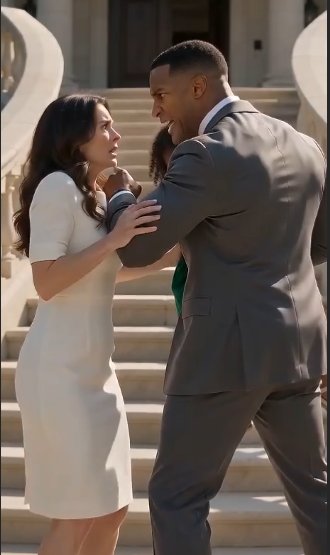
I saw my daughter go over the railing.
There are moments your mind refuses to understand even while your body has already started moving.
That was one of them.
One second, seven-year-old Sophie was standing on the upper outdoor staircase of my family's Virginia estate, one small hand resting on the white stone railing.
The next—
her body disappeared over the side.
Her pink dress lifted in the air.
Her arms reached for something that wasn't there.
And she screamed:
“DADDY!”
I was in the courtyard below.
Maybe twenty feet away.
I didn't think.
I ran.
Someone behind me shouted.
A champagne glass shattered.
I crossed the stone courtyard as my daughter fell toward it.
Three steps.
Four.
Five.
I threw myself forward.
Sophie hit my arms hard enough to knock me backward.
Her shoulder struck my chest.
My knees slammed onto the stone.
For half a second, I couldn't breathe.
Then I heard her crying.
That sound was the most beautiful thing I'd ever heard.
“Daddy!”
“I've got you.”
She wrapped both arms around my neck.
I pulled her against me.
“I've got you, baby.”
Guests were running toward us.
Someone shouted for an ambulance.
Another person yelled to give us space.
But I wasn't looking at them.
I was looking up.
At the staircase.
At the woman standing at the railing.
Vanessa.
My wife's older sister.
She stared down at us.
Her right hand was still extended.
The same hand I had watched press against my daughter's back.
For one second, neither of us moved.
Then Vanessa jerked her hand toward herself.
Her face changed.
She ran.
Not away.
Down the staircase.
Her heels struck the steps rapidly.
CLACK.
CLACK.
CLACK.
“Sophie!”
I tightened my arms around my daughter.
Vanessa came around the curve.
“It was an accident!”
I looked at her.
She kept descending.
“SHE SLIPPED!”
My daughter buried her face against my chest.
I stood slowly.
My knees hurt.
My arms shook.
But Sophie stayed against me.
Vanessa reached the bottom.
“Michael, listen to me—”
“DON'T LIE TO ME.”
She stopped.
Dozens of people were watching.
I pointed toward the staircase.
“YOU PUSHED HER.”
The color drained from Vanessa's face.
“No.”
“I watched you.”
“She lost her balance.”
“I saw your hand.”
“Michael, you're confused.”
“I watched the entire thing from the courtyard.”
She stared at me.
Then at Sophie.
And that's when she made the worst possible decision she could have made.
She stepped toward my daughter.
“Sophie, tell your father what happened.”
I moved backward.
“Stop.”
Vanessa kept coming.
“Sophie, sweetheart, you know Aunt Vanessa didn't—”
“STOP.”
My voice echoed across the courtyard.
She ignored me.
Another step.
My daughter started trembling.
“Daddy…”
Vanessa reached toward her.
And a woman stepped between us.
My mother.
Seventy-one years old.
Five-foot-three.
Silver hair.
Pearl earrings.
Holding a half-empty glass of iced tea.
She looked Vanessa directly in the face.
“You take one more step toward my granddaughter…”
Vanessa froze.
My mother lowered the glass.
“…and you're going to explain to the police why you ignored her father after he told you to stay away.”
For the first time since Sophie fell—
Vanessa stopped moving.
Then my daughter whispered something into my neck.
So quietly that nobody else heard it.
I almost didn't either.
“She said Mommy would love me less.”
I looked at Vanessa.
And suddenly I understood that what I'd witnessed on the staircase hadn't started on the staircase.
My name is Michael Callahan.
I was forty-four years old when my sister-in-law pushed my daughter from an upper staircase during my parents' anniversary party.
That's the simplest version.
It's also incomplete.
Because families rarely explode because of one moment.
The explosion is simply the part everyone notices.
The pressure usually started building years earlier.
The estate belonged to my parents.
Not me.
That matters.
My father, Richard Callahan, built a commercial landscaping company from two trucks and six employees into a regional business operating across Virginia and North Carolina.
He never called himself wealthy.
Everyone else did.
By the time he retired, he and my mother, Eleanor, owned a large house outside Charlottesville on fourteen acres.
Calling it a house was technically accurate in the same way calling a cruise ship a boat is technically accurate.
It had nine bedrooms.
A library.
Two kitchens.
A courtyard.
A pool.
A guesthouse.
And a curved exterior staircase connecting the second-floor terrace to the rear gardens.
That staircase almost killed my daughter.
My parents were celebrating their fiftieth wedding anniversary.
Nearly eighty guests had come.
Family.
Friends.
Former employees.
Neighbors.
People my parents had known since college.
Sophie had been excited for weeks.
She had picked out her own dress.
Pink.
Tiny white flowers around the waist.
She'd asked me approximately seventeen times whether she was old enough to stay awake until the cake was cut.
“You're seven.”
“That's not an answer.”
“It is technically an answer.”
“Daddy.”
“Yes.”
“Can I?”
“We'll see.”
She hated “we'll see.”
Every child does.
My wife, Laura, was inside when it happened.
She was helping my mother with a slideshow.
That's another detail that would haunt her.
For months afterward, Laura would say:
“I should've been outside.”
And every time, I would tell her:
“No.”
Because guilt loves imaginary alternatives.
If only I'd gone outside.
If only I'd stood there.
If only I'd looked up.
If only.
But Vanessa pushed Sophie.
Not Laura.
Responsibility belonged where the action belonged.
It took Laura a long time to accept that.
Vanessa Hart was Laura's sister.
Forty-seven.
Three years older.
Beautiful in a polished, intimidating way.
Dark hair.
Expensive clothes.
Perfect posture.
She had spent most of her adult life in Atlanta, where she'd worked in luxury real estate.
Her marriage had ended two years earlier.
No children.
That fact became important only because Vanessa believed it was important.
For years, she had been close to Sophie.
At least we thought she had.
Birthday gifts.
Christmas visits.
Trips to museums.
Matching bracelets.
When Sophie was four, Vanessa took her to a children's theater production and bought her a ridiculous princess crown afterward.
Sophie wore it for three weeks.
There had been no obvious reason to believe Vanessa might hurt her.
That's what made everything afterward so difficult to understand.
After my mother stepped between us, one of my friends called 911.
I didn't.
I was focused on Sophie.
She was conscious.
Crying.
Talking.
Moving both arms.
But she'd fallen far enough that I wasn't taking chances.
I sat on a stone bench.
Sophie stayed on my lap.
My friend Aaron knelt nearby.
“Ambulance is coming.”
I nodded.
“Don't move her more than necessary.”
“I know.”
He looked at me.
Aaron was an emergency physician.
That helped.
And terrified me.
Because when an emergency physician looks worried about your child, every second expands.
Vanessa stood twenty feet away.
My mother remained between us.
People whispered.
Laura came through the terrace doors.
She saw the crowd.
Then me.
Then Sophie.
Her face changed instantly.
“What happened?”
She ran.
Sophie reached for her.
“Mommy!”
Laura dropped beside us.
“Oh my God.”
She touched Sophie's hair.
“What happened?”
Sophie started crying harder.
Laura looked at me.
I said:
“She fell from the upper stairs.”
Laura went white.
“What?”
“I caught her.”
“How?”
“Laura—”
“HOW?”
“I caught her.”
Then Vanessa said from behind my mother:
“It was an accident.”
Laura turned.
Vanessa stepped sideways.
“She slipped.”
I stood.
“No.”
Laura looked between us.
“What?”
I said:
“Vanessa pushed her.”
Silence.
Laura stared at me.
Then at her sister.
Vanessa shook her head.
“Michael didn't see it correctly.”
I felt something hot move through my chest.
But before I could answer, Sophie cried:
“SHE DID!”
Everyone stopped.
Sophie pointed.
“Aunt Vanessa pushed me!”
Laura looked at her sister.
Vanessa whispered:
“Sophie…”
My mother raised one hand.
“Do not speak to her.”
Vanessa's face tightened.
“I'm her aunt.”
My mother answered:
“Not right now, you're not.”
The paramedics arrived eleven minutes later.
It felt like an hour.
They evaluated Sophie in the courtyard.
Neck.
Head.
Shoulders.
Arms.
Back.
Legs.
Pupils.
Questions.
“What's your name?”
“Sophie Callahan.”
“How old are you?”
“Seven.”
“Do you know where you are?”
“Grandma's house.”
“What hurts?”
“My arm.”
My stomach dropped.
The paramedic carefully examined her left wrist.
Sophie cried when he touched it.
He looked at me.
“We're going to immobilize that.”
Laura squeezed my hand.
Police arrived almost simultaneously.
Two county deputies.
Then another unit.
The anniversary party ended without anyone officially announcing it had ended.
Nobody wanted cake anymore.
Guests began leaving quietly.
Several remained because they'd witnessed parts of what happened.
One woman had seen Vanessa and Sophie together on the staircase.
A man near the fountain had seen Sophie fall.
Another guest had seen me run and catch her.
Nobody except me claimed to have clearly seen the push itself.
At least initially.
That mattered.
Vanessa immediately became calmer when deputies arrived.
That disturbed me.
She'd been frantic seconds earlier.
Now she folded her hands.
Controlled her breathing.
Spoke softly.
“She slipped.”
One deputy asked:
“You were near her?”
“Yes.”
“How near?”
“Behind her.”
“Did you touch her?”
“No.”
I heard that.
From across the courtyard.
I looked at Laura.
She heard it too.
Vanessa hadn't said:
I tried to catch her.
I accidentally bumped her.
I touched her but didn't push.
She said:
No.
A clean denial.
That meant there was no room left for misunderstanding.
I had seen her hand on Sophie.
And now she was lying.
I rode in the ambulance with Sophie.
Laura followed in our car.
My parents stayed behind to speak with police.
Before the ambulance doors closed, I saw Vanessa sitting alone on a garden chair.
A deputy stood nearby.
She looked at me.
I looked back.
No words.
I didn't need any.
Sophie had a fractured wrist.
Bruising along her hip.
A scrape on her shoulder.
Nothing worse.
No head injury.
No spinal injury.
No internal injury.
When the doctor told us, Laura sat down and cried.
I leaned against the wall.
My legs stopped working for a moment.
I'd caught her.
Actually caught her.
A few inches differently—
a second slower—
I stopped myself.
Imaginary outcomes can torture you almost as effectively as real ones.
Sophie was alive.
She was talking.
That was the reality I forced myself to stay inside.
The doctor asked Sophie what happened.
Not aggressively.
Not like an interrogation.
Just:
“Do you remember how you fell?”
Sophie looked at Laura.
Then me.
I said:
“You can tell her.”
Sophie nodded.
“Aunt Vanessa pushed me.”
The doctor did not react dramatically.
“What happened before that?”
Sophie looked down.
“She was mad.”
“About what?”
“I don't know.”
Laura's hand tightened around mine.
The doctor asked:
“Did she say anything?”
Sophie nodded.
Then became quiet.
“What did she say?”
Sophie looked at her mother.
“I don't want Mommy to be sad.”
Laura moved closer.
“Baby, you can't make me sad by telling the truth.”
Sophie started crying.
“Aunt Vanessa said you loved me too much.”
Laura froze.
“What?”
“She said I took you away from her.”
Laura's face emptied.
I remembered what Sophie had whispered in the courtyard.
She said Mommy would love me less.
Now it had context.
And the context was worse.
We didn't press Sophie for more.
The doctor didn't either.
Children aren't machines you shake until facts fall out.
She'd been injured.
Terrified.
Exhausted.
There would be trained people to speak with her appropriately later.
That night, she needed her parents.
Around 9:00 p.m., my father called.
“Michael.”
“How's Sophie?”
“Broken wrist. Bruises. Doctor says she'll be okay.”
My father exhaled.
“Thank God.”
“What happened there?”
“The deputies took statements.”
“Vanessa?”
“She left with an attorney.”
I stared at the hospital wall.
“An attorney?”
“She called one.”
“Already?”
“Yes.”
That told me she understood the seriousness.
Dad continued:
“And Michael…”
“What?”
“We found something.”
I stood straighter.
“What?”
“The courtyard camera.”
I had forgotten about it.
My parents installed security cameras after a burglary in a neighboring property three years earlier.
Most covered entrances.
Driveway.
Garage.
Side gates.
One camera sat beneath the rear terrace roof overlooking the courtyard.
I knew it existed.
I'd seen it hundreds of times.
But I hadn't thought about it once since Sophie's fall.
“Does it show the staircase?”
“Part of it.”
My heart started pounding.
“Does it show Vanessa?”
“We haven't watched everything.”
“Dad.”
“The deputy told us not to start passing footage around. They're preserving it.”
“Did you see the fall?”
“Yes.”
“And?”
Silence.
“Dad.”
His voice broke.
“Michael, you were right.”
I closed my eyes.
The camera angle wasn't perfect.
It didn't show every step.
A stone column blocked part of the upper landing.
But it showed enough.
Sophie appeared near the upper railing.
Vanessa appeared behind her.
They spoke.
No audio.
Sophie tried to move away.
Vanessa stepped closer.
Sophie turned toward the stairs.
Vanessa reached out.
Her hand contacted Sophie's upper back.
Then extended.
Sophie went forward.
Over.
Vanessa did not reach to catch her.
She did not recoil as though surprised by an accidental collision.
She stood at the railing and looked down.
Then ran toward the stairs only after I caught Sophie.
The footage didn't explain motive.
It didn't answer every question.
But it destroyed:
She just fell.
Laura didn't watch it that night.
I did.
Once.
Then wished I hadn't.
Seeing your child fall once in real life is enough.
Watching it again on a screen feels obscene.
I saw myself in the courtyard.
Tiny in the frame.
Head turning.
Then running.
I watched Sophie disappear over the edge.
Watched myself reach her.
Watched both of us hit the ground.
Then Vanessa.
Still above.
Still looking.
I paused.
Her hand was visible near the railing.
I stared at the screen.
Laura stood behind me.
“Turn it off.”
I did.
She whispered:
“I can't.”
“You don't have to.”
“That's my sister.”
I turned.
Laura covered her mouth.
“My sister.”
I held her.
She collapsed against me.
The next morning, Vanessa called Laura.
Laura stared at the phone.
Didn't answer.
It rang again.
Then a message arrived.
Please let me explain before Michael turns everyone against me.
Laura showed me.
I said nothing.
Another message.
It wasn't what he thinks.
Then:
Sophie was already losing her balance. I reached for her.
Laura looked at me.
“That's not what she told police.”
“No.”
“She said she never touched her.”
“I know.”
Another message arrived.
I panicked.
Laura sat down.
That was the first crack.
Vanessa's story was changing before she'd even seen the footage.
Laura typed:
Do not contact Sophie.
Vanessa immediately called.
Laura rejected it.
Then typed:
Do not come to our house. Do not come to Mom and Dad's house. Speak through your attorney if necessary.
Vanessa responded:
You're choosing him over me again.
Laura stared at those words.
Again.
Not:
You're misunderstanding me.
Not:
I'm terrified.
Not:
I'm sorry Sophie got hurt.
You're choosing him over me again.
Laura put the phone down.
And I watched twenty years of family history rearrange itself behind her eyes.
The story began long before Sophie.
Laura and Vanessa's mother died when Laura was fourteen and Vanessa seventeen.
Their father struggled afterward.
Vanessa became protective of Laura.
Sometimes appropriately.
Sometimes excessively.
She drove her to school.
Helped with homework.
Cooked.
Covered for their father when grief made him unreliable.
Laura adored her.
For years, Vanessa wasn't merely a sister.
She was half parent.
That bond survived adulthood.
When Laura moved to Virginia for graduate school, Vanessa hated it.
When Laura and I began dating, Vanessa disliked me immediately.
Not openly.
Politely.
Which can be worse.
She questioned everything.
My career.
My family.
My intentions.
“Michael's family has money.”
Laura laughed.
“So?”
“Just be careful.”
“Of what?”
“Power differences.”
I didn't know about that conversation until years later.
When we got engaged, Vanessa said:
“That's fast.”
We'd been together three years.
When we bought a house:
“That's far from me.”
When Laura became pregnant:
“Everything's changing.”
That phrase appeared repeatedly.
Everything's changing.
What she meant was:
Laura is changing in ways I can't control.
After Sophie was born, Vanessa was initially thrilled.
Then something shifted.
Laura's attention naturally moved toward her child.
Vanessa interpreted that as abandonment.
If Laura didn't answer a call:
“You used to make time for me.”
If we couldn't travel to Atlanta:
“Michael's family gets every holiday.”
Not true.
If Laura chose Sophie's school event over a weekend trip:
“You're disappearing into motherhood.”
Laura thought Vanessa was lonely.
So she compensated.
Called more.
Invited her more.
Made room.
Every accommodation temporarily soothed Vanessa.
Then became the new minimum.
We didn't understand the pattern.
Two years before the staircase incident, Vanessa's marriage ended.
Her husband, Peter, filed for divorce.
I didn't know all the details.
I still don't.
Laura flew to Atlanta repeatedly.
Helped Vanessa move.
Sat with her through mediation.
Stayed for a week after the house sold.
I supported it.
Vanessa was family.
But after the divorce, her dependence on Laura intensified.
She called at midnight.
During dinner.
During vacations.
Once during Sophie's school play.
Laura stepped outside to answer.
Afterward I said:
“You don't have to answer every time.”
“She has nobody.”
“She has friends.”
“Not like me.”
That sentence mattered.
Not like me.
Vanessa believed there was a category of loyalty only Laura could provide.
And every other person in Laura's life competed with it.
Including our daughter.
None of that excused what happened.
Understanding motive is not forgiveness.
But eventually investigators needed to understand why an aunt who had bought princess crowns for a child would put a hand against that child's back beside a staircase.
The answer wasn't one dramatic secret.
It was obsession mixed with resentment.
Sophie later told a trained child interviewer that Vanessa had taken her upstairs before the fall.
Vanessa told her:
“Your mom used to love spending time with me.”
Sophie said:
“She still does.”
Vanessa answered:
“Not since you came.”
A seven-year-old doesn't understand adult resentment.
Sophie thought Vanessa was joking.
She laughed.
Apparently that made Vanessa angrier.
Vanessa said:
“Everything is always Sophie now.”
Sophie replied:
“Because I'm her kid.”
That sentence came from my daughter.
Simple.
Obvious.
Devastating.
According to Sophie, Vanessa then said:
“One day you'll understand people get tired of giving everything to children.”
Sophie tried to walk downstairs.
Vanessa caught her shoulder.
Sophie said:
“Let go.”
Then:
“You're mean.”
Vanessa said:
“Your mother would have a life if she wasn't always running after you.”
Sophie answered:
“Mommy likes me.”
That was when Vanessa told her:
“Your mommy loved me first.”
Sophie turned away.
Then Vanessa pushed.
Was it planned?
That question haunted everyone.
Prosecutors would later wrestle with it.
So did I.
There was no message saying:
I'm going to hurt Sophie.
No weapon.
No elaborate setup.
No evidence Vanessa arrived at the party intending to throw a child from a staircase.
The evidence suggested an escalating confrontation.
Resentment.
Anger.
A terrible impulse.
A deliberate physical act with potentially catastrophic consequences.
That was bad enough.
We didn't need to invent more.
Vanessa's attorney argued she had reached for Sophie after the child stumbled.
The video contradicted important parts of that.
Vanessa's own changing statements caused additional problems.
First:
No contact.
Then:
Reached to help.
Then:
Accidental contact.
Then:
Tried to stop her.
Each version moved closer to what the evidence showed while trying to preserve innocence.
That's rarely persuasive.
But what disturbed Laura most wasn't the legal defense.
It was what Vanessa had done immediately after.
She came toward Sophie.
She tried to speak directly to her.
“Sophie, tell your father what happened.”
After lying to police.
After I told her to stop.
After Sophie was crying.
Laura saw it differently once she had time to think.
“She was trying to get to her before Sophie talked.”
I didn't answer.
Laura repeated:
“She was going to tell Sophie what to say.”
“Maybe.”
“No.”
She looked at me.
“That's why she kept coming.”
Possibly.
We couldn't know exactly what was in Vanessa's mind.
But Laura never forgot it.
Neither did I.
A temporary protective order followed.
Then a longer one after hearings and legal review.
We didn't post about it online.
Didn't give interviews.
Didn't release the security video.
Someone at the party leaked enough information that rumors spread anyway.
By Monday, people were messaging.
Is Sophie okay?
Did Vanessa really push her?
I heard she threw her off a balcony.
That last one wasn't accurate.
I corrected anyone close to us.
“She was pushed from the staircase area. Please don't exaggerate.”
People thought I was being overly technical.
I wasn't.
Truth was already serious enough.
It didn't need help.
Sophie became afraid of stairs.
That was one consequence no courtroom could measure neatly.
At home, she'd stop at the top.
Look down.
Freeze.
Our staircase had carpet.
Only thirteen steps.
Didn't matter.
The first week after the incident, I carried her.
Then our therapist advised us not to turn avoidance into permanence.
So we worked slowly.
One step.
Then two.
Holding the railing.
Me beside her.
Laura below.
Never forcing.
Never saying:
“There's nothing to be afraid of.”
Because there was.
Her body had learned that stairs could become danger.
We needed to help it learn safety again.
One afternoon she stood at the top.
Cast on her wrist.
Tears in her eyes.
“I can't.”
I said:
“Okay.”
She looked at me.
“You said we were practicing.”
“We are.”
“But I'm not doing it.”
“Standing there is part of practicing.”
She thought about that.
Then put one foot down.
One step.
Stopped.
I didn't cheer.
Didn't make it a performance.
I just said:
“I'm right here.”
She took another.
Three months later, she ran downstairs because she smelled pancakes.
I stood in the kitchen and nearly cried.
Healing rarely announces itself.
Sometimes it just comes downstairs hungry.
Laura struggled differently.
She lost her sister.
Not physically.
Vanessa was alive.
But the person Laura believed Vanessa to be was gone.
That kind of grief is complicated because the person can still text you.
Can still send letters.
Can still ask family members to intervene.
Vanessa did all three.
Their father, Thomas, initially defended Vanessa.
Not the push.
He said he didn't believe she'd intentionally done it.
He called Laura.
“You know your sister.”
Laura answered:
“I thought I did.”
“She raised you.”
“She helped raise me.”
“She loves you.”
“I know.”
“She loves Sophie.”
Laura went silent.
Then:
“Dad, don't use love as an excuse for what she did.”
Thomas started crying.
“She lost everything.”
Laura's face changed.
“She almost made me lose my daughter.”
That ended the conversation.
Thomas didn't speak to us for three weeks.
Then he watched the footage.
He had avoided it.
When he finally did, he called.
His voice sounded twenty years older.
“I saw it.”
Laura said nothing.
“I saw her hand.”
Laura started crying.
Thomas whispered:
“I'm sorry.”
Not for Vanessa.
For himself.
For doubting.
For asking Laura to soften reality so he could survive it.
Families often do that after something terrible.
They don't necessarily deny because evidence is weak.
They deny because accepting truth requires rearranging too many relationships.
If Vanessa had deliberately pushed Sophie, then Thomas had to accept one daughter had harmed his granddaughter.
Laura had to accept her sister wasn't safe.
My parents had to accept violence had happened during their celebration.
Everyone wanted a version that cost less.
Accident.
Misunderstanding.
Slip.
Anything.
The camera refused to negotiate.
Vanessa eventually faced criminal proceedings.
I won't romanticize them.
They were miserable.
Slow.
Technical.
Continuances.
Motions.
Interviews.
Evidence review.
Expert questions about the fall.
Video enhancement.
Medical records.
Statements.
Her attorney challenged interpretations.
Our attorney reminded us repeatedly that outrage wasn't evidence.
I appreciated that.
Mostly.
Sometimes I wanted outrage to count.
It doesn't.
Vanessa eventually accepted responsibility through a plea rather than forcing Sophie through a full trial.
The legal consequences included incarceration followed by supervision and strict restrictions on contact.
The exact label attached to the offense mattered to lawyers.
To me, what mattered was that the official record no longer said:
Sophie just fell.
It said Vanessa caused it.
That mattered.
Not because a court could heal my daughter.
Because truth shouldn't be negotiated into disappearance merely because acknowledging it hurts a family.
Before sentencing, Vanessa submitted a letter.
Laura received a copy through counsel.
She didn't read it for two weeks.
Then one Sunday afternoon she asked me to sit with her.
The first page was apology.
The second was explanation.
Childhood.
Losing their mother.
Feeling responsible for Laura.
Her divorce.
Loneliness.
Watching Laura build a family.
Feeling replaced.
Resenting me.
Then Sophie.
Vanessa wrote:
Every time Laura chose Sophie, I knew intellectually that a mother was supposed to choose her child. Emotionally, it felt like being abandoned again.
Laura stopped reading.
Her hands shook.
I waited.
She continued.
That day, Sophie said Laura liked being her mother more than being my sister. I became angry at a child for saying something that was essentially true.
Laura cried.
Then came the sentence neither of us expected.
I put my hand on her and pushed. I have spent months wanting to call it something else. It was not something else.
Laura lowered the pages.
That was the first unqualified admission we'd seen.
No slipped.
No reached.
No accident.
I pushed.
The letter continued:
I did not think through what could happen when she went over the side. That does not make what I did accidental. It makes it reckless, cruel, and unforgivable in that moment.
I disliked one word.
Unforgivable.
Not because I believed Vanessa deserved forgiveness.
Because she didn't get to decide that either.
Forgiveness belonged to the people she'd harmed.
If it ever came.
Then:
When Michael caught her, I panicked. I ran downstairs because I wanted to control what Sophie said. Michael told me to stop. I kept walking toward her anyway. I was thinking about myself. I understand why that made everything worse.
Laura covered her face.
There it was.
The answer.
Why Vanessa kept coming.
She wasn't rushing to comfort Sophie.
She was trying to reach the child before the child's truth became fixed in everyone else's minds.
That choice became almost as disturbing to Laura as the push.
Vanessa ended:
Laura, I used everything I did for you when we were young as if it created a debt you were supposed to repay forever. It didn't. You did not abandon me by becoming a wife or mother. Sophie did not steal you. Michael did not steal you. I turned love into ownership and called the result loyalty.
Laura read that paragraph three times.
Then folded the letter.
“Do you believe her?”
I asked:
“About what?”
“That she understands.”
“Maybe.”
“Does it matter?”
“Yes.”
She looked at me.
“But it doesn't mean you owe her anything.”
Laura nodded.
“I know.”
That was progress.
Months earlier, she wouldn't have known.
Sophie did not read the letter.
She was eight by then.
There was nothing in it she needed.
Children shouldn't become the audience for adults' redemption.
Vanessa's remorse was Vanessa's responsibility.
Sophie was allowed to heal without helping the person who hurt her feel forgiven.
Years passed.
Slowly.
The dramatic part of the story ended.
The ordinary consequences remained.
Sophie grew.
Her wrist healed.
The cast came off.
She returned to gymnastics eventually, although she never loved the balance beam again.
She developed a fierce dislike of anyone touching her unexpectedly from behind.
We taught family members to respect that.
No jokes.
No sneaking up.
No “she needs to get over it.”
Her boundaries belonged to her.
When she was ten, she asked:
“Is Aunt Vanessa evil?”
I hated the question.
Children like categories.
Heroes.
Villains.
Safe.
Dangerous.
Adults know people don't fit cleanly.
I said:
“She did something very dangerous and very wrong.”
“That isn't what I asked.”
“I know.”
“Is she bad?”
I sat beside her.
“People can do terrible things without every part of them being terrible.”
Sophie frowned.
“So she's good?”
“No.”
“Dad.”
I smiled sadly.
“It's complicated.”
“I hate when adults say that.”
“So do I.”
She thought.
Then asked:
“Do I have to forgive her?”
“No.”
That answer came easily.
“Ever?”
“No.”
“What if she says sorry?”
“You can accept that she's sorry without deciding she gets to be close to you.”
Sophie nodded.
That distinction mattered to her.
It mattered to me too.
Laura eventually exchanged letters with Vanessa.
Not visits.
Not phone calls initially.
Letters.
Her therapist helped her establish boundaries.
Laura didn't write:
I forgive you.
She wrote:
I believe you're taking responsibility. I am not ready for a relationship.
Vanessa answered:
I understand.
For once, she didn't argue.
That was perhaps the first evidence of real change.
Thomas struggled.
He wanted reconciliation before everyone else was ready.
“Family shouldn't stay broken forever.”
Laura answered:
“Then stop trying to repair it on your schedule.”
He didn't like that.
But he listened.
Eventually.
My parents removed the exterior staircase during a renovation.
Not because Sophie asked.
She didn't.
My mother hated looking at it.
The contractor proposed repairing the railing and updating the stone.
Mom said:
“Take the whole damn thing out.”
My father looked at her.
“You always liked those stairs.”
“I changed my mind.”
Gone.
In its place, they built a covered terrace with a ground-level garden entrance.
When Sophie saw it, she stood in the courtyard.
“Where are the stairs?”
“Grandma redesigned it.”
Sophie looked at my mother.
“Because of me?”
Mom said:
“Because I wanted more flowers.”
Sophie knew she was lying.
So did everyone.
But some lies are really gifts wrapped badly.
My parents stayed in that house another six years.
Then downsized.
The estate sold to a family from Maryland.
I never told them what happened on the staircase.
Not because it was secret.
Because houses aren't guilty.
Stone doesn't remember unless people force it to.
Sophie was fourteen when she asked to watch the security footage.
Laura immediately said no.
I said:
“Let's talk about why.”
Sophie folded her arms.
“I want to know.”
“You remember what happened.”
“Parts.”
“What do you think watching it will give you?”
“I don't know.”
“That's important.”
She became angry.
“You watched it.”
“Yes.”
“Mom watched it.”
“Yes.”
“So everyone gets to see what happened to me except me?”
That landed.
We spoke with her therapist.
Eventually, we agreed.
Not casually.
Not alone.
Not on a phone she could replay endlessly.
One viewing.
With us.
She could stop anytime.
Sophie watched herself walk onto the upper stairs.
Watched Vanessa follow.
Watched the silent argument.
Watched the hand.
The fall.
My run.
My catch.
She didn't cry during the fall.
She cried afterward.
When the video showed Vanessa looking over the railing.
Sophie paused it.
“She didn't try to catch me.”
“No.”
“She just watched.”
“Yes.”
Then:
“You were really far away.”
I looked at the screen.
It looked farther on video than it had felt.
“I guess.”
“You almost didn't make it.”
Laura started crying.
I said:
“But I did.”
Sophie looked at me.
“You didn't even stop.”
“What?”
“You just ran.”
“I saw you falling.”
She leaned against me.
For years, I'd thought the video was evidence of Vanessa's act.
For Sophie, it became evidence of something else too.
Her father ran.
She never asked to watch it again.
When Sophie was seventeen, Vanessa became eligible under the relevant legal restrictions to request limited contact.
She didn't.
Instead, she sent a letter through Laura.
It was addressed to Sophie.
Laura asked our daughter if she wanted it.
Sophie thought for three days.
Then said yes.
The letter was short.
No childhood explanation.
No excuses.
No request for forgiveness.
Vanessa wrote:
Sophie, I harmed you when you were seven. I lied immediately afterward because I was afraid of what I had done and more concerned with protecting myself than protecting you. Your father saw the truth. The camera confirmed it. But neither of those facts is why I accept responsibility. I accept it because I know what I chose.
Then:
You owe me no reply, relationship, forgiveness, or understanding. I hope your life is large enough that what I did becomes a small part of it.
Sophie read it.
Folded it.
Put it in a drawer.
I asked nothing.
Three weeks later, she said:
“I believe she's sorry.”
I nodded.
“Do you want to answer?”
“No.”
“Okay.”
“Are you disappointed?”
“No.”
“Mom?”
“No.”
She looked relieved.
That was all.
Sophie went to college in North Carolina.
Studied architecture.
I found that funny.
After everything, my daughter chose buildings.
She specialized eventually in public spaces and accessibility.
Her senior project included a large staircase.
When she showed me the design, I stared longer than I should have.
She noticed.
“Dad.”
“What?”
“It's a staircase.”
“I know.”
“It has a railing.”
“I see that.”
“A very high railing.”
“I appreciate it.”
She rolled her eyes.
At twenty-three, Sophie returned to Virginia for my mother's eightieth birthday.
Vanessa was invited.
That decision belonged primarily to Sophie and Laura.
I didn't love it.
But Sophie was an adult.
She said:
“I don't want Grandma arranging separate birthdays forever.”
I asked:
“Are you sure?”
“Yes.”
“Do you want me near you?”
She smiled.
“Dad, I'm twenty-three.”
“That wasn't my question.”
Her smile softened.
“Yes.”
So I stayed near.
Not hovering.
Near.
Vanessa arrived early.
She was sixty-three.
Gray in her hair now.
No dramatic entrance.
No tears.
She greeted my parents.
Then Laura.
Then me.
“Michael.”
“Vanessa.”
Finally Sophie entered the room.
Vanessa stopped.
Sophie did too.
Everyone pretended not to watch.
Terribly.
Families are bad actors.
Vanessa said:
“Hi, Sophie.”
“Hi.”
Then silence.
Vanessa didn't step forward.
Didn't reach for a hug.
Didn't say:
Look how grown up you are.
Didn't demand anything.
She waited.
Sophie walked closer.
Stopped several feet away.
“I got your letter.”
Vanessa nodded.
“I know.”
“I didn't answer.”
“You didn't have to.”
“I know.”
Another silence.
Then Sophie said:
“I believe you meant it.”
Vanessa's eyes filled.
“Thank you.”
Sophie immediately added:
“That doesn't mean everything's okay.”
Vanessa nodded.
“I understand.”
And she stayed where she was.
That mattered more than anything she could've said.
Twenty-three-year-old Sophie closed the distance later.
On her terms.
They never became the aunt and niece they'd once been.
That relationship was gone.
Something smaller developed.
Holiday conversations.
Occasional messages.
Birthday cards.
No private trips.
No intense emotional closeness.
No pretending.
Sometimes repair means rebuilding the house.
Sometimes it means clearing the ruins and putting a bench where the house used to be.
Both can be forms of peace.
Laura and Vanessa also rebuilt something.
Slowly.
With boundaries.
Laura no longer answered midnight calls unless there was an actual emergency.
No guilt trips.
No loyalty tests.
No:
After everything I've done for you.
The first time Vanessa slipped into old language, Laura ended the conversation.
Not angrily.
“I'm going to go now.”
Vanessa apologized the next day.
That was new.
Change isn't proven by never making old mistakes.
Sometimes it's proven by what happens immediately after you recognize one.
My relationship with Vanessa remained distant.
Civil.
Nothing more.
People occasionally found that strange.
“If Sophie can forgive her, why can't you?”
First, Sophie never described what she did as full forgiveness.
Second, Sophie's decision did not obligate mine.
Third, I didn't hate Vanessa.
That was enough.
I could wish her well without inviting closeness.
Boundaries aren't revenge.
I'm sixty-one now.
Sophie is twenty-four.
She still calls me whenever she has car trouble despite having roadside assistance.
Laura and I are still married.
My parents are both alive.
Dad complains about his knees.
Mom complains about Dad complaining about his knees.
Some things remain stable.
Last summer, Sophie and I visited my parents' old estate.
The new owners had turned part of the property into a small event venue.
Sophie had been invited to consult on an accessibility renovation.
She asked me to come.
I almost declined.
Then went.
We entered through the courtyard.
The staircase was still gone.
The garden my mother installed had grown enormous.
Hydrangeas.
Boxwoods.
Climbing roses.
Sophie stood where I had caught her seventeen years earlier.
She looked around.
“This is smaller than I remember.”
“Everything from childhood is.”
She pointed.
“Were you over there?”
I followed her finger.
“About there.”
“And I fell from…”
She looked toward the terrace.
“Yes.”
She studied the distance.
Then looked at me.
“How did you catch me?”
“I ran.”
“No, seriously.”
“So am I.”
She shook her head.
“You were forty-four.”
“Ancient.”
“Basically.”
I laughed.
Then she walked to the exact place where I'd dropped to my knees.
The stone had been replaced during renovations.
Nothing marked it.
She said:
“You know what I remember most?”
“What?”
“Not falling.”
I waited.
“I remember hitting you.”
I smiled.
“Pretty hard.”
“I remember your shirt.”
“What about it?”
“Blue.”
It had been.
“And you kept saying, ‘I've got you.’”
My throat tightened.
She looked at me.
“That's what I remember.”
Not Vanessa's hand.
Not the railing.
Not the scream.
I've got you.
For years, I had remembered the event as the moment someone tried to harm my daughter.
Sophie remembered it partly as the moment her father caught her.
Same event.
Different center.
We walked through the garden.
At the far end, Sophie stopped.
“Dad?”
“Yeah?”
“What would've happened if you hadn't seen?”
I knew exactly what she meant.
I could've given her physics.
Distance.
Stone.
Injury probabilities.
I didn't.
“I saw.”
“But if you hadn't?”
“I did.”
She smiled slightly.
“You hate hypothetical questions.”
“Only terrible ones.”
She nodded.
Then said:
“I think Mom would've blamed herself forever.”
“Probably.”
“You too?”
“Yes.”
She looked toward the terrace.
“Vanessa?”
I thought.
“Probably in a different way.”
Sophie was quiet.
Then:
“I'm glad you saw.”
“So am I.”
That evening, driving home, I remembered the moment again.
Not the softened version.
The actual one.
My daughter on the staircase.
Vanessa behind her.
A hand extending.
Sophie's body going forward.
Her scream.
My legs moving before thought.
Stone beneath my shoes.
People shouting.
Her body dropping.
My arms reaching.
Impact.
Pain.
Her crying.
Alive.
Then Vanessa rushing down.
“SHE SLIPPED!”
Me holding Sophie.
Looking directly at the woman whose hand I'd seen.
“DON'T LIE TO ME. YOU PUSHED HER!”
And Vanessa continuing toward us.
That was the part I had never understood until her letter.
She wasn't coming because she couldn't bear to see Sophie hurt.
She was coming because she couldn't bear to lose control of the story.
She wanted to reach my daughter before the truth did.
But she was already too late.
I had seen it.
Other people had seen pieces.
The camera had recorded it.
Most importantly—
Sophie knew what happened to her.
For years, I thought catching Sophie was the most important thing I did that day.
Physically, it was.
But as she grew older, I understood there was another catch.
One parents don't talk about as much.
When a child tells you someone hurt them, especially someone you love, the truth can fall just as suddenly as a body.
Adults panic.
Families protect themselves.
People search for softer explanations.
Maybe she misunderstood.
Maybe it was an accident.
Maybe she exaggerated.
Maybe we shouldn't destroy the family over this.
Those explanations can arrive very quickly.
Sometimes faster than a father can cross a courtyard.
That day, I caught Sophie twice.
Once with my arms.
And once by refusing to let the adults around her turn what happened into something easier to live with.
She didn't “just fall.”
She wasn't confused.
She wasn't responsible for Vanessa's anger.
And she didn't owe anyone silence to keep a family comfortable.
That's what I would tell any parent who asks what I learned.
Not that you should assume every accusation is automatically true.
Evidence matters.
Questions matter.
Fairness matters.
But comfort is not evidence.
Family loyalty is not evidence.
A person's previous kindness is not evidence that they could never cause harm.
And a child's truth does not become less important because believing it creates consequences for someone you love.
Vanessa's life didn't end because we told the truth.
It changed.
Ours did too.
She faced consequences.
She got help.
She eventually took responsibility.
She built a life after what she'd done.
Sophie built one too.
That's more honest than the fantasy where one terrible act permanently freezes every person involved.
People continue.
Some become better.
Some don't.
Some relationships return.
Some shouldn't.
What never changed was the fact itself.
Vanessa pushed.
Sophie fell.
I caught her.
Everything afterward had to begin there.
Truth first.
Then whatever healing was possible.
Years after the incident, Vanessa once asked me a question.
We were standing outside my mother's birthday dinner.
Everyone else had gone inside.
She said:
“Michael?”
“Yes?”
“Can I ask you something?”
I almost said no.
Then nodded.
She looked toward the house.
“Do you remember what you said to me?”
“When?”
“That day.”
“I remember everything.”
She swallowed.
“When you said, ‘Don't lie to me. You pushed her.’”
“Yes.”
“I hated you.”
“I know.”
“I thought if Laura believed you, I'd lose her forever.”
I said nothing.
Vanessa continued:
“That's why I kept walking toward Sophie.”
“I know that now.”
“I thought if I could get her to say she slipped…”
She stopped.
Couldn't finish.
I finished for her.
“You could control what happened next.”
“Yes.”
She wiped her eyes.
“I think about that almost more than the push.”
“So does Laura.”
Vanessa nodded.
“I know.”
Then she said:
“You told me to stop.”
“Yes.”
“And I didn't.”
“No.”
She looked at me.
“Your mother scared the hell out of me.”
I almost laughed.
“She does that.”
Vanessa actually smiled.
Then it disappeared.
“I'm sorry.”
I nodded.
I didn't say:
It's okay.
Because it wasn't.
I didn't say:
I forgive you.
Because that wasn't what I felt.
I said:
“I believe you're sorry.”
Her eyes filled.
“Thank you.”
Then we went inside.
That was enough.
People sometimes want every painful story to end with either punishment or forgiveness.
Life has more endings than that.
Ours ended with distance.
Responsibility.
Boundaries.
Growth.
A daughter who could walk down stairs again.
A mother who learned that loving her sister didn't require surrendering herself to her.
An aunt who eventually stopped treating love like ownership.
And a father who still occasionally looks at high railings longer than normal.
I'll take that ending.
But when I think back to that afternoon, I don't begin with courtrooms.
I don't begin with therapy.
I don't begin with Vanessa's letter.
I begin in the courtyard.
Sunlight across pale stone.
Music playing.
Guests laughing.
My father talking beside the fountain.
My mother carrying iced tea.
My wife somewhere inside.
And my seven-year-old daughter appearing above me on the curved staircase.
Pink dress.
White shoes.
One hand on the railing.
Vanessa behind her.
I remember looking up for no particular reason.
Just a father checking where his child was.
Then Vanessa's hand moved.
One push.
Sophie's body tipped forward.
Her feet left the step.
And the world changed.
“DADDY!”
I ran.
I don't remember deciding to.
I don't remember the guests.
I don't remember crossing the courtyard.
I remember only watching my daughter fall toward stone and knowing there was no acceptable version of the next second where I didn't reach her.
Then—
impact.
Her body against mine.
My knees hitting the ground.
Her arms around my neck.
Her scream becoming sobs.
“Daddy!”
“I've got you.”
Above us, Vanessa stood frozen.
Then she ran down.
“SHE JUST FELL!”
I looked at her.
My daughter trembling against my chest.
And I said the sentence that divided our family into everything before it and everything after:
“DON'T LIE TO ME. YOU PUSHED HER.”
Vanessa kept coming.
One step.
Then another.
“Sophie, tell him—”
“Stop.”
She didn't.
“Sophie—”
“I SAID STOP.”
Still she moved toward my daughter.
Until my mother stepped between us.
Until the police came.
Until the camera was found.
Until Sophie's own voice became impossible to ignore.
Vanessa had believed that if she could reach my daughter quickly enough, she might still control the story.
She was wrong.
Because the story wasn't hers anymore.
It belonged to the little girl who survived it.
And seventeen years later, standing in that same courtyard, Sophie told me what she remembered most.
Not the hand behind her.
Not the railing.
Not even the fall.
She remembered a blue shirt rushing toward her.
Two arms reaching up.
And one sentence repeated while the rest of the world panicked around us:
“I've got you.”
That was the part she carried forward.
So that is the part I choose to carry too.