She Pushed My Injured Daughter Down the Stairs—Then My Daughter Pointed to the Camera
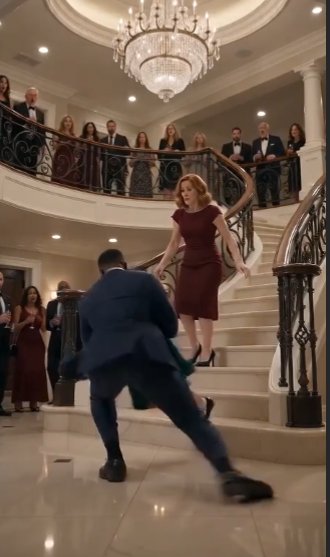
My daughter had made it down four steps when the woman behind her reached out.
I saw the hand.
I saw the push.
And then I saw my eight-year-old daughter fall.
“DADDY!”
Her scream cut through the music.
Every conversation in the foyer stopped.
Sophie's crutches flew in opposite directions.
Her right leg—still wrapped in a bright purple cast from ankle to just below the knee—twisted sideways as she struck the next step.
Then another.
Guests screamed.
Someone dropped a champagne glass.
CRASH!
I was already running.
“SOPHIE!”
She slid onto the marble landing and curled around her injured leg.
I pushed through the crowd, dropped to my knees beside her, and put one hand beneath her shoulder.
“Don't move, sweetheart.”
Her face was white.
Tears ran down both cheeks.
“Daddy…”
“I'm here.”
I looked at her cast.
“Where does it hurt?”
Before she could answer, a voice came from halfway up the staircase.
“SHE SLIPPED!”
I looked up.
My sister-in-law, Victoria Hale, stood beside the carved walnut railing.
Her hands were raised.
Her face was pale.
“I NEVER TOUCHED HER!”
Nobody had accused her yet.
That was the first thing I noticed.
The second was that Sophie stopped crying long enough to look directly at Victoria.
Then my daughter raised one trembling hand.
Not toward Victoria.
Above her.
Toward the corner of the second-floor balcony.
A small black security camera sat beneath the molding.
Sophie swallowed.
Then whispered:
“Daddy…”
I leaned closer.
“What?”
Her eyes never left Victoria.
“…the camera.”
Victoria froze.
Completely.
And in that moment, before I had watched a single second of footage, I knew the rest of that evening was going to destroy something in my family that had been cracking for years.
My name is Andrew Callahan.
I was forty-three when it happened.
The house belonged to my family, although calling it a house always felt ridiculous.
It was a three-story Georgian mansion outside Greenwich, Connecticut, built in the 1920s and renovated so many times that only the stone exterior, central staircase, and a few original fireplaces remained from the first construction.
My wife, Claire, hated when people called it a mansion.
“It makes us sound unbearable.”
“It has thirteen bathrooms.”
“Twelve and a powder room.”
“That's your defense?”
She'd roll her eyes.
We hadn't built it.
My grandfather bought the property decades earlier.
My father expanded it.
After my parents moved to Florida, Claire and I became responsible for it.
I had done well financially, but not “casually purchase a Greenwich mansion” well.
I owned a logistics software company with two partners.
Claire was an architect who had reduced her workload after Sophie was born.
We had one child.
Sophie.
Eight years old.
Curious.
Stubborn.
Funny.
And, on the night of the party, furious that she was still wearing a cast.
She'd broken her leg three weeks earlier.
Nothing dramatic.
No villain.
No family conspiracy.
She fell from a climbing structure at a friend's birthday party.
A clean fracture.
Painful, frightening, but expected to heal well.
Her doctor had given us clear instructions.
Limited weight bearing.
Crutches.
No running.
No stairs without an adult nearby.
We moved most of her daily activities downstairs temporarily.
Sophie hated every second.
“I look like a broken flamingo.”
Claire laughed.
“What does that even mean?”
“I don't know.”
She chose purple for the cast.
Then immediately regretted it because half her class signed it with silver markers and somebody drew a dinosaur wearing sunglasses.
I loved it.
Sophie did not.
The family party had been planned months earlier.
My mother, Margaret, was turning seventy.
She didn't want a restaurant.
She wanted everyone together.
Siblings.
Cousins.
Grandchildren.
Old friends.
Approximately fifty people.
Claire suggested postponing because of Sophie's leg.
Sophie refused.
“Grandma only turns seventy once.”
“Technically everyone only turns every age once,” I said.
She stared at me.
“Dad.”
“Right.”
So we kept the party.
We arranged everything to make the evening easier for her.
Food downstairs.
Bathroom downstairs.
A comfortable chair near the library.
No reason for Sophie to use the main staircase.
That was the plan.
Then Victoria arrived.
Victoria was married to my younger brother, Michael.
She was thirty-nine.
Beautiful in the polished way that made every photograph look staged even when it wasn't.
Dark blond hair.
Perfect posture.
Expensive clothes that somehow never looked flashy.
She had been part of our family for nine years.
For the first five, we got along well.
Not close.
But well.
Then something changed.
At the time, I couldn't identify exactly when.
Looking back, I could.
It started when Michael's business failed.
My brother had always been the charming one.
I was organized.
Michael was magnetic.
I studied spreadsheets.
Michael could walk into a room full of strangers and leave with three invitations to dinner.
Our father adored that about him.
He used to say:
“Andrew can build the machine. Michael can convince people to buy it.”
For years, that worked.
Michael went into luxury residential development.
He made good money.
Then he made very good money.
Then he started believing every deal he touched would work.
One didn't.
Then another.
Then interest rates moved.
A financing partner withdrew.
One project stalled.
Another became litigation.
Within eighteen months, Michael's company went from expanding to surviving.
Then from surviving to collapsing.
I helped him.
That mattered later.
At the time, it felt obvious.
He was my brother.
I didn't rescue the business.
I couldn't.
But I covered some legal fees personally.
I helped him find a restructuring attorney.
I loaned him money.
Real loan.
Written agreement.
Reasonable repayment schedule.
No interest for the first year.
Claire supported it.
Victoria thanked us.
At first.
Then gratitude became discomfort.
Discomfort became resentment.
And resentment has a strange way of rewriting history.
Eventually, Victoria stopped describing it as help.
She described it as humiliation.
The first comment I remembered clearly happened at Christmas.
Michael had been talking to my father about a possible consulting job.
Victoria was drinking wine beside the fireplace.
She looked around our house and said:
“Must be nice never having to worry.”
Claire heard.
“So does Andrew,” she replied.
Victoria smiled.
“Oh, please.”
Claire didn't react.
Victoria continued:
“Some people land on the right side of every decision.”
I was across the room.
I heard it.
I pretended not to.
That became a pattern.
Another time, Sophie showed Victoria a new keyboard we'd bought for piano lessons.
Victoria said:
“Another present?”
Sophie answered:
“It wasn't my birthday.”
“I know.”
“Then why did you say present?”
Victoria smiled.
“Nothing, sweetheart.”
Later Claire said:
“I don't like the way she talks to Sophie.”
“What way?”
“Like Sophie is responsible for our money.”
I thought Claire was reading too much into it.
“She was joking.”
Claire looked at me.
“You always say that.”
“What?”
“When your family says something uncomfortable.”
I got defensive.
“That's not fair.”
“Maybe.”
Then she walked away.
I should have listened more carefully.
There were other signs.
At Easter, Victoria told Sophie:
“You're very lucky your daddy can fix everything.”
At a summer barbecue:
“You'll never know what normal people worry about.”
At Thanksgiving, after Sophie complained that the Wi-Fi in her bedroom was slow:
“Tragic. Should we call the servants?”
We didn't have servants.
We had a housekeeper three days a week and a landscaping company.
Sophie didn't understand the sarcasm anyway.
I told Victoria:
“Enough.”
She laughed.
“I'm teasing.”
I let it go.
Claire didn't.
Two months before my mother's birthday, Claire confronted me in our bedroom.
“She resents Sophie.”
“No.”
“Yes.”
“She resents me.”
“Andrew, that's not better.”
“I know.”
“You don't know.”
She closed the door.
“Every time Victoria is here, she says something to our daughter about money.”
“I've told her to stop.”
“You told her once.”
“I'll tell her again.”
Claire stared at me.
“Why does there have to be an again?”
That question stayed with me.
Not enough.
But it stayed.
The broken leg made Victoria worse.
When she first heard, she called Claire.
Not to ask whether Sophie was okay.
Her first comment was:
“I guess she'll finally have to slow down.”
Claire didn't respond.
Victoria added:
“Maybe it'll be good for her.”
Claire ended the call quickly.
When she told me, I felt the first real flash of anger.
“Good for her?”
“That's what she said.”
I called Michael.
He sighed.
“She didn't mean it like that.”
“How did she mean it?”
“I don't know.”
“Then don't tell me what she didn't mean.”
Michael became defensive.
“She feels judged by you.”
“By Sophie?”
“No.”
“Then why is she making comments about my eight-year-old?”
Silence.
“I'll talk to her.”
He did.
Apparently.
Nothing changed.
On the night of Mom's birthday, Victoria arrived wearing a deep green dress and carrying a bottle of champagne.
Michael looked tired.
Their daughter, Ava, was with Victoria's mother for the weekend.
That surprised Claire.
“Ava isn't coming?”
Victoria said:
“She had plans.”
Ava was six.
Six-year-olds rarely have independent plans.
But nobody pushed.
My mother arrived fifteen minutes later.
The party filled the house.
For the first hour, everything was fine.
Sophie sat near Grandma Margaret and collected signatures on her cast.
My cousin drew a second dinosaur.
Sophie threatened legal action.
People laughed.
I relaxed.
That was my mistake.
Around seven-thirty, Sophie asked Claire if she could go upstairs.
Her favorite cardigan was in her room.
Claire said no.
Sophie negotiated.
“Mom.”
“You don't need a cardigan.”
“I'm cold.”
“I'll get it.”
“I can do it.”
“No stairs alone.”
“I know.”
My mother volunteered.
“I'll go with her.”
Sophie agreed.
They took the staircase slowly.
No problem.
My mother waited while Sophie got the cardigan.
Then one of my mother's oldest friends called her from downstairs.
Mom leaned over the balcony.
“What?”
Someone asked about the birthday cake.
Mom shouted:
“Two minutes!”
Sophie emerged from her room.
Victoria was in the upstairs hall.
That detail would matter.
According to my mother, Victoria said:
“I'll bring her down.”
Mom hesitated.
“You sure?”
“Of course.”
Sophie had already positioned her crutches.
Victoria smiled.
“I've got her.”
My mother came downstairs ahead of them.
She trusted Victoria.
We all did, to some degree.
Or at least we trusted that whatever resentment existed, it had boundaries.
That assumption was wrong.
The camera later showed Sophie approaching the staircase.
Slowly.
Carefully.
She placed both crutches together on the lower step.
Shifted her weight.
Brought her good leg down.
Paused.
Repeated.
Victoria stood behind her.
At first, she looked helpful.
One hand hovered near Sophie's shoulder.
Then Sophie said something.
The camera recorded audio.
Faint.
But understandable.
Victoria:
“Your mother really makes everyone stop for you, doesn't she?”
Sophie turned her head.
“What?”
“Nothing.”
Another step.
Victoria continued:
“You could've let Grandma enjoy her party.”
Sophie stopped.
“I just wanted my sweater.”
“Cardigan.”
“What?”
“It's a cardigan.”
Sophie looked confused.
Then continued down.
Victoria followed.
“Everyone runs whenever you ask.”
Sophie said:
“I didn't ask Grandma.”
“Of course not.”
Another step.
Sophie stopped again.
“My leg hurts.”
Victoria said:
“Then maybe you shouldn't have gone upstairs.”
That was the moment.
Sophie turned slightly.
“You said you'd help me.”
Victoria's face changed.
Only for a second.
Then she looked down toward the foyer.
Dozens of people were below.
Music.
Conversation.
Nobody looking directly up.
She looked toward the balcony.
Then toward the camera.
And reached forward.
Her palm struck Sophie's upper back.
Not hard enough to launch her over the railing.
Hard enough to destroy the balance of a child using crutches with one leg in a cast.
Sophie's body pitched forward.
One crutch slipped.
Her good foot missed the next tread.
She fell.
By the time I reached her, Claire was seconds behind me.
“Sophie!”
“I've got her.”
“Don't move her.”
“I know.”
My daughter was crying.
“My leg.”
“Which one?”
“The cast.”
“Where?”
“Here.”
She touched near the knee.
Claire knelt on the other side.
“Can you feel your toes?”
“Yes.”
“Don't make her move.”
“I won't.”
Then Victoria shouted:
“SHE SLIPPED! I NEVER TOUCHED HER!”
I looked up.
Michael appeared at the edge of the crowd.
“What happened?”
Victoria immediately answered.
“She slipped.”
Sophie looked at me.
Then pointed upward.
“Daddy… the camera.”
Michael heard her.
His eyes followed her finger.
Then he looked at his wife.
Victoria's face went blank.
Claire said:
“Andrew, forget the camera. Call 911.”
She was right.
Evidence could wait.
Our daughter couldn't.
I called.
One of our guests was an emergency-room nurse.
She knelt nearby but didn't attempt to move Sophie.
We kept her still and comfortable.
The ambulance arrived quickly.
Paramedics assessed her.
They stabilized the leg.
Asked about head impact.
Asked whether she'd lost consciousness.
No.
Asked what happened.
I said:
“She fell down several stairs.”
Victoria interrupted.
“She slipped.”
The paramedic looked at her.
Then at me.
I said:
“We have security footage. Right now I want my daughter checked.”
That ended the discussion.
Claire rode in the ambulance.
I followed.
Before leaving, I pulled Michael aside.
“Do not let Victoria leave.”
He stared.
“Andrew.”
“Don't.”
“You don't know what happened.”
“I saw enough.”
“She said Sophie slipped.”
“My daughter said camera.”
Michael lowered his voice.
“She's eight.”
I stared at him.
“What does that mean?”
“Kids get confused when they're hurt.”
“Do you hear yourself?”
His face tightened.
“I'm saying don't decide what happened before you watch.”
“Fine.”
I pointed upstairs.
“Then watch.”
I didn't.
Not yet.
I drove to the hospital.
That decision saved me from doing something stupid.
Because if I had watched the footage in that moment, with Sophie still screaming in my head, I don't know what I would have said to Victoria.
At the hospital, anger had to wait.
Doctors examined Sophie.
Imaging was ordered.
Claire held her hand.
I paced.
Sophie kept asking:
“Is my leg broken again?”
“We don't know.”
“Is it?”
“We don't know, sweetheart.”
“Daddy.”
“What?”
“She pushed me.”
I stopped.
Claire looked at me.
Sophie said:
“Aunt Victoria pushed me.”
Claire closed her eyes.
I sat beside the bed.
“Okay.”
“You believe me?”
That question hurt more than I expected.
“Yes.”
Immediately.
No qualification.
No “are you sure?”
No “maybe it felt like.”
“Yes.”
Sophie cried harder.
“I didn't slip.”
“I know.”
The new imaging showed no major displacement of the original fracture.
That was the first good news.
She had bruising.
Pain.
A minor additional injury around the knee that required follow-up.
Her orthopedic team later adjusted her recovery plan.
But she didn't need surgery that night.
No head injury was identified.
No spinal injury.
We were lucky.
Painfully lucky.
A different angle.
A different step.
A different landing.
The story could have been much worse.
While we waited for discharge instructions, my phone rang.
Michael.
I answered.
His voice sounded wrong.
Flat.
“Andrew.”
“What?”
“I watched it.”
I said nothing.
He breathed.
Then:
“She pushed her.”
Three words.
No defense left.
“I know.”
“No. I mean…”
His voice broke.
“I watched her do it.”
I walked away from Sophie's bed.
“What is Victoria doing?”
“Sitting in the library.”
“Is she still denying it?”
“Not exactly.”
“What does that mean?”
“She says she touched Sophie but didn't mean for her to fall.”
I looked through the hospital-room glass.
My daughter was lying in bed.
Purple cast.
Hospital blanket.
Claire beside her.
I said:
“Save the footage.”
“I already did.”
“Original file.”
“Yes.”
“Don't edit anything.”
“I know.”
“And don't let anybody delete anything.”
“Andrew—”
“What?”
“Police are here.”
I stopped.
“Who called them?”
“Mom.”
Of course she did.
My seventy-year-old mother had watched the footage.
Then called police.
Birthday party over.
We returned home after midnight.
Most guests were gone.
My parents remained.
Michael remained.
Victoria was no longer there.
Police had spoken with people and continued their process from there.
I won't pretend that one video caused instant movie justice.
It didn't.
There were statements.
Interviews.
Evidence preservation.
Medical records.
Questions.
Attorneys later became involved.
The exact legal process moved on a timeline far slower than my anger.
But the central fact wasn't ambiguous.
The footage showed Victoria's hand make deliberate contact with Sophie's back immediately before Sophie lost her balance.
And it showed Victoria looking around first.
That mattered.
My mother was sitting in the foyer when we returned.
The birthday decorations were still up.
A gold 70 balloon floated near the ceiling.
Half the cake remained on a table.
One champagne glass was still broken beneath a chair because nobody had remembered to clean it.
Mom stood when Sophie entered on crutches.
She started crying.
“Oh, baby.”
Sophie hugged her.
“Happy birthday, Grandma.”
Mom cried harder.
That was Sophie.
Eight years old.
Leg in a cast.
Pushed down stairs.
Still worried she'd ruined Grandma's birthday.
I looked at Michael.
He was sitting in the library.
Alone.
I walked in.
He stood.
For several seconds, neither of us spoke.
Then he said:
“I'm sorry.”
I answered:
“You didn't push her.”
“No.”
“But I defended Victoria.”
“At first.”
“I said Sophie might be confused.”
“Yes.”
He sat down.
“I don't know why I said that.”
I did.
Because accepting the alternative meant accepting something unbearable about his wife.
People often reach for the less painful explanation first.
That doesn't make it fair.
Especially when the less painful explanation requires doubting a child.
Michael rubbed both hands over his face.
“She said she just wanted Sophie to stop.”
“Stop what?”
“Acting helpless.”
My stomach turned.
“She has a broken leg.”
“I know.”
“She's eight.”
“I know.”
“What exactly was she supposed to stop?”
Michael looked sick.
“I don't know.”
I stepped closer.
“No. Tell me.”
“She said Sophie was milking it.”
I stared.
“Milking a fracture?”
“I didn't say it made sense.”
“You married her.”
He looked at me.
“That doesn't mean I understand this.”
For once, I had nothing useful to say.
Then Michael told me something I hadn't known.
Victoria's resentment toward our family had become much worse over the previous year.
Not just toward me.
Toward Claire.
Toward Sophie.
Toward our parents.
Toward the house.
Toward almost anything she interpreted as evidence that my life had remained stable while theirs fell apart.
She had begun comparing Ava and Sophie constantly.
Sophie attended a private school.
Ava attended a good public school.
Sophie took piano and riding lessons.
Ava took dance.
Sophie lived in the mansion.
Ava lived in a perfectly nice four-bedroom house that Victoria now described as “small.”
Every difference became proof.
Not of different circumstances.
Of injustice.
Michael said:
“She thinks Dad always favored you.”
“He probably did in some ways.”
“She thinks the business failure proved everyone was waiting for me to fail.”
“Were we?”
“No.”
“Then?”
“I know.”
He looked toward the foyer.
“She thinks you enjoyed lending me money.”
That made me angry.
“Enjoyed?”
“I told her that's insane.”
“Did you?”
“Yes.”
“Every time?”
He didn't answer.
That told me enough.
I asked:
“Why didn't you tell me she was saying these things about Sophie?”
“I thought it was venting.”
There it was.
The same mistake I'd made.
I sat opposite him.
“Claire warned me.”
Michael looked up.
“About what?”
“Victoria's comments.”
“When?”
“Months ago.”
“What did you do?”
“Not enough.”
Silence.
Neither of us looked good in that conversation.
That was important.
It would've been easy for me to make Michael the cowardly husband and myself the father who had always seen everything clearly.
That wasn't true.
Claire had seen the pattern.
I minimized it.
Michael had seen worse.
He rationalized it.
Different degrees.
Same instinct.
Avoid conflict until conflict becomes impossible to avoid.
Sophie paid for that.
The next morning, I watched the full recording.
Once.
Then again.
The first viewing made me angry.
The second made me cold.
I noticed details.
Victoria looking down toward the party.
Checking who was watching.
Looking toward the camera.
Pausing.
Then pushing.
After Sophie fell, Victoria's first movement wasn't toward her.
She stepped backward.
Then, as guests reacted, she moved forward.
That detail stayed with me.
So did her first words.
Not:
“Sophie!”
Not:
“Are you okay?”
Not:
“Call someone!”
Her first words were:
“SHE SLIPPED!”
Defense before concern.
Then:
“I NEVER TOUCHED HER!”
Before anyone accused her.
Claire watched once.
Only once.
Then she closed the laptop.
“I told you.”
I looked at her.
She immediately shook her head.
“No.”
“What?”
“I don't want to be right about this.”
“I know.”
“I told you Victoria was directing this at Sophie.”
“I know.”
“You said she was joking.”
“I know.”
“You said she was hurting because of Michael.”
“I know.”
“You said we should give her grace.”
I couldn't look away.
“I know.”
Claire's voice broke.
“Grace for her became exposure for our daughter.”
That sentence stayed with me longer than anything Victoria said.
I apologized.
Not the kind designed to make the other person comfort you.
No:
I was only trying to keep the family together.
No:
How could I have known?
I said:
“You saw something I didn't want to see. I made you keep proving it to me. I was wrong.”
Claire cried.
So did I.
Then she said:
“We're not doing that again.”
“We aren't.”
“If someone makes Sophie feel unsafe, we don't need courtroom evidence before creating distance.”
“Agreed.”
“Even family.”
“Especially family.”
That became our rule.
Sophie struggled after the fall.
Physically, she recovered.
Emotionally, it took longer.
She became afraid of the staircase.
That made sense.
For weeks after her doctor allowed more normal movement, she still used the back stairs when possible.
If someone walked behind her, she'd stop.
“Go first.”
We didn't force her.
A child therapist helped.
Slow exposure.
Control.
Predictability.
No pressure.
Eventually she climbed the main staircase again.
Then descended.
Claire stood at the bottom.
I stood at the top.
Sophie looked at us.
“This is weird.”
Claire laughed through tears.
“Probably.”
Sophie rolled her eyes.
Then took another step.
The camera became complicated.
At first, Sophie loved it.
She called it “my witness.”
Then her therapist helped us make sure she didn't start believing cameras were necessary for adults to believe her.
One evening she asked:
“If there wasn't a camera, would you still believe me?”
I answered immediately.
“Yes.”
She looked skeptical.
“But Aunt Victoria said I slipped.”
“I know.”
“And Uncle Michael believed her.”
“At first.”
“So?”
I sat beside her.
“The camera showed everyone exactly what happened. That's useful.”
She waited.
“But you telling me what happened matters too.”
“Even if nobody saw?”
“Yes.”
“Always?”
I thought carefully.
“If you tell me someone hurt you, I will take you seriously. We may still need to understand exactly what happened. But you won't have to earn the right to be protected first.”
She nodded.
That was the promise.
Not blind certainty about every future fact.
Immediate seriousness.
Immediate safety.
Victoria sent me a message four days after the party.
I didn't answer immediately.
It read:
Andrew, I need you to understand that I did not intend for Sophie to fall. I touched her back because she was blocking the stairs and refusing to move. I know the video looks terrible. I panicked afterward. I am sorry she was hurt.
I read it twice.
Then showed Claire.
She said:
“Don't answer angry.”
I laughed without humor.
“You sound like me.”
“No. I'm telling you not to give her something she can use to make this about your reaction.”
Good point.
I didn't respond that night.
The next morning, I wrote:
Do not contact Sophie directly. Any necessary communication regarding the incident should go through the appropriate adults and legal channels.
Nothing else.
Michael moved out of their house temporarily.
He stayed in an apartment.
Ava spent time with both parents under arrangements adults and professionals worked through.
I stayed out of those details unless they directly involved Sophie.
That was difficult.
I wanted to know everything.
But Victoria was Ava's mother.
Ava was six.
She loved her mother.
Whatever Victoria had done to Sophie, Ava didn't deserve to become a weapon in the aftermath.
Claire reminded me of that whenever my anger started turning everyone into teams.
My parents struggled too.
Mom was furious.
Dad was devastated.
He kept asking:
“How did we miss this?”
I finally said:
“We didn't miss everything.”
He looked at me.
“What?”
“We heard comments.”
“That isn't the same as expecting her to push Sophie.”
“No.”
“So how could we know?”
“We couldn't know she'd do exactly that.”
That distinction mattered.
Warning signs are not prophecy.
Cruel comments don't always become physical harm.
Resentment doesn't automatically become violence.
We couldn't honestly say:
We should have known she would push a child down the stairs.
We could say:
We knew she was treating Sophie badly and allowed too much access anyway.
That was enough responsibility.
We didn't need to invent more.
A month later, Michael asked to meet me.
We met at a coffee shop.
He looked ten years older.
He had started therapy.
So had Victoria, separately.
He said:
“She admitted something.”
“What?”
“She knew the camera was there.”
I already suspected that.
“She looked at it.”
“I know.”
“No. She knew about that specific camera.”
“How?”
“You mentioned replacing the foyer cameras at Christmas.”
I remembered.
One camera had failed.
I'd replaced two older units.
Victoria had been in the room.
Michael continued:
“She thought the upstairs camera only covered the balcony.”
I stared at him.
“She thought she was outside its view?”
“Yes.”
That made the act feel even colder.
Not because a planned act is legally or morally transformed by camera awareness alone.
But because she had considered whether anyone would see.
Michael looked down.
“She says she wasn't trying to make Sophie fall all the way down.”
I said nothing.
“She says she wanted to jolt her.”
“Why?”
He swallowed.
“To scare her.”
I felt my jaw tighten.
“Why?”
“She was angry.”
“At an eight-year-old?”
“At everything.”
“That isn't an answer.”
“I know.”
Then he told me the part that finally made the pattern make sense.
Earlier that evening, Victoria had overheard my mother telling Sophie:
“When your leg is better, Grandpa and I are taking you to Vermont.”
A simple trip.
Nothing extravagant.
My parents had also invited Ava.
Victoria apparently didn't hear that part.
She heard Sophie.
Trip.
Grandparents.
Attention.
And interpreted it through months of resentment.
Upstairs, when Sophie struggled with the crutches, Victoria saw exactly what she'd trained herself to see.
Not an injured child.
A spoiled child receiving attention.
That perception had become so distorted that an eight-year-old moving slowly on a broken leg looked manipulative to her.
Michael said:
“She told me she wanted Sophie to stop making everyone revolve around her.”
I stared at him.
“And pushing her was supposed to accomplish that?”
“She says she wasn't thinking.”
“She looked for witnesses.”
“I know.”
“She checked the camera.”
“I know.”
“She was thinking.”
Michael closed his eyes.
“Yes.”
The legal process continued.
I won't turn it into courtroom fantasy.
There was no dramatic judge pounding a gavel while Victoria confessed.
There were attorneys.
Statements.
The footage.
Medical documentation.
Witnesses.
Negotiations.
Court dates.
Conditions.
Consequences that unfolded over time.
Our priority was Sophie's safety and recovery.
We followed professional advice.
We preserved evidence.
We didn't release the footage publicly.
That decision caused arguments inside the extended family.
Some relatives wanted everyone to see it.
My cousin said:
“If people are defending her, post the video.”
Claire said no.
So did I.
Sophie was visible in it.
Her pain was not family entertainment.
The people who needed the evidence could receive it through appropriate channels.
Facebook did not need it.
That became especially important when rumors started.
A relative on Victoria's side claimed the push had been “an accident exaggerated by Andrew because of the business dispute with Michael.”
I was furious.
Claire stopped me from responding publicly.
“Anyone who matters can know the facts privately.”
“They're lying.”
“I know.”
“They're making this about money.”
“I know.”
“I want to post the video.”
“No.”
“Why?”
“Because Sophie is the one falling in it.”
That ended the argument.
She was right.
Again.
Eventually, the truth settled without social media.
Enough family members saw the footage privately.
Enough witnesses had been present.
Michael stopped defending Victoria's version.
My parents knew.
The people closest to Sophie knew.
That was enough.
People who wanted to construct alternate stories could do so without our participation.
I learned that defending the truth and performing the truth are not the same thing.
Victoria wrote Sophie a letter.
We did not give it to Sophie immediately.
Her therapist reviewed the situation with us first.
The letter said, in part:
You did nothing to deserve what I did.
That sentence mattered.
Then:
I was angry about things that had nothing to do with you, and I turned that anger toward you. I pushed you. I told myself I only meant to scare you, but that does not make what I did acceptable. When you fell, I became afraid of what would happen to me, and I lied instead of helping you. I am sorry.
No excuses.
At least not in that paragraph.
Later, she wrote about therapy.
About resentment.
About shame.
About comparing families.
About feeling like everyone looked at Michael as the failed brother and at her as the wife of the failed brother.
She admitted that nobody had actually called them that.
She had begun hearing judgment even when nobody spoke.
Sophie eventually chose to read the letter.
She was nine by then.
She asked:
“Do I have to forgive her?”
“No.”
“Will everybody be mad if I don't?”
“No.”
“Grandma says forgiveness is important.”
I sighed.
“Grandma also thinks everyone should wear undershirts in winter.”
Sophie laughed.
Then I said:
“Forgiveness can mean different things. You don't have to decide anything now.”
“Can I forgive her and still not want her here?”
“Yes.”
“Can I not forgive her?”
“Yes.”
“Can I change my mind later?”
“Yes.”
She folded the letter.
“Okay.”
That was enough.
Michael and Victoria eventually separated permanently.
I won't pretend Sophie's fall was the only reason.
Their marriage had serious problems before that night.
Financial stress.
Resentment.
Communication.
Trust.
The incident forced Michael to confront things he had been avoiding.
He told me later:
“I kept thinking if I could get the business fixed, everything at home would become normal again.”
I understood that instinct.
Solve the measurable problem.
Ignore the emotional one.
But money had stopped being their central problem long before he admitted it.
Michael apologized to Sophie himself.
Not for pushing her.
For doubting her.
He came to our house.
Sat across from her.
No Victoria.
No audience.
He said:
“When you fell, Aunt Victoria said you slipped. I wanted that to be true because I was scared of what it meant if it wasn't.”
Sophie listened.
Michael continued:
“So for a few minutes, I let what I wanted to be true matter more than what you were telling us.”
Sophie asked:
“Did you think I was lying?”
Michael's face crumpled.
“I don't think I let myself decide. But I didn't believe you fast enough.”
Sophie thought about that.
Then:
“The camera did.”
Michael nodded.
“The camera showed me.”
“No.”
She shook her head.
“The camera believed me.”
I almost corrected her.
Then stopped.
Michael said:
“You're right.”
Later, her therapist helped Sophie understand that cameras don't believe anything.
People do.
Cameras record.
People interpret.
But in that moment, I understood what she meant.
The camera couldn't be pressured by family loyalty.
It couldn't prefer a comfortable story.
It simply kept the record.
Sophie healed.
The cast came off.
She hated the saw used to remove it.
Screamed before it even touched her.
Then laughed when she realized it didn't cut her skin.
Her leg looked smaller.
She stared.
“That's disgusting.”
Claire laughed.
“That's your leg.”
“It looks like a breadstick.”
Physical therapy followed.
Strength returned.
So did confidence.
By summer, she was swimming again.
By fall, she was running.
The first time I saw her sprint across the backyard, I had to turn away because I unexpectedly started crying.
Claire saw.
“Seriously?”
“Dust.”
“Outside?”
“Very localized dust.”
She hugged me.
The staircase remained.
People asked whether we considered remodeling it.
No.
The stairs hadn't pushed Sophie.
Victoria had.
I didn't want to teach my daughter that the architecture was dangerous because someone had harmed her there.
We added a second handrail in one section.
Not because of the incident specifically.
Because the house was old and it was sensible.
The camera stayed too.
For security.
Not as a shrine.
Two years after the party, my mother turned seventy-two.
She asked for another family gathering.
Smaller.
Sophie looked at me.
“At our house?”
“If you're okay with it.”
She thought.
Then:
“Yes.”
“You sure?”
“Dad.”
“What?”
“It's stairs.”
I smiled.
“Right.”
She ran up them two at a time.
Claire shouted:
“Walk!”
Some things return to normal so gradually you don't notice until they suddenly make you laugh.
Victoria was not invited.
That was not revenge.
It was a boundary.
By then, she had done substantial work in therapy according to Michael.
She had complied with the conditions that applied to her.
She had expressed remorse.
All of that could be true.
It did not automatically restore access to Sophie.
Recovery is not a ticket back into somebody else's life.
Years passed.
Sophie became a teenager.
The purple cast became family mythology.
We still had it in a storage box because she refused to throw it away.
“Why?”
“Signatures.”
“There's a dinosaur wearing sunglasses.”
“Exactly.”
She barely remembered the pain of the original fracture.
She remembered the staircase more clearly.
But even that memory changed.
At fourteen, she watched the footage again for the first time since childhood.
Her choice.
Claire and I sat with her.
She watched silently.
Victoria walking behind her.
The comments.
The hand.
The fall.
The shouting.
Then little Sophie pointing upward.
“Daddy… the camera.”
Teenage Sophie paused the video.
“I was tiny.”
I laughed.
“You were eight.”
“She looks so scared.”
I knew she meant herself.
“You were.”
She stared at the frozen image.
Then:
“I thought nobody would believe me.”
That hurt.
“Why?”
“Aunt Victoria was an adult.”
I didn't answer.
“She sounded so sure.”
That was the power imbalance in one sentence.
Victoria had shouted first.
Loud.
Certain.
Adult.
SHE SLIPPED.
An eight-year-old child in pain had whispered.
Daddy… the camera.
Without footage, whose confidence would have dominated the room?
I didn't like thinking about it.
But Sophie did.
She said:
“Would Grandma have believed her?”
“No.”
“How do you know?”
“Because Grandma saw enough.”
“What about everyone else?”
“Some would've believed you. Some would've been unsure. Some might've believed Victoria.”
Sophie nodded.
“That's what I thought.”
Then she closed the laptop.
“I don't want to watch it again.”
She never did.
At sixteen, Sophie asked about Victoria.
Not the incident.
Her life.
“Is she okay?”
I was surprised.
“As far as I know.”
“Does she still live nearby?”
“No. She moved to Massachusetts.”
“Is she married?”
“No.”
“Does Uncle Michael hate her?”
“I don't think so.”
Sophie looked confused.
“How can he not?”
“People can stop being married without hating each other.”
“She pushed me.”
“Yes.”
“Wouldn't you hate someone who pushed me?”
I thought.
“I would be very capable of it.”
She smiled.
“That isn't an answer.”
“No.”
I continued:
“I was furious at Victoria. Part of me probably did hate her for a while.”
“What changed?”
“Time.”
“That's it?”
“Time, distance, seeing you recover, seeing her take some responsibility.”
“Did you forgive her?”
“I stopped needing to be angry every day.”
“Is that forgiveness?”
“Maybe.”
I wasn't sure.
I still am not.
When Sophie was seventeen, Victoria asked through Michael whether she could send another letter.
I told Sophie.
Her decision.
She said yes.
The letter was short.
No explanation this time.
No family history.
No mention of Michael's failed business.
No discussion of jealousy.
Just:
Sophie, I have wanted to apologize again without asking you for anything in return. What I did to you was deliberate, dangerous, and wrong. You were a child, you were injured, and you trusted me to help you down those stairs. I violated that trust. I am grateful you recovered. I understand if you never want contact with me. I hope your life is full and safe. — Victoria
Sophie read it.
Then put it in a drawer.
She didn't reply.
Not then.
College took Sophie to Boston.
Architecture.
Like Claire.
I accused Claire of recruiting.
She said:
“I did nothing.”
“Genetics are unfair marketing.”
Sophie rolled her eyes.
She loved school.
Struggled with structures.
Loved design studio.
Hated all-nighters.
Called us when overwhelmed.
Came home for holidays.
The mansion became quieter again.
One Thanksgiving, she brought home a friend.
They were walking down the main staircase when her friend pointed toward the camera.
“Why do you have cameras inside?”
Sophie looked up.
For a second, I expected tension.
Instead she said:
“Long story.”
Then continued downstairs.
That was all.
Long story.
Not defining story.
I considered that progress.
Michael rebuilt his career more modestly.
Consulting first.
Then a partnership in a smaller development firm.
He repaid the money I'd loaned him.
Every dollar.
It took years.
On the day he made the final payment, he came to my office.
Handed me confirmation.
“Done.”
I looked at it.
“You didn't need to come here.”
“I wanted to.”
We sat.
Then he said:
“Victoria thought this loan was why you looked down on us.”
“I didn't.”
“I know.”
“Did you?”
He looked surprised.
“Did I what?”
“Think I looked down on you?”
Michael considered.
“Sometimes.”
That hurt.
“Why?”
“Because you always seemed like you knew what to do.”
I laughed.
“That isn't the same as knowing.”
“I know that now.”
He looked out the window.
“After everything collapsed, I felt like every conversation with you was a performance review.”
“I wasn't reviewing you.”
“I know.”
Again.
So many conflicts in our family had grown inside assumptions nobody bothered to test.
I asked:
“Did you tell Victoria that?”
“Not enough.”
There it was again.
Not enough.
Two words that explained too much.
Not enough communication.
Not enough boundaries.
Not enough listening.
Not enough willingness to confront resentment before it hardened.
But I had learned not to turn hindsight into magical prevention.
We could have handled earlier warning signs better.
That didn't mean we possessed the power to guarantee Victoria would never make the choice she made.
Her choice remained hers.
That mattered too.
Responsibility should not become another form of control fantasy.
My father died when Sophie was twenty-one.
Cancer.
He had time to say goodbye.
At the funeral, Michael stood beside me.
Victoria did not attend.
She sent flowers to my mother privately.
No message to Sophie.
Appropriate.
After the service, Mom held my hand.
“You boys stay close.”
Michael laughed sadly.
“We're in our forties, Mom.”
“Still my boys.”
She looked at me.
Then at Michael.
“Don't make me come back and fix it.”
Michael said:
“That would be terrifying.”
Mom smiled.
Dad would've laughed.
Years later, when my mother died, Sophie was twenty-six.
Victoria came to the memorial.
She asked first.
Through Michael.
Sophie said:
“It's Grandma's memorial. She knew Grandma too.”
So Victoria came.
I saw her across the room.
Older.
Gray beginning at her temples.
She saw me.
We nodded.
That was all.
Then she saw Sophie.
Victoria stopped.
Sophie had become a woman.
Tall.
Confident.
No cast.
No crutches.
No frightened child looking upward from marble.
Victoria didn't approach.
Good.
She waited.
Hours later, Sophie walked toward her.
I saw it from across the room.
Every fatherly instinct told me to follow.
I didn't.
Sophie was twenty-six.
Her boundaries belonged to her now.
They spoke for approximately ten minutes.
I never asked exactly what was said.
Sophie told me only one part.
Victoria said:
“I don't expect you to forgive me.”
Sophie answered:
“I forgave you years ago. I just didn't need you to know.”
That sounded exactly like my daughter.
Then Sophie said:
“I don't want a relationship. But I don't want to carry you around either.”
Victoria cried.
Sophie didn't.
They hugged once.
Briefly.
Then separated.
That was the last time Sophie saw her for several years.
When Sophie was twenty-nine, she got married.
The wedding was held at our house.
Her choice.
Claire asked:
“Are you sure?”
Sophie laughed.
“You two really need to stop asking me that about this house.”
The ceremony was outside.
Dinner in a tent on the lawn.
But photographs were taken throughout the house.
At one point, Sophie stood at the top of the main staircase in her wedding dress.
I was waiting below.
She smiled.
“You look nervous.”
“I am.”
“Why?”
“You're wearing expensive white fabric near stairs.”
She laughed.
Then walked down.
Slowly.
Not from fear.
Because of the dress.
Halfway down, she looked toward the old camera.
It had been replaced twice since she was eight.
Same corner.
Different device.
She smiled.
Then continued.
At the bottom, she took my arm.
“Daddy?”
That word.
Even at twenty-nine, it could still turn me into the father kneeling on marble beside an eight-year-old.
“Yes?”
“You okay?”
“Perfect.”
She looked up at the camera.
Then at me.
“Don't start.”
“I didn't say anything.”
“You were thinking.”
“I have rights.”
“Not today.”
I laughed.
Then walked my daughter toward the garden where the man she loved was waiting.
During my toast, I did not tell the staircase story.
Some relatives expected me to.
I refused.
That day belonged to Sophie as an adult.
Not Sophie as a victim.
Instead, I talked about her stubbornness.
Her kindness.
Her architecture degree.
Her inability to load a dishwasher correctly.
Her husband laughed.
Sophie objected loudly.
Normal family embarrassment.
Exactly what I wanted.
Later that night, after most guests left, I found Sophie sitting on the bottom stair.
Wedding dress spread across the marble.
I sat beside her.
“Big day.”
“I'm exhausted.”
“You can still run.”
“From my husband?”
“Too late legally.”
She laughed.
Then touched the railing.
“Do you remember that night every time you look at these stairs?”
I considered lying.
“No.”
She looked surprised.
“I used to.”
“When did you stop?”
“I don't know.”
That was true.
At some point, the staircase became a staircase again.
People carried laundry down it.
Christmas decorations.
Suitcases.
Children.
Dogs.
Guests.
Sophie herself had walked it thousands of times since the fall.
One terrible event had happened there.
Then thousands of ordinary things happened afterward.
Ordinary eventually reclaimed the space.
She asked:
“Do you still have the video?”
“Yes.”
“Why?”
“Records.”
“Dad.”
“Fine.”
I smiled.
“I don't know.”
“Delete it.”
That surprised me.
“You sure?”
“Yes.”
“It's your evidence.”
“I don't need evidence anymore.”
I looked at her.
She smiled.
“You believe me, right?”
“Yes.”
“Mom?”
“Yes.”
“Uncle Michael?”
“Yes.”
“Grandma believed me.”
“Yes.”
“Then what is it proving now?”
Nothing.
She was right.
The next morning, after she and her husband left, I opened the archived folder.
There it was.
Date.
Time.
Foyer Camera 03.
I opened it once.
Not because I doubted her request.
Because I wanted to understand what I was deleting.
Eight-year-old Sophie appeared.
Purple cast.
Crutches.
Victoria behind her.
Step.
Pause.
Step.
Pause.
Words.
The hand.
The fall.
Guests gasping.
Me running.
Victoria shouting:
“SHE SLIPPED! I NEVER TOUCHED HER!”
Then Sophie looking upward.
One trembling hand rising.
“Daddy…”
Pause.
“…the camera.”
I stopped the video.
For years, I'd thought that was the moment the truth arrived.
It wasn't.
The truth had already happened.
Victoria pushed her.
Sophie knew it.
The camera didn't create the truth.
It only prevented the adults around her from escaping it.
That distinction mattered.
I deleted the personal copy after confirming there was no continuing reason we needed to retain it.
Then I emptied the folder.
The screen went blank.
I expected something emotional.
Relief.
Sadness.
Closure.
Nothing dramatic happened.
I closed the laptop.
Claire walked in.
“Done?”
“Done.”
She kissed my cheek.
“Coffee?”
“Please.”
Life continued.
A year later, Sophie and her husband had a daughter.
My granddaughter, Lily.
The first time I held her, I became exactly the kind of grandfather I used to make fun of.
Pictures constantly.
Unnecessary gifts.
Strong opinions about car seats.
I denied all accusations.
Sophie ignored me.
When Lily was three, she discovered our staircase.
She wanted to climb it constantly.
I followed one step behind.
Sophie watched.
“Dad.”
“What?”
“She can climb.”
“I know.”
“You're hovering.”
“I'm supervising.”
“You're hovering.”
Claire called from the library:
“He's hovering.”
Betrayed by my own wife.
I backed away.
Slightly.
Lily reached the top.
Turned.
Smiled.
Then started down.
Sophie stood beside me.
For one second, I felt my body tighten.
She noticed.
She took my hand.
“She's okay.”
I nodded.
Lily descended.
One step.
Another.
Another.
No camera needed.
No danger.
No history repeating itself.
Just a child learning stairs.
When she reached the bottom, she threw both hands up.
“I DID IT!”
I picked her up.
“Yes, you did.”
Sophie smiled.
And that was the moment the staircase finally lost the last piece of power it had over me.
People sometimes want family stories to have clean endings.
Villain exposed.
Hero vindicated.
Family healed.
Door closed.
Life doesn't organize itself that neatly.
Victoria did something dangerous and cruel.
She also later accepted responsibility.
Michael failed Sophie in the first minutes after the fall.
He also spent years being a loving uncle who never again asked her to compete with an adult's version of events.
I failed to respond strongly enough to earlier warning signs.
I also changed.
Claire had been right.
That didn't make her happy.
Sophie was harmed.
That didn't make her permanently damaged.
The camera mattered.
But it wasn't the hero.
Sophie was.
She was eight years old, injured, frightened, surrounded by adults, and facing a woman who had already begun rewriting what happened.
She still raised her hand.
Still pointed upward.
Still insisted reality mattered.
And whenever I remember that party, I still hear everything.
Music.
Laughter.
Champagne glasses.
My mother arguing about where to put her birthday cake.
Then—
Sophie crying out.
“DADDY!”
Crutches striking wood.
Guests gasping.
My shoes hitting marble as I ran.
Claire behind me.
My daughter curled at the bottom of the staircase.
“Where does it hurt?”
Then Victoria's voice from above.
Loud.
Immediate.
Certain.
“SHE SLIPPED! I NEVER TOUCHED HER!”
For one second, her confidence filled the foyer.
Then my daughter looked up.
Tears on her face.
Purple cast on her leg.
One hand trembling as she lifted it toward the ceiling.
“Daddy…”
I leaned closer.
And she whispered the two words Victoria had hoped nobody would remember.
“…the camera.”
Victoria froze.
Everyone looked up.
And yes—
the camera proved what happened.
But years later, that isn't what I remember most.
I remember that Sophie pointed to it because she thought she needed proof.
That's the part I wish I could change.
Not the staircase.
Not the party.
Not even the camera.
I wish eight-year-old Sophie had already known what twenty-nine-year-old Sophie eventually understood.
The footage was evidence.
It was never the price of being believed.
Because long after the recording was gone, long after the cast disappeared, long after Victoria left our daily lives and the mansion filled with new birthdays, weddings, grandchildren, and ordinary footsteps—
my daughter's words were still enough.
They always should have been.